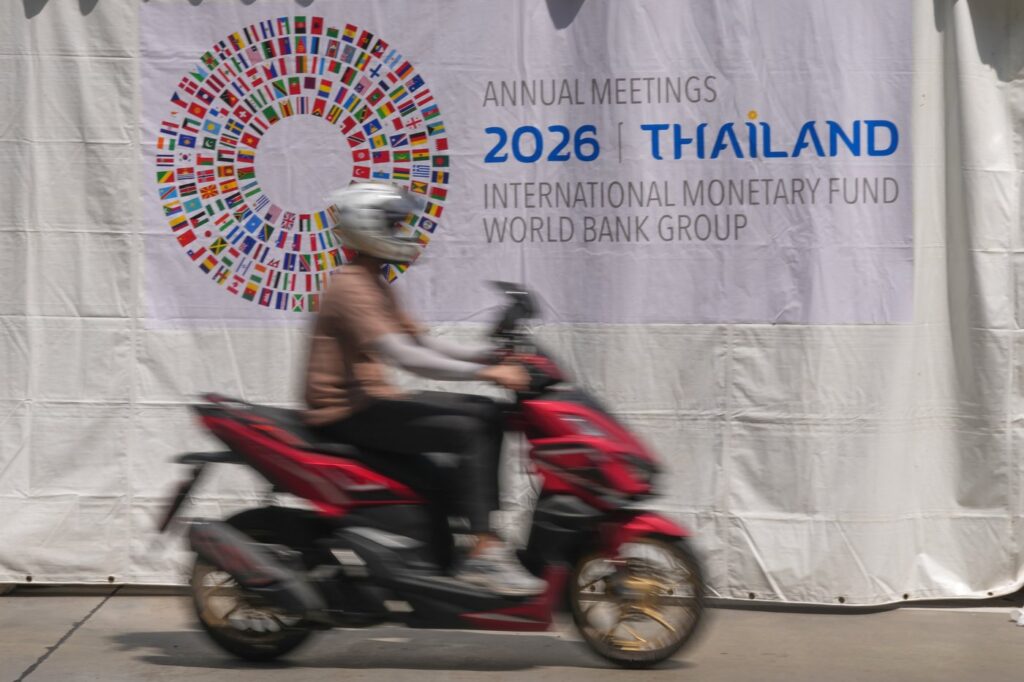
BANGKOK (AP) - The International Monetary Fund (IMF) has upgraded its global economic outlook for the year, projecting an increase in growth despite warnings about rising debts and the potential risks associated with artificial intelligence (AI) borrowing. The IMF now expects the global economy to grow by 3.1% in 2023, an upward adjustment from its previous forecast of 3.0%. However, this is below the anticipated 3.5% increase for the year 2025. The report indicates a rebound in growth to 3.4% by 2027.
This forecast comes as economic and financial leaders gather in Bangkok for the fall meetings of the IMF and the World Bank. In this context, growth in the United States is projected to remain stable at 2.3% for both 2026 and 2027. Collectively, advanced economies are expected to see growth of 2.1% this year, slightly up from 2.0% in 2025, but this figure is predicted to slow to 1.9% next year.
The IMF's forecasts are influenced significantly by a nearly 41% surge in oil prices this year, with the average expected to be around $96 per barrel. The organization anticipates global inflation to stand at 4.7% in 2026, decreasing to 4.1% in 2024. These projections are based on assumptions of resuming shipments of oil and gas through the Strait of Hormuz by March, alongside a moderation in the burgeoning demand for AI technologies.
According to IMF economists, while the boom in AI is providing some counterbalance to the adverse effects of rising oil and gas prices, it also carries inherent risks. The benefits derived from this AI demand are unevenly distributed; the United States and China together account for more than three-quarters of net imports for computer chips and AI-related equipment. Silvana Tenreyro, the IMF's director of research, has commented on the unevenness of economic growth, noting that just 32 countries are responsible for 95% of global growth, a stark contrast to the 54 countries recorded in April.
The IMF report highlights that the nature of global economic growth has shifted, with performance being reallocated among countries based on their resilience to the supply shocks brought on by the war and their exposure to growing AI demand. Athanasios Vamvakidis, deputy director at the IMF’s Monetary and Capital Markets Department, identified various risks, including potential corrections in AI-related stock markets, rising bond yields, and cyberthreats that could destabilize financial systems.
The implications of AI on employment are also a focal point of discussion in Bangkok. IMF Managing Director Kristalina Georgieva described the changes as "a slow-moving tsunami," projecting that the overall impact on jobs will amount to about 40%, with roles either augmented, downgraded, or eliminated. She noted that some of these effects are already noticeable in the labor market.
The issue of rising debt continues to concern both developed and developing nations. The IMF chief recently urged countries to enhance their national finances and manage the increasing levels of debt more effectively, especially amid high borrowing costs. Some countries that are less affected by energy disruptions and are benefiting from AI advancements are maintaining growth, whereas developing economies and emerging markets that are more susceptible to high oil and gas prices are forecasted to see a slowdown in growth from 4.5% to 3.7% this year. Recovery is expected next year, with an anticipated annual growth rate of 4.4%.
The situation remains precarious in the Middle East and Central Asia, where economies are expected to contract this year before recovering to a growth rate of 6.3% by 2027. Meanwhile, the 21 European countries that share the euro currency are projected to grow by 1.1% this year, slightly improving to 1.2% by 2027. China, regarded as the world's second-largest economy, is expected to experience a growth rate of 4.5% this year, down from 5% in 2025, aligning with its government’s targets. India is poised to maintain its status as the fastest-growing major economy, expected to grow at a rate of 7%, though down from last year’s impressive 7.7%.
The IMF operates as a 191-nation lending organization with an aim to promote economic growth, financial stability, and the reduction of global poverty. During the meetings in Bangkok, finance ministers and central bank governors are set to evaluate the current state of the world economy and deliberate on strategies to ensure financial stability and sustained economic growth.