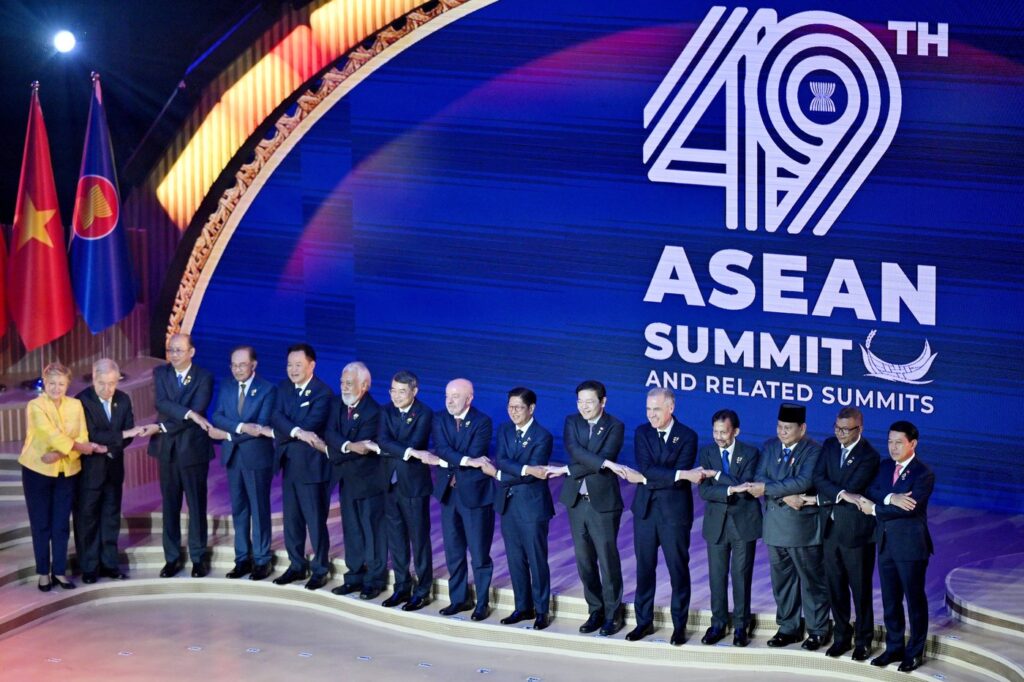
MANILA, Philippines (AP) – Southeast Asian leaders commenced their annual summit on Sunday in Manila, projected to last for three days. This gathering includes vital dialogues with world leaders, headlined by U.S. President Donald Trump, whose trip to Asia is deemed critical for improving his standing following the Republicans' losses in the recent midterm elections.
The discussions involving the leaders of the Association of Southeast Asian Nations (ASEAN) will extend to topics addressing significant global conflicts, particularly highlighted by the war in the Middle East. Drafts of post-summit communiques have indicated that this will be a central point of focus throughout the meetings, as observed by The Associated Press.
President Trump is scheduled to arrive in Manila on Tuesday afternoon, accompanied by Secretary of State Marco Rubio, following the conclusion of the main ASEAN summit meetings. Philippine President Ferdinand Marcos Jr. is expected to pass the rotating leadership of the regional bloc to Singapore during this transition.
ASEAN leaders are anticipated to reiterate their calls for self-restraint and peaceful resolutions concerning various unresolved conflicts, notably the protracted disputes in the South China Sea and the civil war in Myanmar. In their efforts, they aim to protect their economies and citizens from the repercussions of ongoing global conflicts.
The draft statement from the ASEAN leaders emphasizes their collective commitment to upholding international law, aligning with the principles outlined in the United Nations Charter. It underscores the importance of resolving disputes peacefully, safeguarding the freedom of navigation and overflight, as well as maintaining lawful uses of the sea, including rights of transit passage in international straits.
In his opening remarks, President Marcos highlighted the necessity for the diverse 11-nation bloc to stay united amidst various geopolitical challenges, economic uncertainties, advancements in technology, climate change, and transnational threats. He expressed concern that global issues are reshaping the ASEAN region more rapidly than any single country can adapt.
Despite these expressed pledges of unity, achieving cohesive action within ASEAN has proven challenging, given its composition of both democracies and authoritarian regimes, many of which lean toward either the United States or China. Historically, ASEAN has been more recognized for its public displays of unity rather than for effectively addressing pressing regional issues, including Myanmar's turmoil and tensions in the South China Sea.
President Trump is set to engage in three significant meetings on Tuesday, including one concerning the Quadrilateral Security Dialogue, which comprises the United States, Japan, Australia, and India. This grouping is primarily seen as a counterbalance to China's influence in the region. Trump will also participate in a special summit with ASEAN leaders, where discussions will occur over cocktails, as per Philippine official reports.
On Wednesday, Trump is expected to meet with Marcos, who will provide him with a red-carpet welcome and host a state luncheon at Manila's presidential palace. During this meeting, they are likely to reaffirm their longstanding treaty alliance before both leaders proceed to Shenzhen, China, for the Asia-Pacific Economic Cooperation (APEC) summit, which will be hosted by Chinese President Xi Jinping.
Analyst Greg Poling has stated that Trump's brief stop in Manila is intended to reassure regional allies and partners ahead of his talks with Xi in Shenzhen. However, the recent electoral defeat faced by Republicans is expected to resonate with Trump during his visit to Asia. Poling notes that the U.S. administration has been cautious in lowering expectations regarding the encounter with China, suggesting that substantial advancements in discussions between Trump and Xi are unlikely, especially considering Trump’s weakened political position following the midterm elections.
China's representation at the Manila summit includes Premier Li Qiang, who will interact with ASEAN leaders on Monday before departing, prior to Trump's arrival.