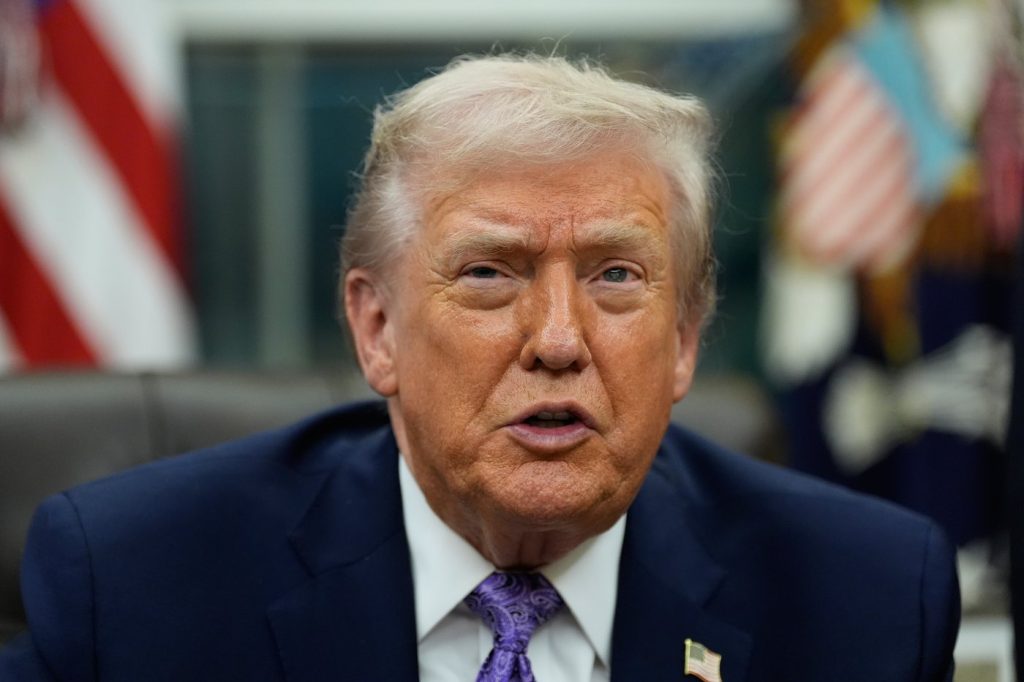
Republican lawmakers in Washington are alarmed by President Donald Trump's repeated threats to take possession of Greenland. This unexpected approach has seen some of the strongest opposition from within the party since Trump assumed office. In recent actions, Republican senators emphasized the importance of NATO by delivering speeches, introducing legislation to prevent U.S. military action against Denmark, and even traveling to Copenhagen to engage with Danish officials.
Despite these efforts, President Trump maintains his aggressive stance, reiterating his belief that the U.S. should control the Arctic island. His rhetoric has raised concerns about the future of NATO, which has been a cornerstone of American influence in Europe and worldwide. Senator Chris Coons, a Delaware Democrat, highlighted the seriousness of Trump's threats, stating that when the president of the most powerful military nation threatens another country's territory repeatedly, it deserves attention.
To mitigate the situation, Senator Coons organized a bipartisan trip to Denmark alongside Republican Senators Thom Tillis and Lisa Murkowski, aiming to calm tensions and discuss military agreements in the Arctic. The meetings in Washington with the Danish foreign minister and his Greenlandic counterpart centered on security cooperation. However, Trump's position remains unchanged, and he announced a planned 10% import tax on goods from eight European nations opposing his Greenland proposals.
Some Republican officials have distanced themselves from Trump's plans to forcefully acquire Greenland, highlighting that such a move would be detrimental to U.S. interests and alliances. Senator John Thune expressed a lack of appetite for the drastic measures discussed, while former Republican leader Mitch McConnell cautioned that occupying Greenland would severely damage trust with allies and adversely affect Trump's legacy.
Bipartisan discussions have shown a clearer path for enhancing U.S. interests in Greenland while preserving relations with Denmark. Danish Foreign Minister Lars Løkke Rasmussen, along with Greenlandic officials, discussed potential collaboration on critical mineral industries and military partnership, assuring U.S. lawmakers that there is no significant Chinese or Russian activity in Greenland.
Trump's justification for acquiring Greenland revolves around national security concerns, specifically the threat posed by China and Russia. However, several lawmakers, including Murkowski, argued that NATO allies are diverting their attention to Greenland, a situation that plays into the hands of foreign adversaries like Vladimir Putin.
To restrict potential military action, legislators are exploring options to ensure that any U.S. attack on Greenland would not occur without congressional approval. Proposals include legislation to prevent the Department of Defense from using funds to attack other NATO members without their consent. Furthermore, discussions on nullifying Trump's tariffs are ongoing, as previous attempts to halt tariffs met resistance in the House.
Democrats are also pushing for war powers resolutions requiring the president to seek congressional approval before engaging in hostilities. Despite some bipartisan support for these efforts, Republicans have recently rejected such resolutions aimed at preventing military action in Venezuela, indicating the complexity of the political landscape surrounding military engagements.
Other Republicans still back Trump's assertions about Greenland, albeit with assurances that forceful tactics will not be employed. With the strongest dissent coming from retiring lawmakers, the pushback against Trump's Greenland ambitions reflects a debate within the party on U.S. foreign policy and relations with NATO allies. Rep. Don Bacon from Nebraska remarked that an invasion could lead to impeachment, while Tillis directed criticism at White House advisers pushing for aggressive action.