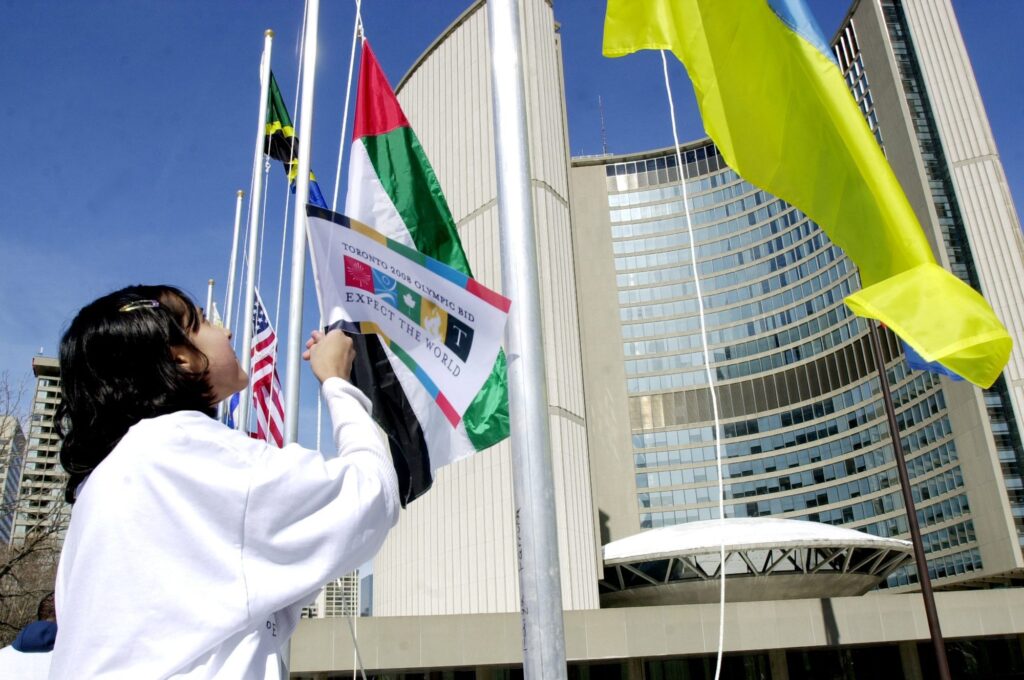
The city council has made a significant decision by voting to prohibit the ceremonial raising of foreign flags at City Hall and civic centres. In a notably divided vote of 19-7 on Thursday night, the motion, which was initially proposed by Councillor John Burnside, mandates the elimination of "flying flags of foreign nations, or any flags which include the depiction of a foreign nation’s flag," starting from December 1. Importantly, only flag raisings that have already been booked will be permitted to proceed.
The seven councillors who opposed the motion included Lily Cheng, Mike Colle, Ausma Malik, Nick Mantas, Jamaal Myers, James Pasternak, and Neethan Shan. These dissenters expressed strong concerns about the implications of such a ban. Councillor Mantas articulated his viewpoint during the debate, suggesting that the decision effectively penalizes 160 countries recognized in Toronto, advocating for public consultations before implementing such a sweeping change. Mantas emphasized the importance of inclusivity in the city’s representation.
Cheng echoed similar sentiments, reflecting on her own experiences and the significance that flag-raising holds for many citizens. She remarked, "I really struggle with this decision," underscoring the emotional weight of such gestures for communities who take pride in seeing their national flags displayed. Cheng’s comments highlight the complexities surrounding the issue, pointing out that difficulty should not deter the council from embracing diversity.
The push for the ban has its roots in the current geopolitical climate, which has resulted in rising tensions among certain diaspora groups. Several councillors argued that the proliferation of foreign flags could contribute to divisiveness and animosity within the community. The recent raising of flags representing countries like Angola, Morocco, and Palestine at Toronto’s City Hall, in conjunction with local events such as Louis Riel Day and the Trans Day of Remembrance, has fueled this debate. These events showcased a diverse tapestry of cultural acknowledgments within the city.
Councillor Burnside’s motion reflects a trend seen in other Canadian cities, notably Calgary, which narrowly passed a similar ban on foreign flags at its City Hall last year. This suggests a growing sentiment among some municipal leaders to prioritize domestic symbols over international representations in civic spaces.
Significantly, the ban is not all-encompassing; it does not extend to flags representing Indigenous and Treaty partners, the Intersex Pride flag, the Black Liberation flag, as well as flags from professional sports organizations and cities that are part of Toronto’s International Alliance program. This exclusion indicates a recognition of certain flags that carry distinct cultural and historical significance within Canadian society.
As the city prepares to implement this ban, the potential ramifications on communal relationships and image among diverse populations in Toronto remain to be seen. The discussion surrounding the ban reflects broader conversations about representation, inclusion, and the ways municipalities choose to celebrate their multicultural fabric amidst a complicated global backdrop.