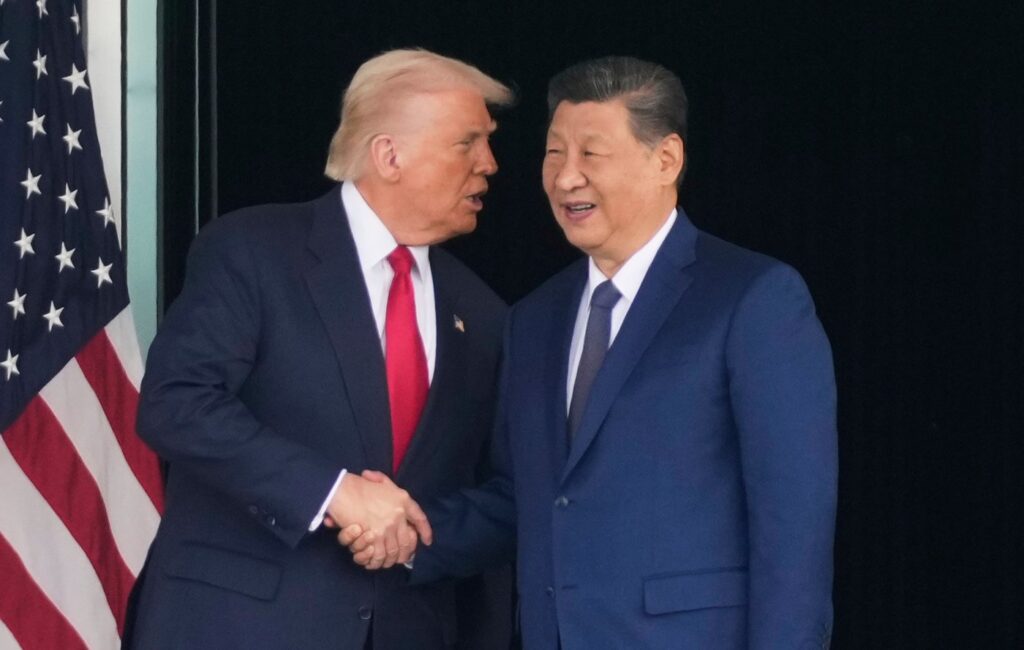
WASHINGTON (AP) — President Donald Trump emphasized the financial benefits of trade with China while downplaying ongoing tensions regarding rare earth minerals, tariffs, and advanced technologies like artificial intelligence. As he prepared to depart for a summit in Beijing with Chinese President Xi Jinping, expected to be the first of four meetings this year, Trump stated, “We’re doing a lot of business with China and making a lot of money; it’s different than it used to be.”
The summit aims to stabilize the economic relationship between the two nations, with limited policy announcements anticipated. A trade truce established in October is likely to be extended, alongside potential Chinese announcements to purchase American agricultural products like soybeans and beef, as well as Boeing airplanes. Experts suggest that maintaining stability and space for continuous engagement is critical for fostering domestic resilience and facilitating future negotiations.
Despite Trump's assertions of profitability, U.S. Census Bureau data revealed that China imported nearly $50 billion less from American products last year compared to 2022. This decline can be attributed in part to China's decision to halt soybean purchases during the previous year's trade conflict. The Trump administration aims to support American farmers and factories by encouraging increased Chinese imports from the U.S., targeting a trade imbalance that reached $202 billion last year.
Moreover, the U.S. has started to import more goods from Taiwan than from China, largely influenced by the AI competition, prompting American firms to source computer chips and servers from the self-governing island. During Trump's initial term, China began rerouting products intended for the U.S. through other Asian countries, while American companies also shifted supply chains for electronics to nations like Vietnam and India.
According to data analyzed by Chad Bown from the Peterson Institute for International Economics, China’s share of goods imported in the U.S. plummeted from 22% at the beginning of Trump's presidency in 2017 to just 7.5% in the first three months of the current year. U.S. Trade Representative Jamieson Greer in a recent call with Chinese Vice Premier He Lifeng underscored the importance of a proposed government-to-government Board of Trade, which could enhance trade in non-sensitive goods like agriculture while avoiding national security issues.
The initiative could assist in resolving trade disputes and American aspirations to boost exports to China. It aims to offer an alternative to imposing heavy tariffs, which have become a logistical challenge following a recent Supreme Court ruling that limited Trump's authority to unilaterally enforce many tariff measures.
As Trump embarks on this diplomatic journey, a delegation comprising 17 CEOs, including Tesla's Elon Musk, Apple’s Tim Cook, and Boeing's Kelly Ortberg, accompanies him to enhance economic engagements. However, underlying tensions signal potential disruptions to the discussions. The U.S. concerns about China’s dominance in rare earth minerals, its advanced technology capabilities, and its automotive industry pose significant friction points.
China has significant control over rare earth mining and processing, assets critical for electronics, while the U.S. aims to develop its own production capabilities through partnerships and investments over the coming years. The Trump administration's push to restrict China's access to advanced computer chips threatens to further inflame relations, especially as China’s automotive exports increased by 21% last year.
Additionally, the potential for new tariffs looms following the Supreme Court’s recent decisions against Trump’s previous tariffs, now prompting investigations to impose new tariffs aimed at addressing industrial excesses and combating forced labor allegations. The U.S. has also sanctioned a Chinese oil refinery related to Iranian oil transport, heightening tensions regarding compliance with U.S. penalties among Chinese businesses.
Experts note that the U.S. and China are navigating differing priorities, with Trump focusing on the trade imbalance while Xi Jinping appears to be adapting China's industrial strategy amid global shifts such as climate change. As they discuss economic engagement, the underlying frictions suggest that navigating their complex relationship may prove challenging.