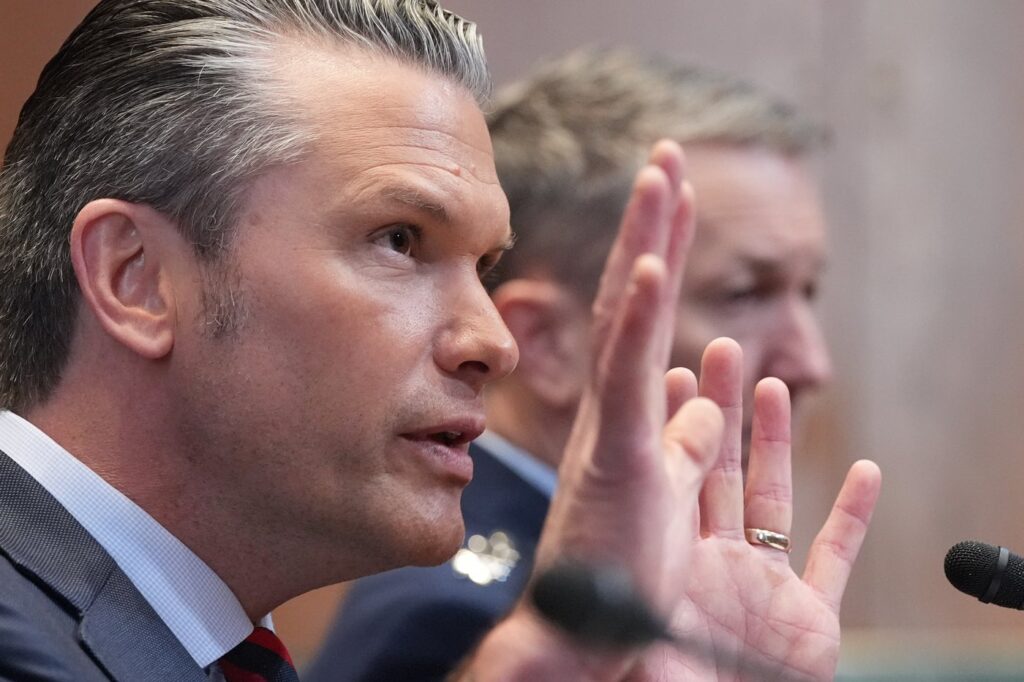
On Tuesday, Defense Secretary Pete Hegseth faced rigorous questioning from both Republican and Democratic lawmakers regarding the Trump administration's strategy in the ongoing conflict with Iran. The discussions highlighted the rising financial toll of the war, which has now reached approximately $29 billion, and the implications it has for U.S. weapons stockpiles.
During the hearing, Hegseth took a more measured approach compared to his previous testimonies, steering clear of direct criticisms aimed at Congress. However, he met substantial resistance from his own party members concerning U.S. munitions utilization in the Iran war and President Donald Trump’s sharp criticisms directed at traditional allies for their absence in the conflict.
Hegseth contested claims about depleted munitions, asserting, "I take issue with the characterization that munitions are depleted in a public forum. That’s not true." While maintaining that the U.S. military possesses ample stocks of missile defense systems and other ammunition for both the Iran war and potential future conflicts, he informed lawmakers that efforts to increase armament production were underway.
As the financial burden of the Iran war escalates, Pentagon officials confirmed to congressional members that most of the $29 billion spent thus far has been directed toward replacing munitions and repairing equipment, with a significant portion also allocated for operational costs linked to deployed forces. This updated figure represents an increase from earlier estimates, which did not account for the costs associated with repairing or rebuilding damaged military installations in the region.
The hearings revealed notable pushback from Republican lawmakers regarding the Trump administration's strategy, particularly concerning its impact on longstanding alliances. Kentucky Senator Mitch McConnell emphasized the historical significance of NATO, stating, "NATO is the most important military alliance in world history." He expressed concerns over perceptions that European countries could view the U.S. as diminishing its influence and leaving them to fend for themselves.
Trump has been vocally critical of NATO allies for their perceived lack of support in reinstating operations in the Strait of Hormuz, a critical global shipping lane, and has signaled intentions to withdraw thousands of troops from Germany in the near future. Oklahoma Representative Tom Cole reiterated the importance of coalition-building, asserting, "America First has never meant America alone," highlighting that U.S. power is most effective when exercised in coordination with other nations that share common interests and values.
The hearings, which lasted four hours and covered the Trump administration's military budget proposal, confronted the ongoing stalemate of the Iran conflict and the political ramifications of rising fuel prices on the Republican Party ahead of upcoming congressional elections. Questions arose about whether the military is adequately prepared for a high-end conflict, particularly regarding the depletion of weapons stockpiles, as noted by California Representative Ken Calvert and Minnesota Representative Betty McCollum.
Further pressing him on troop management strategies in the Middle East, McCollum inquired if there were contingency plans to reduce troop levels should Congress succeed in efforts to de-escalate the conflict. Hegseth stated that strategies for escalation and retrograde were in place, though he deferred detailing any specific future actions. He described lawmakers’ concerns over ammunition stocks as "unhelpfully overstated," insisting that the military has sufficient resources.
Hegseth attributed challenges in military production capacity to prior administrations as well as the ongoing support to Ukraine amid its conflict with Russia. Meanwhile, the Center for Strategic and International Studies issued warnings regarding U.S. munitions stockpiles, indicating that significant portions of prewar inventories had been expended, warning that replenishment needed for possible confrontations with China would require time.
The economic repercussions of the Iran conflict have become more pronounced as Iran continues to disrupt operations in the Strait of Hormuz, ultimately fueling surging gasoline prices across the United States. Republican Senator Susan Collins raised concerns about the administration's ability to manage the situation effectively, querying whether the closure of the strait was anticipated. She suggested there appeared to be a lack of cohesive planning in dealing with the evolving crisis.
Throughout the hearings, Democratic lawmakers challenged the administration on the financial implications of the conflict and pressed for transparency regarding spending on military endeavors. Senator Patty Murray criticized the use of taxpayer dollars for a war opposed by many, emphasizing that it burdens citizens with higher fuel prices without a clear understanding of the war's overall costs.
In response to questions addressing the long-term strategic outlook, Hegseth underscored the administration's commitment to confronting Iran's nuclear ambitions, stating that while the war incurs costs, the implications of inaction could be far more significant.
As discussions continued about military strategy and budget provisions, lawmakers appeared deeply concerned about a potential shift from tactical successes to a broader strategic failure in the Middle Eastern theater.