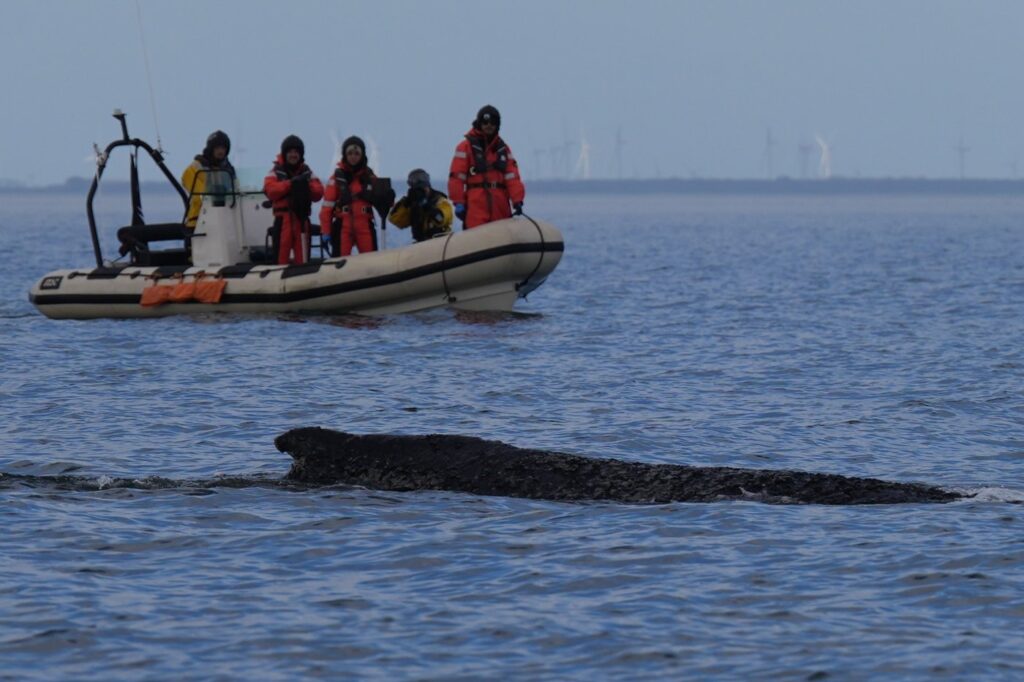
BERLIN (AP) – A humpback whale that was recently freed after being stuck for several days in shallow waters at a Baltic Sea resort in Germany has encountered further difficulties. The whale became stranded again on Saturday after failing to navigate its way back to the Atlantic Ocean, raising concerns about its survival.
The rescue efforts for the 12-15 meter (39-49 feet) whale off the sandbank at Timmendorfer Strand beach were complex and delicate. The situation captivated the German public, with media outlets broadcasting live updates and streaming footage of the rescue operations. As the story unfolded, it generated widespread interest and discussion across the nation, with people texting each other about the ongoing rescue attempts.
Efforts to assist the whale included deploying an excavator on Thursday to dig a man-made escape channel, after earlier methods failed. Rescuers utilized coast guard and fire department boats to create waves in an attempt to coax the animal back to deeper waters. Eventually, on Friday, the whale successfully swam through the escape channel. However, rescuers lost track of it until it was spotted on Saturday near Wismar, a coastal town in the state of Mecklenburg-Pomerania.
According to Greenpeace, the whale became stranded again in Wismar Bay, as confirmed by a spokesperson from the environment ministry of Mecklenburg-Pomerania. It was reported that the whale had managed to free itself earlier but was seen again at noon on Saturday in the same vicinity where it had last been sighted.
The reasons behind the whale's incursion into the Baltic Sea remain uncertain. Experts speculate that the whale may have inadvertently followed a shoal of herring, leading it into unfamiliar waters. There is also a theory that the whale is a male, which tend to migrate more extensively than females. Unfortunately, the humpback whale is not suited for long-term survival in the Baltic Sea due to several factors, including insufficient salt concentration in the water and a skin disease it has developed, as reported by local media. Additionally, the whale would struggle to find the proper nutrition necessary for its health.
To survive, the whale must return to the Atlantic Ocean, which is a journey of several hundred kilometers through German and Danish waters. The urgency of this situation raises the question of whether another rescue attempt will be made to facilitate its return to the deeper, saline waters that are essential for its survival.