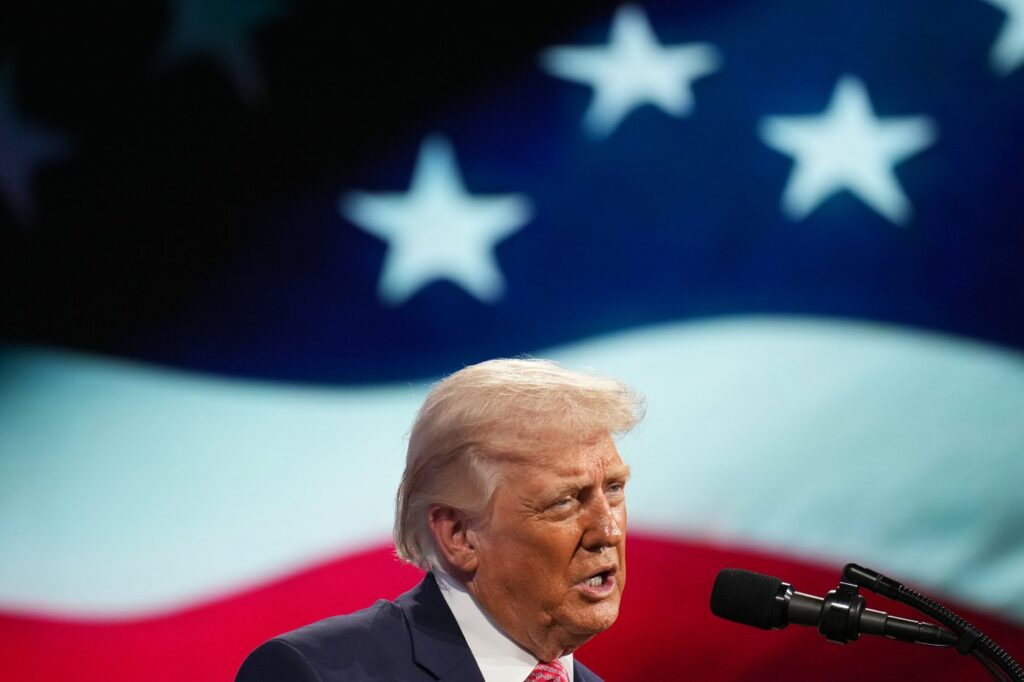
President Donald Trump claims that the United States is prevailing in the war with Iran, despite the recent deployment of thousands of additional American troops to the Middle East. Throughout his administration, Trump has criticized other nations for their lack of support, only to assert that he does not require their aid. He has also postponed deadlines for Iran to reopen the Strait of Hormuz on two occasions. His statements have ranged from threats to "obliterate" Iran's energy facilities if the strait remains closed, to claims that the U.S. is "not affected" by the closure.
This month, Trump suggested that a former Democratic president confided in him about wishing he had adopted a similar stance towards Iran. However, representatives for all living former presidents swiftly disputed this claim, indicating that such a conversation did not take place. As the conflict extends into its second month, Trump's habitual use of embellishment and exaggeration is being scrutinized in a context where the ramifications extend beyond mere political discourse.
Leon Panetta, a prominent political figure who has served under Democratic presidents, noted that historical precedent indicates that truth often suffers during wartime. He remarked that although not the first administration to obscure the realities of war, Trump's approach has become a distinctive hallmark of his tenure. Similarly, Michael Rubin, a historian from the American Enterprise Institute, pointed out that Trump deviates from the normative rhetorical constraints established by previous presidents, thus contributing to public confusion regarding U.S. actions in the region.
Critics argue that Trump's unpredictable communication style reflects a lack of coherent long-term strategy. Yet, for Trump, this unpredictable approach appears to serve a tactical purpose, keeping adversaries and observers perpetually off-balance. During a press session prior to announcing the second delay for Iran's deadline, Trump mentioned uncertainty regarding his next steps, humorously suggesting that even a single day feels like an eternity in his timeline.
Investor confidence, however, wanes amid the conflict, evidenced by a significant drop in U.S. stocks. Lawmakers express frustration at the administration's erratic messaging. Representative Gregory Meeks, the leading Democrat on the House Foreign Affairs Committee, criticized Trump for his contradictory statements, questioning the reliability of presidential messaging during the crisis. Republican sentiments reflect a mix of support for Trump, tempered by concern for domestic economic issues, particularly rising costs of living.
While Trump's support remains robust among Republicans, a recent poll reveals a potential backlash. Although a majority—63%—of Republicans endorse airstrikes against Iranian targets, only 20% support deploying ground troops. This disparity poses political challenges for Trump, particularly as he had previously promised to avoid extensive military involvement in the Middle East. If the conflict deepens, pressure could mount on Republicans as elections approach, with the risk of alienating voters who oppose prolonged warfare.
The Trump administration anticipates the need for congressional approval for an additional $200 billion to sustain military efforts, a significant sum that could prove politically contentious within a budgeting-conscious party during an election year. Trump’s spokesperson, Anna Kelly, emphasized the administration's commitment to highlighting the success of "Operation Epic Fury," which purportedly has severely impacted Iran's military capabilities.
Rubin suggested that there might be a strategic rationale behind Trump's fluctuating rhetoric, potentially aimed at instilling paranoia within Iranian leadership circles. However, this approach carries its risks, as it can easily be perceived as impulsive rather than strategic. Representative Adam Smith, the top Democrat on the House Armed Services Committee, expressed skepticism regarding the feasibility of Trump's objectives in Iran, particularly complete nuclear disarmament, given the current trajectory of the conflict.
Smith humorously speculated that Trump might ultimately rely on his characteristic exaggeration to declare victory, regardless of the war's true outcomes. This dynamic underscores the complex interplay of domestic politics, international strategy, and the challenges inherent in communicating military objectives to a wary public.