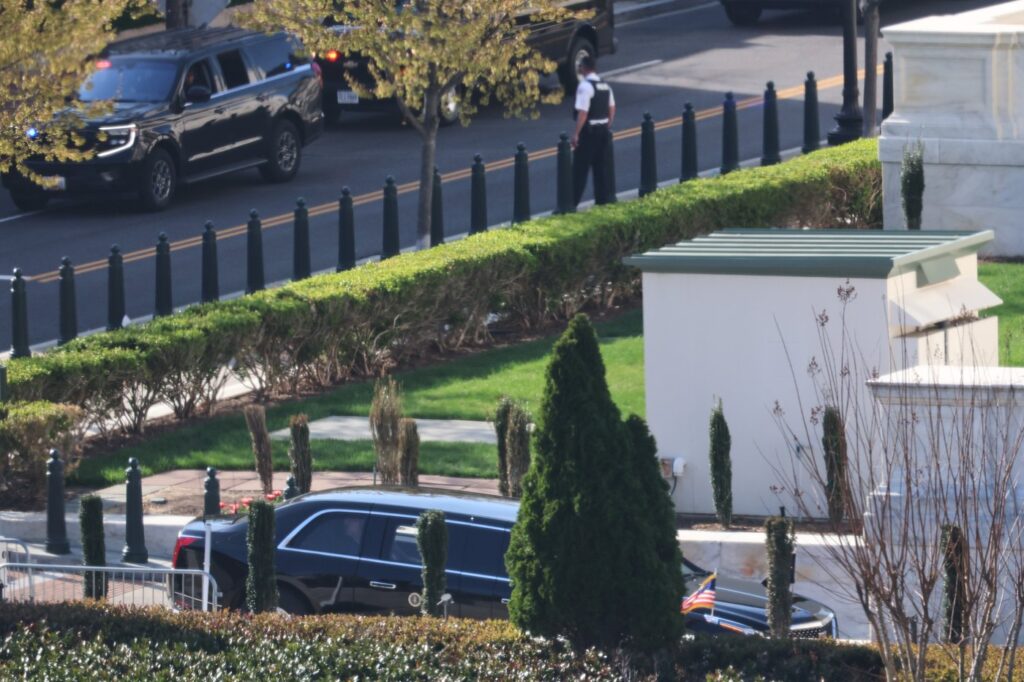
On Wednesday, the Supreme Court appeared ready to reject former President Donald Trump's proposed restrictions on birthright citizenship during a significant case enhanced by Trump's historic presence in the courtroom. This marked the first time a sitting president attended oral arguments at the nation's highest court.
During the proceedings, which lasted over two hours, both conservative and liberal justices raised concerns about the legality of Trump’s order, which asserts that children born in the United States to parents who are in the country illegally or temporarily would not be granted American citizenship. The hearing featured notable attendees including Attorney General Pam Bondi, Commerce Secretary Howard Lutnick, and actor Robert De Niro, as well as Trump himself.
Trump left the courtroom shortly after Solicitor General D. John Sauer presented the administration's case, departing as attorney Cecillia Wang began defending broad birthright citizenship. After the session, Trump expressed his views on Truth Social, criticizing the concept of birthright citizenship while inaccurately claiming the U.S. is the only nation that provides it, despite evidence to the contrary.
Chief Justice John Roberts and Justice Ketanji Brown Jackson raised pivotal questions regarding the practical implications and legality of Trump's order. Jackson inquired about the logistics of determining citizenship eligibility within a hospital setting, while Roberts suggested that Sauer's arguments relied heavily on atypical exceptions that did not support a broader conclusion on citizenship for children of noncitizens.
Justice Clarence Thomas emerged as the most supportive justice of Trump’s stance, questioning the relevance of immigration discussions in the historical context of the 14th Amendment, which was originally intended to ensure citizenship for Black individuals, particularly freed slaves. Concurrently, various lower courts have blocked the implementation of Trump’s citizenship restrictions, reinforcing the notion that the established view of American citizenship has strong roots in the Constitution and federal law.
The case serves as a critical test of Trump's executive power claims, which have often collided with established legal precedents. A ruling from the Supreme Court is anticipated by early summer. Trump's order, signed on the first day of his second term, is part of a wider immigration crackdown by his administration but represents the first Trump-related immigration policy to face a definitive ruling by the court.
Arguments presented by Sauer claimed that unrestricted citizenship could encourage illegal immigration and practices of “birth tourism,” wherein pregnant women travel to the U.S. to give birth. Justice Roberts remarked on the significance of a changing global landscape while affirming the continuity of constitutional principles.
Justice Neil Gorsuch exhibited skepticism toward the administration's position, speculating about the implications of the key 1898 Supreme Court ruling in Wong Kim Ark, which endorsed citizenship for a U.S.-born child of Chinese nationals. Justice Brett Kavanaugh implied that the court could resolve the case by confirming the Wong Kim Ark ruling without engaging in broader constitutional ambiguity.
The justices grappled with the term "domicile," frequently referenced in the Wong Kim Ark decision, which the Trump administration argues indicates that temporary or illegal residents would not be entitled to citizenship. Wang countered that the 1898 ruling did not hinge upon the domicile of the parents but addressed citizenship rights more broadly.
Research indicates that Trump's order could affect over a quarter of a million babies born in the U.S. annually, impacting not only children of undocumented immigrants but also those of individuals legally present, such as students or green card applicants. The evolving discourse around birthright citizenship continues to evoke intense debate, reflecting the ongoing tensions surrounding immigration policy in the United States.