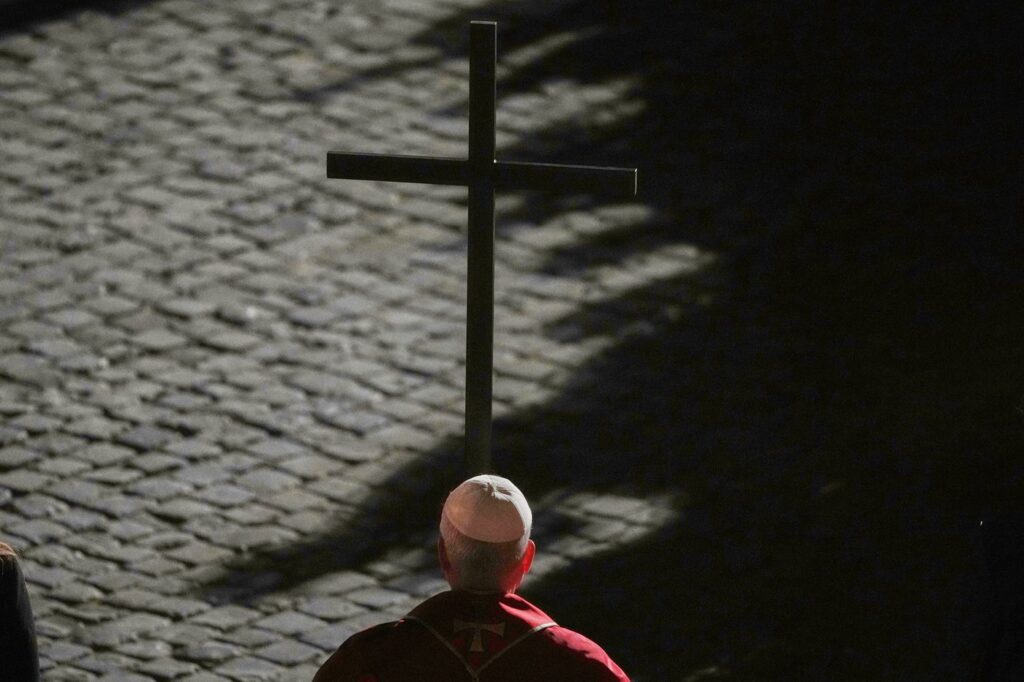
ROME (AP) — Pope Leo XIV carried a wooden cross for all 14 stations of the Way of the Cross at the Colosseum on his first Good Friday as pontiff, marking a significant return to tradition, as this is the first time in decades that a pope has taken on the role of carrying the cross for the entire procession. This event took place on April 3, 2026, during a solemn and symbolic ceremony that retraces Jesus Christ’s journey to his crucifixion.
Speaking to reporters outside the papal retreat at Castel Gandolfo, Leo expressed the importance of his role as a spiritual leader. He noted, "I carry all of this suffering in my prayer," emphasizing the significance of acknowledging that "Christ still suffers." Inside the Colosseum, accompanied by torchbearers, he lifted the cross and commenced the rite, which lasted over an hour, taking him through the excited crowd gathered outside, and culminating with a final blessing at Palatine Hill.
At the first station, which represents Jesus’s condemnation to death, a meditation prepared specifically for this occasion highlighted the moral obligations of authority figures, stating that they will ultimately have to answer to God for how they exercise their power. The meditation, authored by Rev. Francesco Patton, drew attention to pivotal issues such as "the power to judge; the power to start or end a war; the power to instill violence or peace." This underscores the contemplative nature of the Way of the Cross as it addresses real-world implications of faith and morality.
Approximately 30,000 faithful congregated outside the historic Colosseum, participating in the stations as they resonated through loudspeakers. Among them was Sister Pelenatita Kieoma Finau from Samoa, representing the Missionary Sisters of the Society of Mary. She shared her excitement, stating, "It is very meaningful to have the experience of being with the people of Rome on this special occasion," hinting at the deeply communal aspect of such a significant event.
In past observances, Pope John Paul II set a precedent by carrying the cross through the entire procession from his first Good Friday in 1979 until his hip surgery in 1995, after which he carried it only partway. His successors, Benedict XVI and Pope Francis, took different approaches; Benedict carried the cross for just the first station and then followed others, while Francis did not carry the cross at all as health concerns limited his participation until his passing after a prolonged illness last year.
Pope John Paul II was notably vigorous at the age of 58 when he became pope, while his successors were in their late 70s. A striking contrast to this physical vigor is Pope Leo XIV, who, at 70, is described as physically fit, being an enthusiastic tennis player and swimmer. Prior to his papacy, he maintained a rigorous exercise regimen, said to be more befitting of a man in his early 50s, showcasing his vitality and commitment to his role.
As Holy Week progresses, the Pope is scheduled to lead a late-night Easter Vigil on Holy Saturday, where he will baptize new Catholics and celebrate the peak of Christian joy, marking the resurrection of Christ. On Easter Sunday, he is expected to preside over an open-air Mass in St. Peter's Square, where he will convey his Easter message and offer the traditional "Urbi et Orbi" blessing to Rome and the world.
The Way of the Cross is a powerful commemoration of Jesus's final hours, drawing attention to the realities of suffering, faith, and dedication that resonate deeply in the hearts of believers. It emphasizes that true faith must be incarnated in practical and often challenging contexts, as articulated in Rev. Patton's introduction.