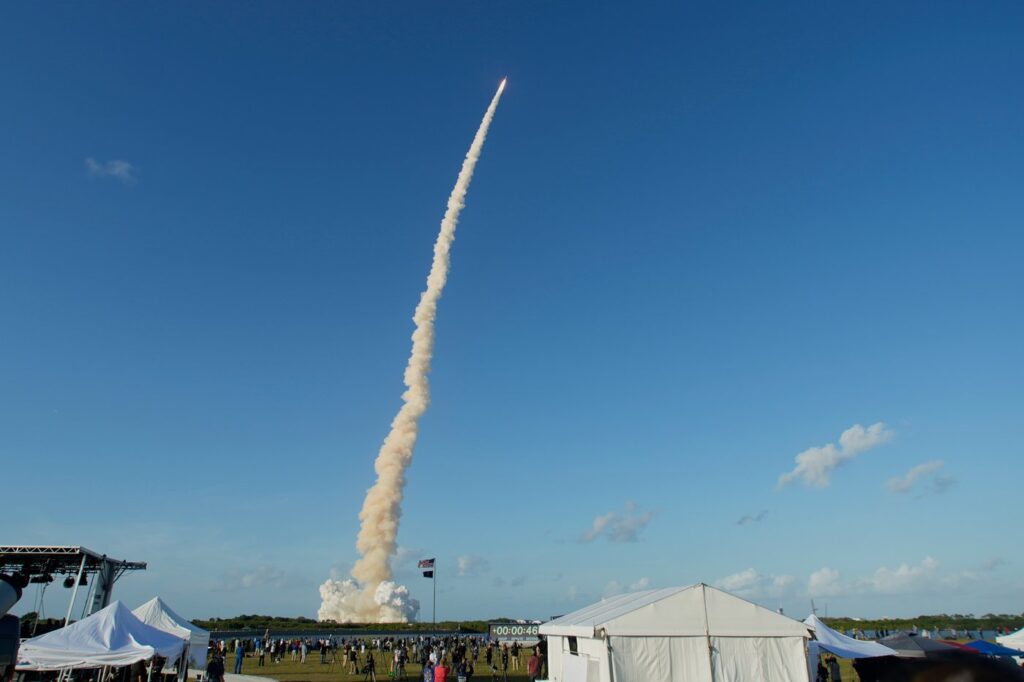
CAPE CANAVERAL, Fla. (AP) — NASA's moonbound astronaut crew aboard the Artemis II mission has much to celebrate, particularly following a successful launch. However, they also faced a critical challenge with the malfunction of their toilet right after reaching orbit on Wednesday evening.
The problem arose in the Orion capsule, where Mission Control had to guide astronaut Christina Koch through various plumbing techniques to restore functionality to the so-called lunar loo. After a series of troubleshooting steps, Koch successfully got the toilet working, allowing the astronauts to manage their waste aboard the spacecraft.
Despite this positive development regarding the toilet, the crew has been dealing with a chilly environment inside the capsule, with temperatures hovering around 65 degrees Fahrenheit (18 degrees Celsius). As a result, the four astronauts have started to rummage through their suitcases for warmer, long-sleeved clothing while Mission Control works on raising the temperature within the capsule.
The Artemis II crew, consisting of three Americans and one Canadian, is set to make history with their first translunar injection since the Apollo missions, leaving Earth's orbit on Thursday night to embark on a lunar fly-around. This particular mission marks a significant milestone as it is poised to reinvigorate NASA's entire Artemis program, with the aim of landing astronauts on the moon by 2028.
From their vantage point tens of thousands of miles high, the astronauts have taken a moment to appreciate the breathtaking views of Earth. Koch relayed her excitement to Mission Control, describing the view as “absolutely phenomenal” and mentioning that they could clearly see the coastlines of continents, including the South Pole, which holds personal significance for her given her previous year-long stint at an Antarctic research station.
The Artemis II mission is scheduled to conclude with a splashdown in the Pacific Ocean on April 10, and NASA is depending on this test flight to validate the Orion spacecraft's capabilities. They intend to address and refine any issues with the toilet design before future missions, as the current version is modeled after an experimental toilet that was previously sent to the International Space Station. That particular toilet has seen minimal use and has not been in operation for several years.
Known as the universal waste management system, the compact toilet in the Orion capsule utilizes air suction instead of relying on water and gravity, which is a strategy consistent with earlier designs for space toilets. Additionally, this toilet has been engineered to better accommodate the needs of female astronauts. Until the toilet was repaired, the crew had to resort to using a bag and funnel system for urination, which is far from ideal in the context of a space mission.
Former Apollo astronauts can attest to the crucial importance of an operational toilet in space travel. The earlier Apollo capsules lacked proper commode facilities, forcing all-male crews to rely on makeshift bags during their lunar missions. These Apollo bags were later repurposed for use in NASA’s shuttle flights, where they acted as backups in case the shuttle's toilet malfunctioned.
While the recent challenges faced by the Artemis II crew have been significant, the successful launch and the resolution of the toilet malfunction is a step forward as they pave the way for future explorations of the moon and beyond.