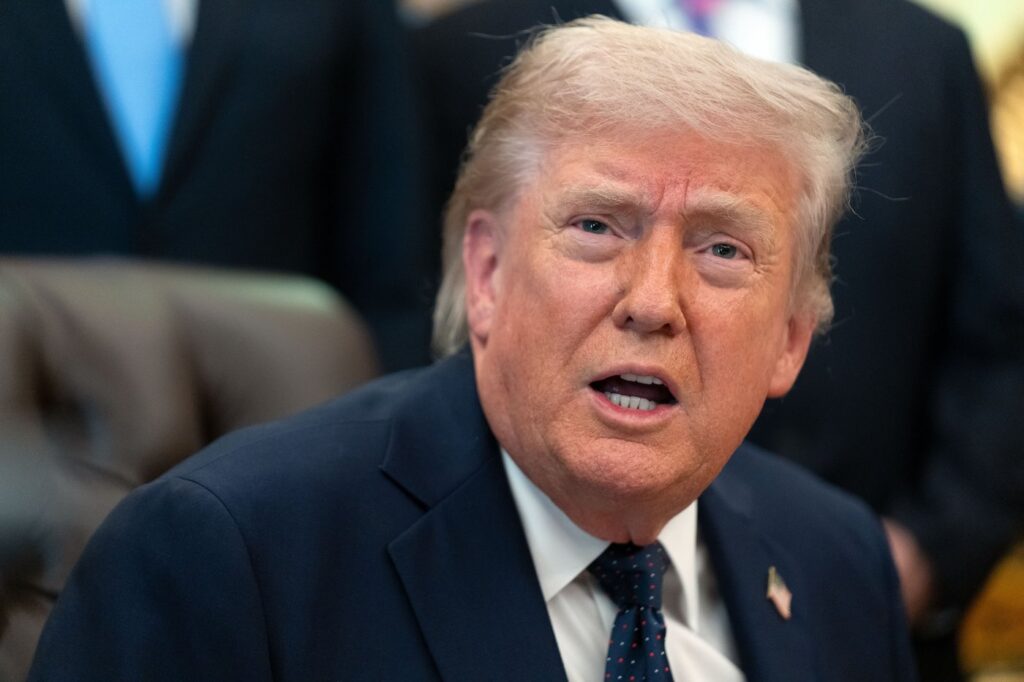
On Friday, an appeals court in Washington blocked President Donald Trump's executive order that aimed to suspend asylum access at the southern U.S. border. This ruling serves as a significant setback for Trump’s efforts to tighten immigration controls. A three-judge panel from the U.S. Court of Appeals for the District of Columbia Circuit determined that current immigration laws confer upon individuals the right to apply for asylum at the border, a right that the President cannot unilaterally revoke.
The legal opinion arises from actions taken by Trump on Inauguration Day, January 20, 2025, when he declared an “invasion” at the southern border, leading to his decision to suspend entry and asylum requests until he deems the situation resolved. The panel unanimously concluded that the Immigration and Nationality Act (INA) does not grant the President the authority to remove asylum seekers through processes of his own design or inhibit their legal right to seek asylum.
Judge J. Michelle Childs, nominated by President Joe Biden, emphasized in her opinion: “The power by proclamation to temporarily suspend the entry of specified foreign individuals into the United States does not contain implicit authority to override the INA’s mandatory process to summarily remove foreign individuals.” The court noted that Congress did not intend for the Executive to possess such expansive removal authority associated with suspending entry.
The White House maintained that the asylum ban fell within Trump's presidential powers. Press Secretary Karoline Leavitt commented on Fox News that the ruling was “unsurprising,” asserting a belief that the judges were politically motivated rather than serving as impartial interpreters of the law. Leavitt defended Trump’s actions as entirely within his authority as commander-in-chief, while another White House spokeswoman affirmed that the Department of Justice planned to seek a review of the decision, expressing confidence in eventual vindication.
The Department of Homeland Security (DHS) expressed strong disagreement with the court’s ruling and reiterated Trump’s commitment to the thorough vetting of all individuals seeking to enter the United States. In response to the ruling, immigration advocates welcomed the decision as a victory for the rights of asylum seekers, emphasizing the established legal expectation that individuals fleeing persecution should have the opportunity to present their claims.
Aaron Reichlin-Melnick, a senior fellow with the American Immigration Council, mentioned that, while prior legal actions had already suspended the asylum ban, the ruling underscores that the President cannot unilaterally prevent individuals from seeking asylum, a right mandated by Congress. Lee Gelernt, an ACLU attorney involved in the case, highlighted the significance of the ruling for those under the Trump administration's policies, which had denied many the chance to present their asylum claims.
While a Trump-nominated Judge, Justin Walker, provided a partial dissent, he agreed with the majority on significant points, including that while immigrants hold protections against removal, the administration cannot broadly deny asylum applications or eliminate essential procedures safeguarding against persecution. Judge Cornelia Pillard, nominated by President Barack Obama, also participated in the case.
In his executive order, Trump contended that the INA allows presidents to suspend the entry of groups deemed harmful to U.S. interests. This order was part of a broader effort that had significantly reduced asylum access during his administration, further compounded by restrictions under President Biden, even though some pathways for asylum seekers remained open.
The ruling brought cautious optimism for those assisting migrants in Mexico, such as psychologist Josue Martinez, who expressed hope that this development could improve conditions for individuals seeking asylum in the U.S. Many migrants, particularly from Haiti, Cuba, and Venezuela, currently face precarious living circumstances in Mexico due to a failing asylum system and limited resources.
In conclusion, the appeals court's decision represents a critical moment in the ongoing legal battles surrounding U.S. immigration policy and asylum rights, emphasizing the principle that the right to seek asylum is a protected aspect of U.S. law that cannot be easily overridden by executive action.