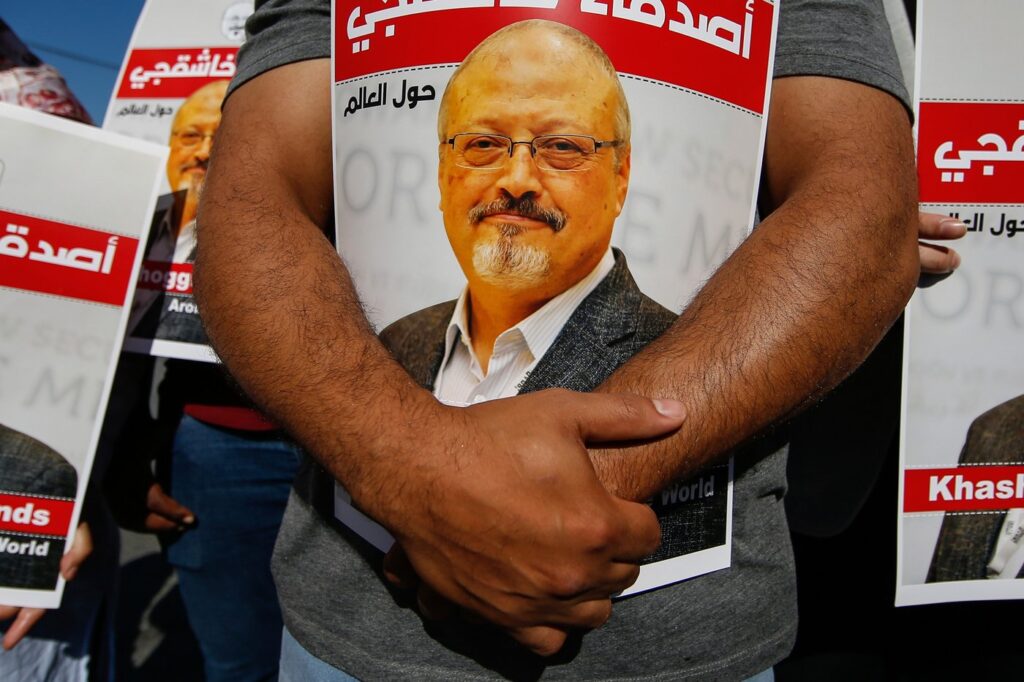
PARIS (AP) — A French investigating judge will review a complaint presented by two human rights organizations that accuse Saudi Crown Prince Mohammed bin Salman of complicity in the 2018 murder of journalist Jamal Khashoggi, announced the national anti-terrorism prosecutor's office, known as PNAT, on Saturday.
The case will be managed by an investigating judge from the crimes against humanity unit, following a ruling from the Paris Court of Appeal on May 11. The judge's role will be to examine the allegations and determine whether the complaint can proceed to further legal actions.
The complaint was lodged by Trial International and Reporters Without Borders, both of which assert that the crown prince is implicated in acts of torture and enforced disappearance in relation to Khashoggi's killing. Khashoggi, a vocal critic of the Saudi government and a columnist for the Washington Post, was murdered inside the Saudi Consulate in Istanbul on October 2, 2018. His body was dismembered, and to date, it has not been located.
The PNAT indicated that the Paris Court of Appeal deemed the complaints admissible because the possibility of classifying the case as a crime against humanity, including underlying crimes such as torture and enforced disappearance, could not be dismissed at this stage of the investigation.
While the prosecutor's office acknowledged the court's decision, it also noted that the ruling does not invalidate its own interpretation of French criminal procedure, which governs whether the organizations were entitled to file the complaint as civil parties in the case.
This French complaint was initially filed in 2022 during a visit by Prince Mohammed to France. Following the international outrage over Khashoggi's murder, the crown prince faced considerable diplomatic isolation. However, in recent years, he has been welcomed again by Western leaders, signalling a shift in international relations.
The initiation of a French judicial inquiry does not imply that Prince Mohammed has been formally charged or that French judges have determined his guilt. Instead, it means that an investigating judge will scrutinize the complaint to ascertain whether it warrants further proceedings.
While Prince Mohammed has consistently denied ordering Khashoggi's assassination, he acknowledged that the incident occurred under his oversight as the de facto ruler of Saudi Arabia. In contrast, U.S. intelligence agencies have concluded that he approved the operation that led to Khashoggi's murder.
Saudi Arabia conducted a closed-door trial regarding the killing and claimed to have punished those involved, but human rights organizations criticized the judicial process for being opaque and inadequate in addressing the severity of the crimes committed.
As this investigation unfolds, it highlights ongoing concerns over human rights and accountability regarding state actions, especially in high-profile cases that draw international scrutiny.