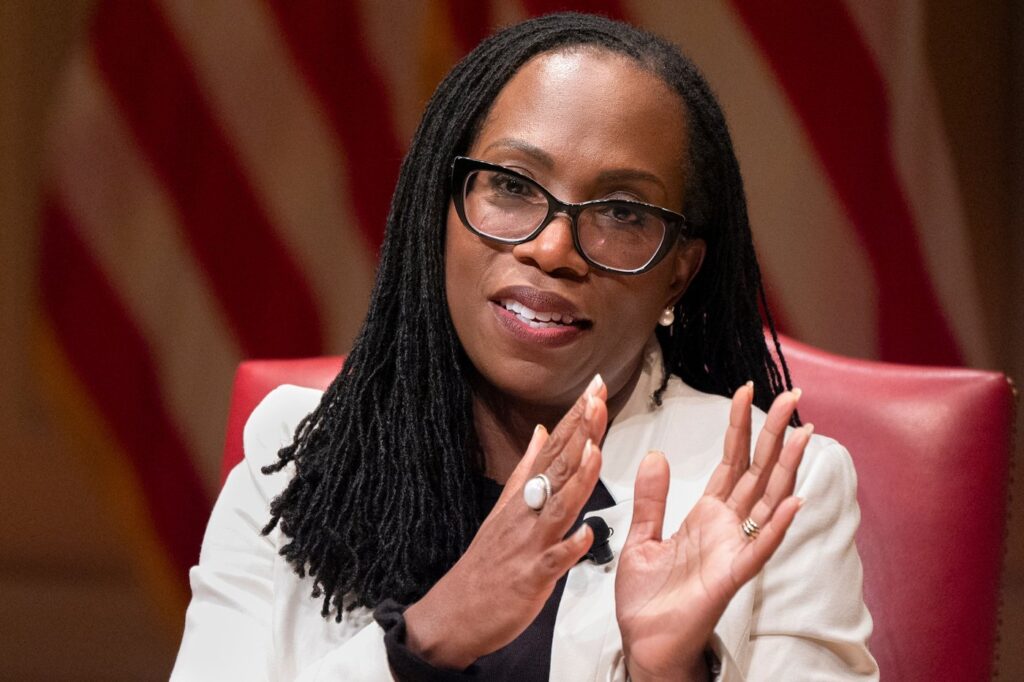
Justice Ketanji Brown Jackson expressed concerns regarding the increasing perception of the Supreme Court as a political body after a significant ruling on voting rights. This statement arose during her solo dissent against the Court's decision that permitted Louisiana to quickly implement new electoral maps following the striking down of a majority-Black congressional district, an action that she argued undermined the Voting Rights Act.
During a talk at the American Law Institute in Washington, D.C., Justice Jackson emphasized that the public's confidence is essential for the judiciary's credibility. She stated, "Public confidence is really all the judiciary has," highlighting the crucial role of maintaining the perception that the court is detached from political influence. Jackson insisted that it is imperative for justices to act in ways that bolster public trust in their decisions and the judicial system as a whole.
Recent polling has indicated that public trust in the Supreme Court has reached historical lows, with Chief Justice John Roberts also lamenting the prevailing view that justices function as "political actors," which he described as a misunderstanding of their role. Justice Jackson's comments resonate with concerns that the court's decisions could increasingly be viewed through a partisan lens.
Jackson has a track record of vocal dissenting opinions on the Supreme Court, particularly in cases relating to voting rights. Just last month, she joined her liberal colleagues in opposing a 6-3 decision that significantly weakened the Voting Rights Act. Additionally, she authored a dissenting opinion criticizing the Court's order that allowed Louisiana to proceed with new electoral maps despite the fact that early primary voting had already commenced. Jackson branded the Court's actions as having "spawned chaos" amid contentious redistricting disputes occurring nationwide.
In stark contrast, three of Jackson's conservative colleagues on the Court firmly rejected her criticisms. They labeled her accusations of partisanship as "baseless," asserting that the alternative to their decision would have been to enforce an election under a map deemed unconstitutional. This divergence illustrates the growing ideological rift within the Supreme Court, particularly on issues related to electoral policies and voting rights.
Justice Jackson's public remarks and the reactions they elicited underscore the delicate balance facing the Supreme Court. As the judiciary navigates complex political landscapes and contentious societal issues, the necessity of maintaining public trust and the perception of impartiality remains paramount. The ongoing discourse surrounding the Court's legitimacy and actions continues to play a critical role in shaping public opinion and the judicial landscape in the United States.