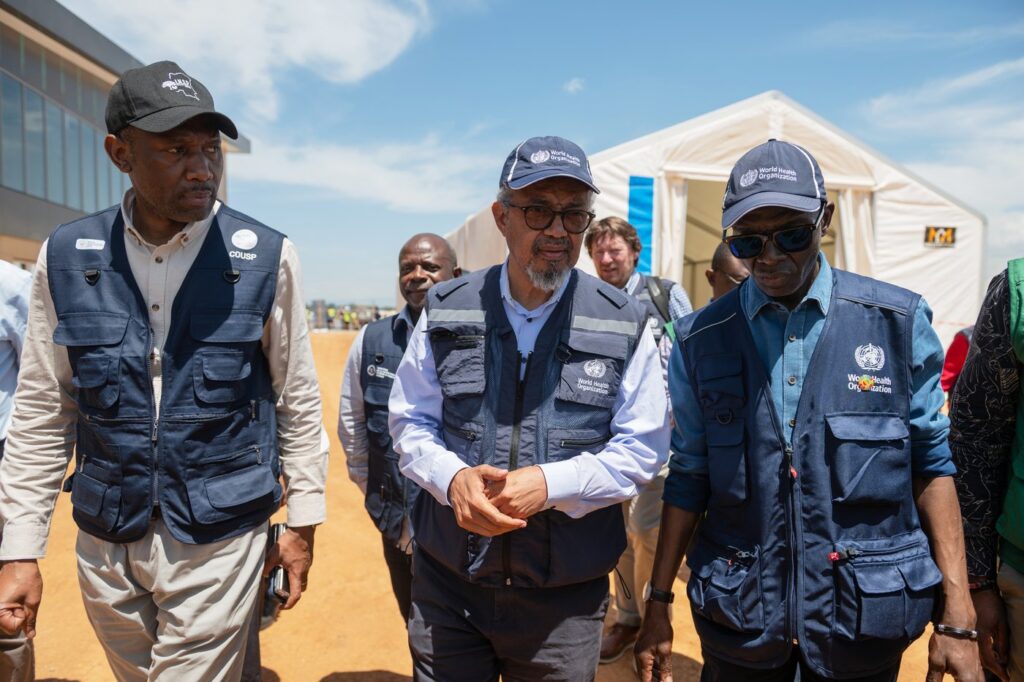
BUNIA, Congo (AP) — On Saturday, the Director-General of the World Health Organization (WHO), Tedros Adhanom Ghebreyesus, visited Bunia, a city in eastern Congo currently experiencing an outbreak of a rare type of Ebola. The virus is spreading rapidly, surpassing the capabilities of the ongoing response despite improvements in health infrastructure and an influx of aid. Tedros highlighted the critical need for building community trust, implementing safe burial practices to mitigate the outbreak's transmission, and urged nations to rethink travel bans and border closures, which he believes undermine transparency.
"The Democratic Republic of Congo has faced Ebola outbreaks 16 times previously and has successfully contained each one. This is the 17th. That history gives me real confidence," Tedros remarked at a press conference held alongside Congo's health minister. Official figures released by the health organization indicated that there are 906 suspected cases and 223 suspected deaths. The neighboring country, Uganda, has reported nine confirmed cases and one death.
The current outbreak is linked to the Bundibugyo virus, a type of Ebola for which there are no approved treatments or vaccines available. In response, the European Union delivered medical aid to Bunia on Thursday, with further shipments anticipated in the upcoming days. On the same day, the U.S. announced an additional $80 million in aid, raising its total commitment to over $112 million.
Efforts to address the outbreak at Rwampara and General hospitals in Bunia show signs of improved organization, now with increased staff, protective gear, and medical supplies. Despite these enhancements, the number of patients arriving continues unabated, according to an Associated Press reporter. However, Doctors Without Borders (MSF) expressed concern over the pace of the response, noting that this outbreak is among the fastest-spreading since its declaration.
"Never before has an Ebola outbreak recorded so many cases so soon after its initiation," cautioned Dr. Alan Gonzalez, MSF’s deputy director of operations. He emphasized the urgency for a swift expansion of testing, faster deployment of aid workers, and unhindered access to medical supplies.
The health workers involved in the response face heightened risks due to community anger towards the strict protocols for handling victims' bodies, which conflict with local burial customs. These tensions have led to at least three attacks on health facilities. Tedros acknowledged these challenges, stating, "We are not here to tell people what to do, we are here to listen." He underscored the importance of trust-building efforts, noting that such processes take time and begin with community engagement.
He further explained, "I understand the grief of losing a loved one and the significance of honoring their memory; however, specific practices, including touching the corpses of those deceased from Ebola, can facilitate further virus transmission." The response has also been compromised by violence in Ituri, perpetrated by the Allied Democratic Forces, a rebel group affiliated with the Islamic State, along with various ethnic militias. This outbreak is also reported in North Kivu and South Kivu provinces, where influence by the Rwanda-backed M23 rebel group hinders efforts.
As a precaution, both Uganda and Rwanda have closed their borders, while the Trump administration recently instituted a ban restricting entry for non-U.S. passport holders who have visited Congo, Uganda, or South Sudan. Tedros appealed to countries that have enacted travel bans or border closures to reconsider, arguing that these measures "discourage the transparency that saves lives."