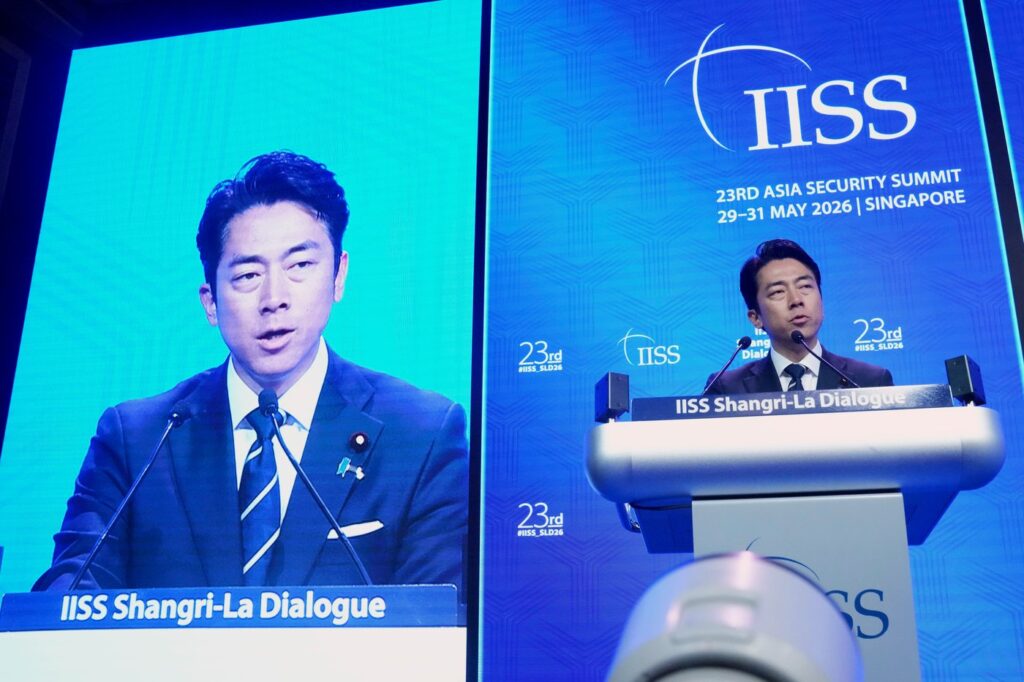
SINGAPORE (AP) - At the Shangri-La Dialogue defense conference on Sunday, American allies highlighted the importance of unity in the face of evolving global threats, stressing that enhanced cooperation among nations is critical despite growing criticisms from the U.S. toward its traditional allies. U.S. Defense Secretary Pete Hegseth had previously admonished Western European allies for their inadequate defense spending, reflecting concerns voiced by President Donald Trump regarding NATO's efficacy and commitment.
Japanese Defense Minister Shinjiro Koizumi endorsed Hegseth's dedication to the Indo-Pacific strategy while emphasizing the necessity for strong international coalitions. He argued, “Division weakens deterrence, unity strengthens deterrence,” asserting that any gaps among the U.S., Europe, and allied nations could prompt adversaries to exploit the situation. Koizumi urged for greater cooperation and called for an escalation in joint efforts to ensure regional stability.
Amidst increasing military advancements in China, Japan is modifying its defense posture. In a significant shift from its postwar pacifist stance, Prime Minister Sanae Takaichi’s administration recently abolished a ban on lethal weapon exports. This decision was met with criticism from China, which accused Japan of pursuing a path toward militarism. Koizumi responded to these accusations by underscoring the irony of a nuclear-armed China labeling Japan, which possesses no such weapons, as militaristic. He expressed discontent that China did not send its defense minister to participate in the conference, highlighting the need for dialogue and transparency.
This year’s conference occurred shortly after a visit by President Trump to Beijing, during which Hegseth noted that the two leaders agreed to construct a relationship aimed at strategic stability. This softer approach towards China drew mixed reactions. Philippine Defense Minister Gilberto Teodoro Jr. remarked that while the U.S. might engage China from a position of strength, the Philippines cannot afford to adopt a similar diplomatic tone without substantive changes in Chinese conduct, stating, “If China doesn’t change its behavior, my tone won’t change.”
Hegseth also commended various Asian nations for increasing their defense budgets in response to regional threats but criticized European allies for being preoccupied with “empty globalist rhetoric” concerning the rules-based international order. He asserted that without military strength backing these rules, their legitimacy is diminished, reinforcing long-standing frustrations with NATO countries that have historically failed to meet their defense spending commitments. The situation shifted following Russia's invasion of Ukraine, prompting many NATO countries to boost their military expenditures drastically.
On the sidelines, Australian Defense Minister Richard Marles resonated with Hegseth's perspective, stressing that while a rules-based order is essential, it must be supported by military power. Marles emphasized that alliances are crucial for regional defense, framing the challenge as a collective issue requiring a unified response, aligning with the principles of the rules-based order.
Dilan Yesilgöz-Zegerius, the Defense Minister of the Netherlands, highlighted the global implications of recent conflicts, stating that issues originating in one region spill over and affect worldwide security. She warned that if middle powers do not collaborate, they risk becoming sidelined. She underscored the importance of defending international rules consistently and courageously, arguing that although imperfect, international law is a critical foundation for global stability.