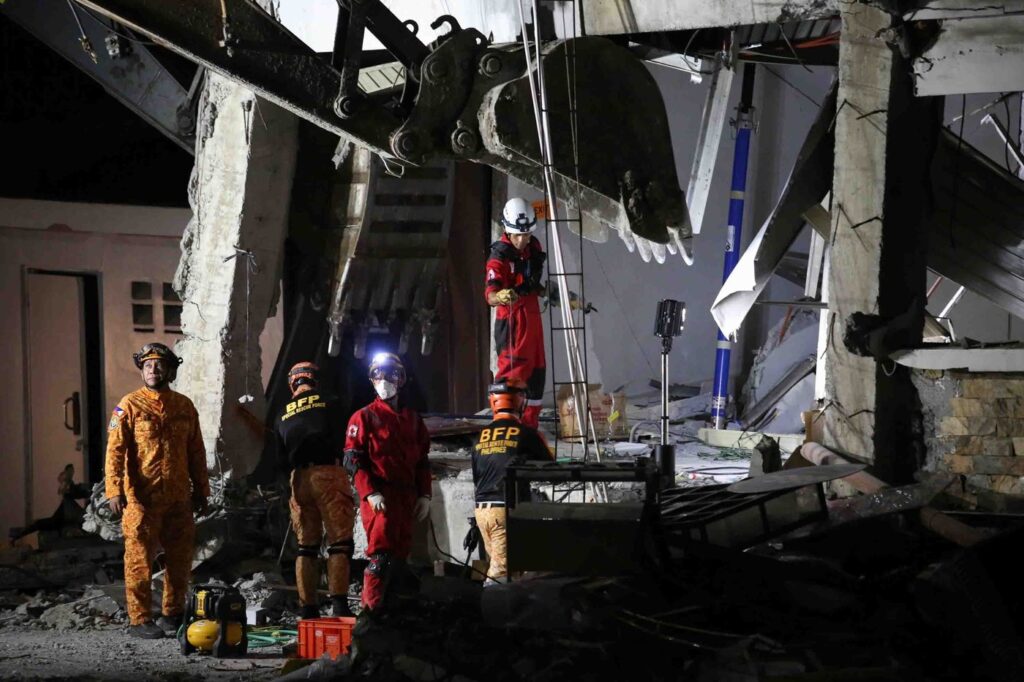
GENERAL SANTOS, Philippines (AP) — On Tuesday, rescuers scoured the wreckage of buildings in southern Philippines to confirm that no one remained trapped, following one of the country’s strongest earthquakes in the past 50 years. The 7.8 magnitude quake, which struck early Monday morning, resulted in at least 37 fatalities and displaced over 32,000 individuals.
According to official records, only four people are currently missing. However, the Office of Civil Defense has acknowledged the need for thorough inspections of various collapsed and severely damaged structures to search for potential survivors or additional casualties. The earthquake's epicenter was located off of Mindanao, the second most populous island in the Philippines. It injured nearly 500 individuals, causing many to seek shelter in emergency accommodations.
In the wake of the disaster, fears of a tsunami prompted many residents to evacuate their homes. Waves measuring up to 1.4 meters (4.6 feet) were recorded, but the only tsunami-related damage occurred in a coastal village, where six shanties on stilts were impacted. Less severe waves also washed ashore in Indonesia, Palau, and as far as southern Japan.
The destruction left in the earthquake's path has been devastating, particularly in General Santos, a bustling coastal city with a population exceeding 700,000. Here, at least 13 casualties were reported due to building collapses and falling debris. In the nearby Sarangani province, at least 18 individuals lost their lives, primarily due to a landslide that buried homes in the mountainous town of Glan. Further fatalities were recorded in South Cotabato, Davao Occidental, and on Balut Island, according to disaster response officials.
An initial damage assessment indicated that approximately 2,500 houses along with 117 government buildings and facilities suffered damage across several provinces. The international airport in General Santos remained closed for a second consecutive day, resulting in the cancellation of 63 domestic flights, with exceptions made for humanitarian missions. Before resuming classes, around 6,000 school buildings in the affected provinces must undergo safety assessments, especially as the earthquake coincided with the first day of classes after a two-month summer break. Many of the injured were young students, who had eagerly gathered for morning flag-raising ceremonies.
Authorities have cautioned that buildings showing signs of cracks could collapse during aftershocks, some of which may exert dangerous levels of force. Rafaelito Alejandro of the Office of Civil Defense emphasized that reopening schools prematurely is not an option, as ensuring the structural integrity of the buildings is essential.
The earthquake, which was centered approximately 32 kilometers (20 miles) southwest of Maasim town in Sarangani province and occurred at a depth of 33 kilometers (20 miles), is the strongest to hit the Philippines since an 8.1 magnitude quake triggered tsunami waves on August 17, 1976. Teresito Bacolcol, director of the Philippine Institute of Volcanology and Seismology, stated that approximately 8,000 individuals died as a result of that quake and the ensuing tsunami, which produced waves of up to 8 to 10 meters (26 to 33 feet) that engulfed numerous towns and provinces.
The Philippine seismological institute had plans to mark the anniversary of the 1976 quake and tsunami in August, stressing the importance of maintaining constant vigilance against such disasters. A similar earthquake in 1990, which also measured 7.8 in magnitude, resulted in more than 1,000 deaths and widespread destruction in northern provinces and cities.
In response to the recent disaster, President Ferdinand Marcos Jr. has mobilized top defense and mitigation officials from Manila to oversee search and rescue operations, the distribution of tens of thousands of food packs, and the assessment of damage to infrastructure like bridges and roads. The United States, as a treaty ally of the Philippines, has stated its readiness to support the Philippine response efforts, with France, Japan, and New Zealand also expressing their willingness to assist.
The Philippines, situated on the Pacific "Ring of Fire," is frequently affected by earthquakes and volcanic eruptions, making it one of the most disaster-prone nations globally. The archipelago also faces the threat of approximately 20 typhoons and tropical storms each year.