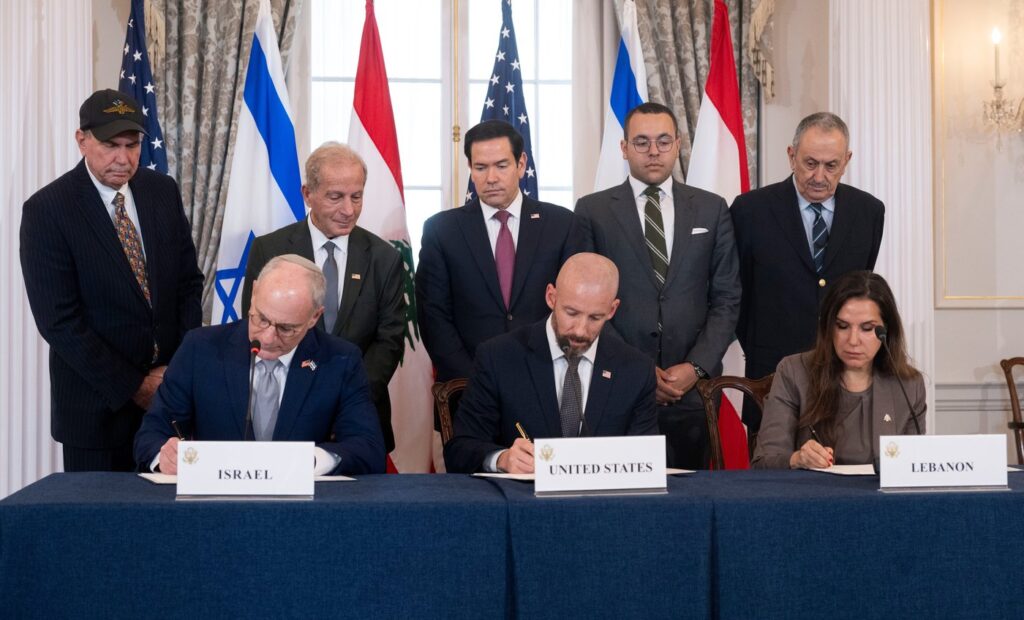
WASHINGTON (AP) Secretary of State Marco Rubio joined the ambassadors of Israel and Lebanon to the United States on Friday to announce a framework agreement. This agreement is presented as a preliminary step towards peace following months of hostilities between Israel and the Lebanese militant group Hezbollah. The framework, however, does not include Hezbollah in its discussions, which has led a group official to issue a warning about the potential for civil conflict within Lebanon.
The U.S. State Department indicated that the framework establishes a process for the disarmament of Hezbollah, allowing Lebanon to reclaim territories that were occupied by Israeli forces during the conflict. In support of this initiative, the U.S. will facilitate a newly established "Military Coordination Group for Lebanon" to help implement the framework and will provide $100 million in humanitarian assistance.
The State Department emphasized that this framework represents a "genuine pathway" out of a prolonged crisis for Lebanon, while it offers Israel a "verifiable path" to eliminate the ongoing threat posed by Hezbollah on its northern frontier. The agreement was formally signed in Washington by Israel's Ambassador to the U.S., Yechiel Leiter, and Lebanon's Ambassador, Nada Hamadeh Moawad, in the presence of Secretary Rubio.
Leiter articulated a vision of future relations, stating, "Our language is we want to embrace Lebanon." He expressed a desire for peaceful coexistence, where it would be commonplace for people to travel between Tel Aviv and Beirut. The realization of such aspirations, however, hinges on the disarmament and dismantlement of Hezbollah, which would permit Israel to withdraw and enable Lebanon to reclaim its sovereignty.
Moawad described the framework as an initial step toward regaining full Lebanese sovereignty and territorial integrity. He stressed the importance of ensuring a permanent cessation of hostilities, enabling the population to return to their lands and live in security and prosperity.
In contrast, an official from Hezbollah asserted that the group would not relinquish its weapons. The latest conflict erupted when Hezbollah launched rockets into Israel shortly after a U.S.-Israel offensive against Iran began on February 28. Since then, more than 4,000 people in Lebanon have died from Israeli airstrikes, while at least 37 Israeli soldiers have been killed in the fighting.
Lebanese officials have prioritized securing an Israeli withdrawal from southern Lebanon during negotiations, while Israel's focus has been the disarmament of Hezbollah, which is backed by Iran. Notably, the talks between Israel and Lebanon were separate from negotiations between the U.S. and Iran, which were intended to address key issues, including Iran's nuclear program.
Hezbollah remains opposed to any disarmament plan beyond its commitments in the areas south of the Litani River. Hassan Fadlallah, a member of Hezbollah's parliamentary bloc, reiterated on Al-Mayadeen TV that the group rejects Lebanon's direct negotiations with Israel, asserting that compliance would lead the Lebanese authorities towards civil conflict.
Lebanese Prime Minister Nawaf Salam stated that the agreement aims to facilitate an Israeli withdrawal from all Lebanese territory, restoring state sovereignty. The proposal under consideration includes "pilot zones" where the Lebanese army would take control as Israeli troops withdraw, pending Israeli approval.
Israeli officials confirmed that negotiations would also address the redeployment of Israeli forces after Hezbollah is neutralized. Prime Minister Benjamin Netanyahu characterized the framework as a significant accomplishment for Israel, reiterating the necessity of maintaining a security presence in southern Lebanon until the threat from Hezbollah is fully mitigated. Additionally, he announced plans to establish two pilot zones to aid the Lebanese army's preparation for territorial control.