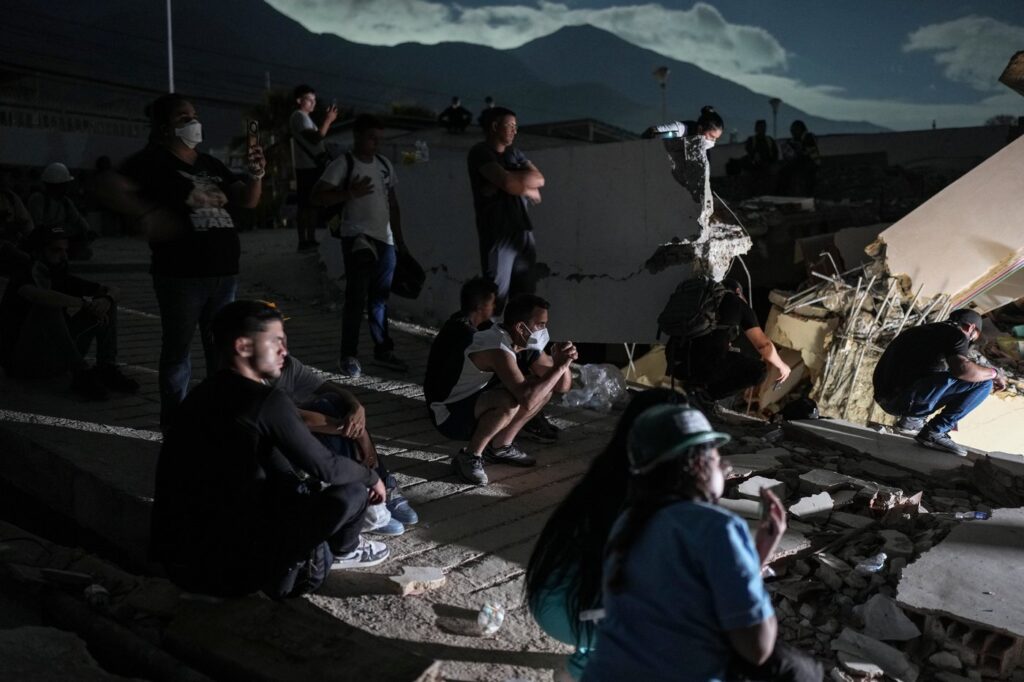
LA GUAIRA, Venezuela (AP) – As the search for survivors following last week’s devastating back-to-back earthquakes continues, Venezuelans are urgently sifting through the debris of collapsed buildings. With the critical time frame for finding survivors rapidly diminishing, the focus is shifting towards the national humanitarian crisis that is expected to linger for years.
Relief organizations highlight the importance of the first 72 hours post-disaster for potential rescues, although they acknowledge that survival can extend beyond this period with access to essential resources such as food and water. Five days after the earthquakes, concerns mount over the cash-starved Venezuelan government’s capacity to manage the care for thousands left homeless.
Adding to the distress, a 4.6 magnitude aftershock was reported in the northern state of La Guaira, complicating rescue efforts. The official death toll has surpassed 1,700, as reported by the government, which maintains stringent control over media coverage.
In response to criticism regarding the pace of relief efforts, government officials showcased their recovery strategies. On Monday, police and military personnel distributed canned tuna and crackers to those displaced in La Guaira. Jorge Rodríguez, the head of the Venezuelan National Assembly and a prominent government figure, announced that 90% of the power supply had been restored in the heavily affected region and mentioned the establishment of 15 temporary shelters for the displaced.
Venezuelan media have largely avoided discussing politically sensitive issues such as the widespread building collapses, opting instead to report uplifting stories of rescues. Delcy Rodríguez, sister of acting President Nicolás Maduro, shared a video of rescue efforts that garnered applause after a lengthy search. “Each life saved is a victory for hope,” she commented on social media.
Despite these efforts, many families remain in anguish, keeping vigil at search sites for their loved ones. Ana Rada, awaiting news about her brother, stated, “We have to stay strong, even without food, without sleep. Until I see the body, I still have hope.”
Over 600 aftershocks have been reported since the initial quake, and residents of Caracas experienced further panic when the 4.6 magnitude aftershock struck. Concepción Hernández fled her apartment, expressing concern for the unpredictability of future shocks.
The U.S. has responded by deploying 300 first responders and has been providing military transport planes to deliver essential supplies. Financial assistance from the U.S. has reportedly exceeded $300 million. Despite these efforts, there is skepticism regarding the Trump administration’s willingness to offer temporary humanitarian protections to displaced Venezuelans, considering its recent actions towards Venezuelan immigration policies.
Among the volunteers helping in rescue operations was Jean Sosa, a 31-year-old miner who was deported from the U.S. earlier this year. Sosa has been using his mining tools to rescue people from the rubble, lamenting the lack of official resources and equipment. He emphasized that many lives could have been saved with better coordination and support.
The full extent of the destruction from the earthquakes is still being analyzed. Experts believe that official government damage estimates fall significantly short of reality. While the Venezuelan government announced that 15,866 individuals were affected, U.N. estimates suggest up to 6.8 million residents may be influenced by the disaster, either through displacement or loss of essential services like electricity and water.
Reports indicate that the government claims of damaged buildings count at 855 are vastly underestimated, with external assessments suggesting as many as 58,870 structures have been impacted. The discrepancies have fueled public skepticism towards the government’s trustworthiness.
The Venezuelan press union has reported that access for foreign journalists to La Guaira has been restricted, citing a need to minimize disturbances during rescue operations, which poses a barrier to obtaining accurate crisis information.
Meanwhile, the chaos following the earthquakes has led many to turn to unofficial digital platforms to report missing persons, with over 50,000 individuals logged as missing. Firefighter Kleider Carrillo expressed surprise at the catastrophic devastation, stating that practical realities often surpass theoretical training in such emergencies.