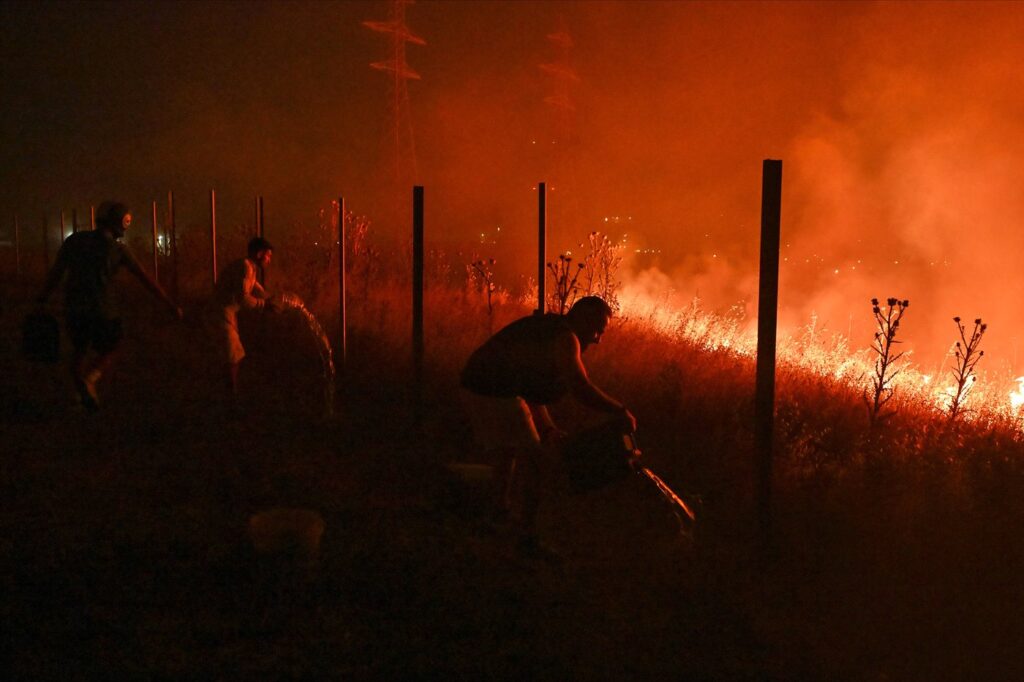
ATHENS, Greece (AP) – Hundreds of firefighters are currently engaged in battling wildfires across Portugal, Greece, and Spain, with Spain and Italy sending reinforcements to assist Portugal in tackling a significant fire that has been raging for over three days.
In parts of Thessaloniki, Greece's second-largest city, local authorities advised residents to stay indoors and secure their windows and doors to avoid exposure to toxic smoke from a recycling plant that was engulfed in flames due to a nearby wildfire. This environmental hazard prompted evacuation measures, affecting three suburbs and a facility housing 157 individuals with disabilities.
On Sunday afternoon, another major wildfire erupted west of Athens. The Greek fire department responded decisively, deploying 210 firefighters, alongside volunteers, specialized units, and 29 aerial firefighting assets including water-dropping planes and helicopters, to combat the blaze in the Mandra area. Firefighters are racing against time to contain the fire before nightfall, as aerial operations will be limited once it gets dark.
Meanwhile, in the Vouzela region of central Portugal, over 1,200 firefighters, supported by nearly 400 vehicles and 15 aircraft, have been working tirelessly to extinguish a wildfire that has been active since Thursday. According to the Civil Protection authority, this fire has incinerated an area of approximately 12,000 hectares (30,000 acres) by Sunday, as reported by the Copernicus satellite mapping agency from the European Union.
The EU Civil Protection and Humanitarian Aid agency revealed that Spain dispatched 120 firefighters along with 45 vehicles as reinforcements to Portugal on Friday. Additionally, three firefighting aircraft from both Italy and Spain were sent to aid in the firefighting efforts.
By Sunday afternoon, there were reports indicating that the intensity of the fire in Portugal was reducing, with officials stating that there were no major active fronts, although several hot spots still required attention.
In Spain, a wildfire in the Girona region has been active since Friday, scorching nearly 2,200 hectares (5,400 acres). According to the EFE news agency, the Catalan Fire Service's operations head, Eduard Martinez, noted that the fire had developed a perimeter of 40 kilometers (25 miles) and that firefighters faced challenges in containing it on Sunday.
The situation was particularly dire in Greece, where a fast-moving fire erupted at a recycling plant near Oraiokastro, close to Thessaloniki. This fire, which broke out Saturday evening, prompted evacuation alerts for several nearby areas. Strong winds exacerbated the fire's spread, leading to the deployment of around 160 firefighters who battled the flames overnight until dawn allowed aerial support to commence.
Mayor Pandelis Tsakiris of Oraiokastro reported that the fire caused damage to several local businesses and homes; however, a comprehensive assessment was still pending. A 76-year-old male was arrested under suspicion of having negligently started the fire by creating sparks with his vehicle, igniting nearby vegetation. He was scheduled to appear in front of a prosecutor on Sunday.
This incident follows a tragic event a few days prior, in which another wildfire in the area resulted in the deaths of a 12-year-old boy and his father. Brig. Ioannis Artopoios, a fire department spokesman, noted that about 85% of wildfires in Greece are attributed to negligence, including sparks from agricultural machinery and discarded cigarettes. This indicates that many of these fires could potentially have been avoided.
Greece is no stranger to wildfires, particularly during the hot, dry summer months when such incidents become frequent and often devastating. The country experienced one of its deadliest fires in 2018, which claimed over 100 lives, and a significant fire in 2023 that was noted as the largest wildfire recorded in the EU. In light of the increasing threat posed by climate change, Greece is turning to technology, including monitoring from four satellites launched into low orbit in May, to combat the wildfire risk effectively.
Despite being spared from the recent heatwaves affecting much of Western Europe, Greece has still witnessed dozens of wildfires across both the mainland and its islands this summer.