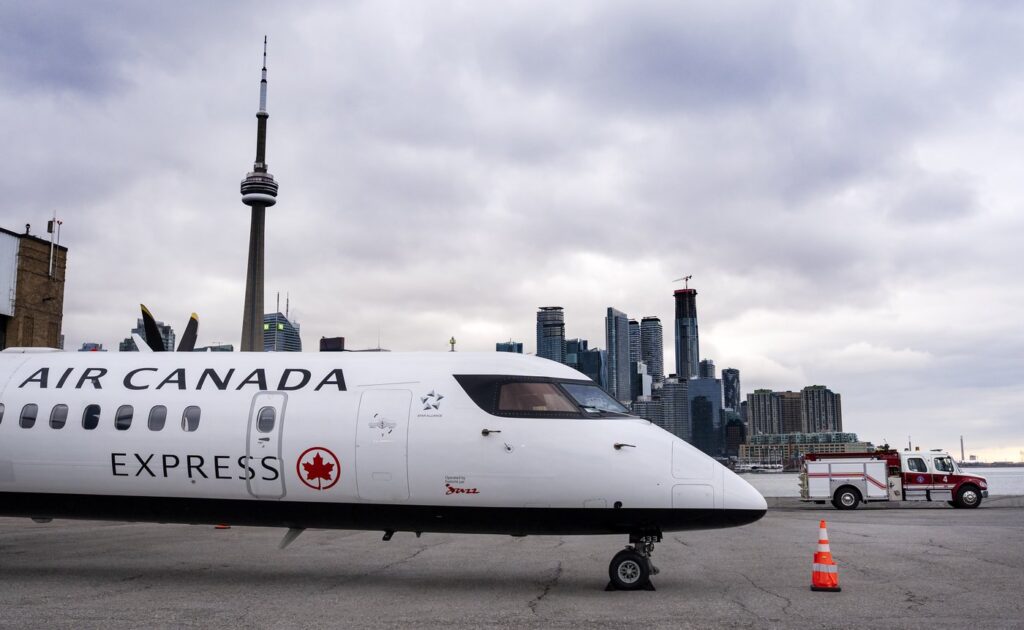
The federal government's decision to halt Ontario's proposal for a significant expansion of Billy Bishop Airport has been hailed by advocates as a protective measure for Toronto's waterfront revitalization. Meanwhile, supporters of the expansion have expressed their disappointment with the decision.
Tim Gray, executive director of Environmental Defence, emphasized the potential negative impact of the proposed project, which would involve increased pollution and the "massive destruction" of the Toronto Islands. He pointed out that nearly one kilometer of lakefill would be necessary to construct additional runway and taxiway, which would contribute to "gridlock" and aircraft emissions along the shore. According to Gray, this decision reflects the government's responsiveness to the public's concerns, as tens of thousands of residents rallied against the expansion.
On Friday, federal Transport Minister Steven MacKinnon stated that the government is focused exclusively on implementing approved safety upgrades at Billy Bishop Airport rather than expanding it to accommodate jets. The conclusion followed a public consultation process that garnered over 87,000 responses. However, MacKinnon indicated that the decision is not set in stone, describing it as "at this stage," suggesting that future changes might be possible.
Giles Gherson, CEO of the Toronto Region Board of Trade, expressed disappointment over the federal government's decision. He noted that the airport has been constrained by an operating agreement established in 1983, which limits it to a single aging aircraft type—turboprops. Gherson described the ongoing circumstances as a choice between stagnation and evolving into a modern regional airport capable of accommodating the needs of a growing population.
Ontario Premier Doug Ford had previously proposed extending the runway 600 meters west, in addition to implementing existing runway end safety zones. This plan faced criticism from environmental and community advocates who raised concerns regarding increased noise, traffic, pollution, affordable housing, and the overall impact on the Toronto waterfront. The expansion was part of a broader effort by the Ford government to reshape the city’s lakeshore, which includes plans to redevelop Ontario Place and potentially establish a new island for a convention center.
Ontario Transport Minister Prabmeet Sarkaria confirmed that the province would continue pursuing the airport expansion, citing potential job creation and economic benefits. He expressed hope that future plans would protect public spaces and address environmental issues while also supporting housing opportunities in the area.
Urban designer Ken Greenberg, who opposed the provincial expansion plan, argued that it would undo decades of progress in reconnecting Toronto with its waterfront. He described the Toronto harbor as a "crown jewel" of Ontario's Golden Horseshoe region, highlighting the importance of its waterfront space as a democratic space for its approximately 18 million annual visitors.
Proponents of the expansion, such as the Toronto Region Board of Trade, argued that small jets like the Airbus A220 could operate from Billy Bishop with similar or better fuel efficiency and noise levels compared to the existing turboprop aircraft. Greenberg contested this notion, asserting that the term "whisper jet" is misleading and that the significant factor is not just the type of airplane but the frequency of flights.
Ford's government projected that the airport could eventually accommodate 10 million passengers annually and generate $8.5 billion in economic benefits. Recent legislative changes allowed the provincial government to take over the municipal role in the tripartite agreement governing the airport, sparking concerns among critics about the lack of a detailed business plan or comprehensive health and environmental studies regarding the proposed expansion, which is projected to cost between $4 billion and $5 billion over 25 years.
Anne Golden, former CEO of the Conference Board of Canada, dismissed the economic arguments supporting the expansion as "bogus," emphasizing that Toronto's connection to the global world is already fulfilled by the ongoing multibillion-dollar expansion of Pearson Airport.
In May, city staff warned that expanding Billy Bishop Airport could lead to adverse effects on housing, congestion, and environmental issues related to the broader waterfront. The federal government's latest decision echoes a previous refusal in 2015 by then-Prime Minister Justin Trudeau to allow Porter Airlines to operate jets at the airport, effectively quashing earlier expansion proposals.