As municipalities across Canada and the United States confront a rise in proposed artificial intelligence (AI) data centres, officials in the Greater Toronto Area (GTA) are advocating for a more thorough response in light of environmental issues. During a recent city council meeting in Mississauga, Councillor Martin Reid is expected to introduce a notice of motion for an interim control bylaw. This initiative aims to halt the development of "major digital infrastructure facilities" for a year to enable city staff to conduct a comprehensive planning study alongside a detailed review of existing bylaws and policies.
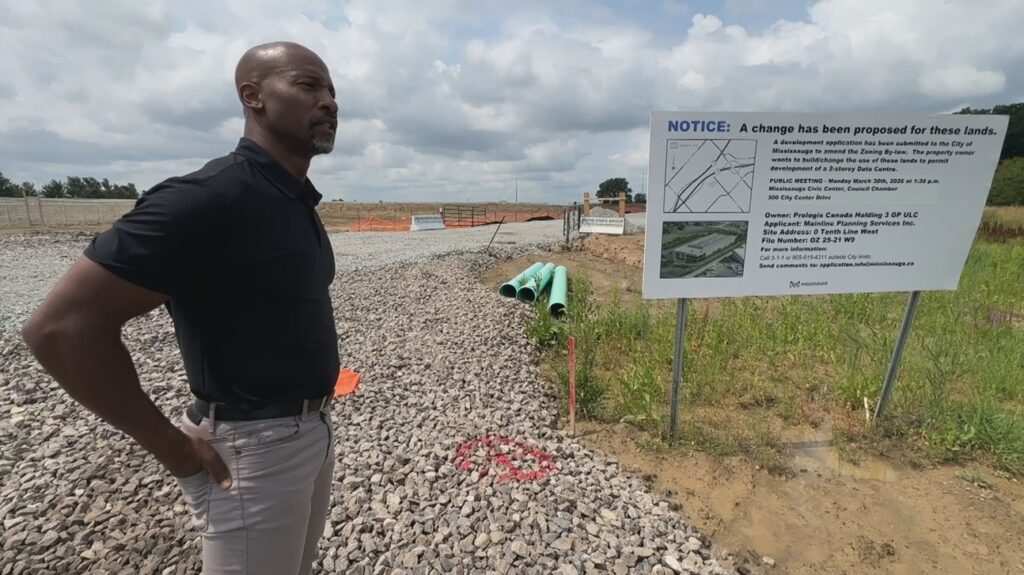
CityNews spoke with Reid at the proposed site of a substantial hyperscale data centre, located on Tenth Line near Winston Churchill Boulevard and Highway 401, adjacent to residential areas, a church, greenspace, and an existing warehouse. With a large shopping centre and multiple housing subdivisions in proximity, Reid noted that local residents have expressed concerns about the potential environmental impacts associated with similar facilities in the U.S., which report high water and electricity consumption. He emphasized the need for clarity, stating, "There are still so many questions that need to be answered, and until we have a fulsome understanding of it, this is not something that I feel that I can responsibly support."
Reid highlighted the uncertainty around the data centre's intended usage, mentioning varied reports ranging from benign to concerning. He stressed the importance of conducting thorough research before making decisions, stating, "Let’s do our homework first before we say yes." Reid's request for a pause has garnered support from some fellow council members, citing the lack of reliable information on the potential impacts on residents and local infrastructure.
In the broader context, Hamilton city council faced vocal opposition regarding a proposed data centre and initially considered a moratorium that was later dismissed due to concerns about legal conflicts and potential loss of investment. Meanwhile, in Toronto, Councillor Vincent Crisanti has proposed a formal meeting with an applicant for a facility near Islington Avenue and Highway 401 to discuss additional mitigation measures. Concurrently, Councillor Parthi Kandavel is advocating for a pause and a reconsideration of processes surrounding a proposed large-scale data centre by Stack Infrastructure located at Birchmount Road and Danforth Avenue, which is surrounded by residential neighborhoods.
Kandavel outlined significant community concerns that need addressing prior to final approvals, particularly issues related to water usage, energy grid strain, and noise levels. He acknowledged the necessity for AI data centres in Canada to enhance "data sovereignty," while also insisting on a thorough evaluation of environmental impacts before proceeding.
A representative from Stack Infrastructure asserted that the company has been collaborating with the City of Toronto since 2022, stating, "The expansion project has undergone extensive technical review and includes measures to address noise and limit water use through a closed-loop cooling system." Furthermore, they guaranteed they would shoulder the costs of necessary electrical distribution upgrades.
Toronto Mayor Olivia Chow expressed her anticipation of a city staff report detailing the environmental implications of AI data centres, emphasizing the need for ethical considerations and community impacts. Both Reid and Kandavel called for provincial leadership to address the concerns surrounding AI data centre developments, as municipalities across Ontario receive numerous applications.
In response to these issues, the Ontario government highlighted its commitment to ensuring that digital infrastructure investments benefit local communities and economic conditions. A spokesperson for Economic Development Minister Vic Fedeli stated, "No digital infrastructure project will proceed unless it contributes to the local economy and the company commits to paying the full cost of energy." They noted that recent legislation has established standards that allow the government to prohibit projects from connecting to the electrical grid if they do not meet these criteria.
Environmental advocates like How-Sen Chong from the Toronto Environmental Alliance are calling for a pause on AI data centres, citing risks associated with reliance on fossil fuel-based power sources and their significant energy and water demands. He warned that many planning processes are not adequately prepared for the unique challenges posed by these facilities.
Eric Miller, director of York University's Ecological Footprint Initiative, discussed how his research relies on the computational power provided by data centres. He urged consideration of how electricity is sourced and the implications of waste heat generated during high-performance computing processes. Miller noted a significant shift toward a facility in Montreal, where renewable energy predominates, leading to an 87% reduction in greenhouse gas emissions associated with their computational work.