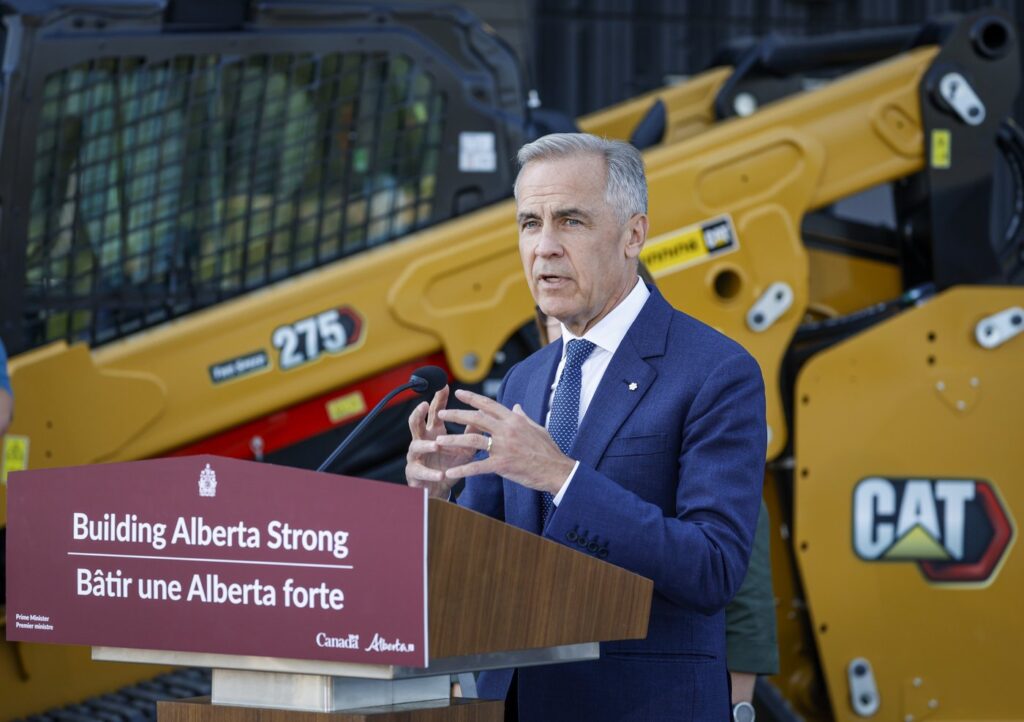
RED DEER – Prime Minister Mark Carney expressed concerns on Wednesday regarding Canada's international reputation as a dependable energy supplier. During an announcement alongside Alberta Premier Danielle Smith in Red Deer, he addressed the possibility of utilizing energy exports as a bargaining chip in ongoing trade discussions with the United States.
Carney emphasized that trust may be among the most valuable commodities Canada possesses, asserting the importance of maintaining reliability as an energy supplier. He advised that nations supplying critical commodities like energy should carefully consider the implications of cutting off their customers. He remarked, "Being a reliable supplier is important," highlighting that any decisions regarding energy exports should not be made lightly.
In a contrasting viewpoint, Ontario Premier Doug Ford stated last week that Canada could "dismantle" the United States if federal and provincial governments united to leverage energy exports against the U.S.' latest threats of tariffs. This discussion gained urgency with reports suggesting that the Trump administration would impose new tariffs of 50% on various Canadian goods starting August 19, 2026.
Currently, Canada's chief trade negotiator, Janice Charette, and Canada-U.S. Trade Minister Dominic LeBlanc are in Washington as tensions escalate. The proposed tariffs differ from previous measures since they would not offer exemptions for goods compliant with the Canada-U.S.-Mexico Agreement (CUSMA) on trade. U.S. Trade Representative Jamieson Greer stated these tariffs respond to provincial regulations such as bans on U.S. liquor and constraints on the dairy market in Canada, as well as limits on specific American vehicles.
In the face of these challenges, Carney reaffirmed that Canada has other options available while pursuing a new continental trade agreement. "We have many things we can do. The first and foremost is to work towards an agreement. That's what we're going to do," he stated. He also suggested that there are other measures Canada could employ if the situation necessitated a stronger response.
CUSMA, which replaced the North American Free Trade Agreement, was originally negotiated during the first Trump administration in a series of sometimes tense discussions. Despite these tensions, all three nations ultimately regarded CUSMA as a successful outcome. Carney revealed he recently engaged in talks with Trump, during which both parties agreed to intensify discussions surrounding trade.
Compounding the situation, the Trump administration announced earlier this July that it would not renew the trade agreement, leading to the initiation of annual reviews for up to a decade. Following this period, CUSMA would expire unless all involved parties agreed to extend the terms of the agreement.
This current escalation reflects ongoing complexities in Canada-U.S. trade relations, where the stakes are considerably high as both nations navigate tariffs and demands for a renewed trade pact.