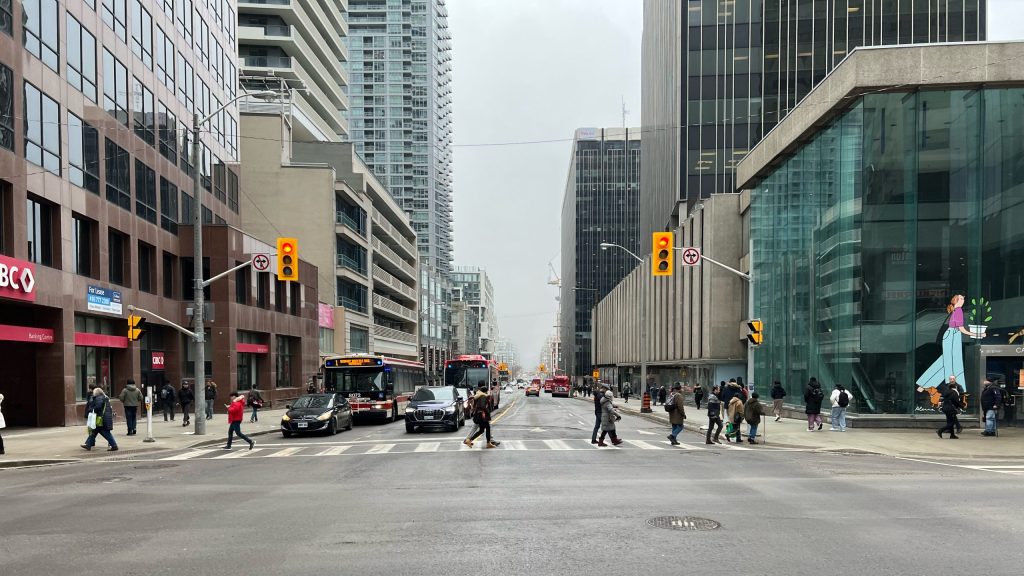
The Toronto City Council has officially voted to implement a "scramble intersection" at the high-traffic convergence of Yonge and Eglinton streets. The proposal was spearheaded by Councillor Josh Matlow, who emphasized the need for enhanced safety and manageability at one of the city's busiest intersections. In addition to the main intersection, the council has also considered a second scramble intersection at Yonge Street and Roehampton Avenue/Orchard View Boulevard, although further evaluation is necessary before it can be implemented.
Matlow stated, “Yonge and Eglinton has become one of the busiest intersections in the city, and I want to make it safer and more manageable.” The concept of a scramble intersection, also referred to as a Pedestrian Priority Phase, allows for vehicles to stop in all directions during specific intervals. This configuration enables pedestrians to cross in any direction, including diagonally, enhancing pedestrian safety significantly.
The importance of this initiative is underscored by the fact that, according to city estimates, approximately 4,500 pedestrians cross the Yonge and Eglinton intersection every hour. Community advocacy played a crucial role in advancing this plan; Lee Scott, a member of the group Walk Toronto, has been pushing for the scramble intersection since last year. Scott highlighted issues faced by pedestrians at the current intersection, mentioning dangers posed by vehicles that encroach on their right-of-way, even when pedestrians have a walk signal.
The expected timeline for the installation of the scramble intersection is set for 2027. However, the proposal has not been without its critics. Concerns have been raised regarding potential delays for drivers, as the introduction of an additional light cycle specifically for pedestrians may impede traffic flow. Matti Siemiatycki, a Professor of Geography and Planning at the University of Toronto, pointed out that the success of the scramble intersection will depend on its implementation and the synchronization of adjacent traffic lights.
As part of the council's motion, Transportation Services has been tasked with optimizing the signal timing for the Yonge Street corridor, aiming to minimize negative impacts on traffic operations. Matlow asserted that, according to city staff, it is indeed feasible to coordinate the traffic signals at Yonge and Eglinton in a way that allows both vehicles and pedestrians to navigate the intersection efficiently.
Furthermore, Siemiatycki emphasized the necessity of considering accessibility for individuals with visual impairments or other disabilities when designing the intersection. He noted, “It’s about understanding that this is now a really busy pedestrian environment in a place that now has probably among the best transit connections in all of Canada.” He stressed the importance of recognizing and prioritizing pedestrians in this increasingly urbanized environment, suggesting that doing so would foster further thriving of the area.
As Toronto continues to grow and evolve, the introduction of the scramble intersection at Yonge and Eglinton represents a significant step towards enhancing pedestrian safety and navigating the challenges of urban transit effectively. Discussions surrounding interconnected traffic systems and pedestrian access reflect a broader commitment to creating inclusive urban spaces.