CAIRO (AP) For Palestinians in Gaza, President Donald Trump's announcement regarding Hamas' agreement to disarm provided a glimmer of hope that Israel's ongoing attacks might cease, allowing them to rebuild their lives and the remnants of their homes. However, this announcement starkly contrasted with the reality on the ground, where Israeli strikes have persisted since Trump presented the deal late Thursday in Washington, and efforts to solidify a broader ceasefire agreement, which was enacted in October, have been minimal.
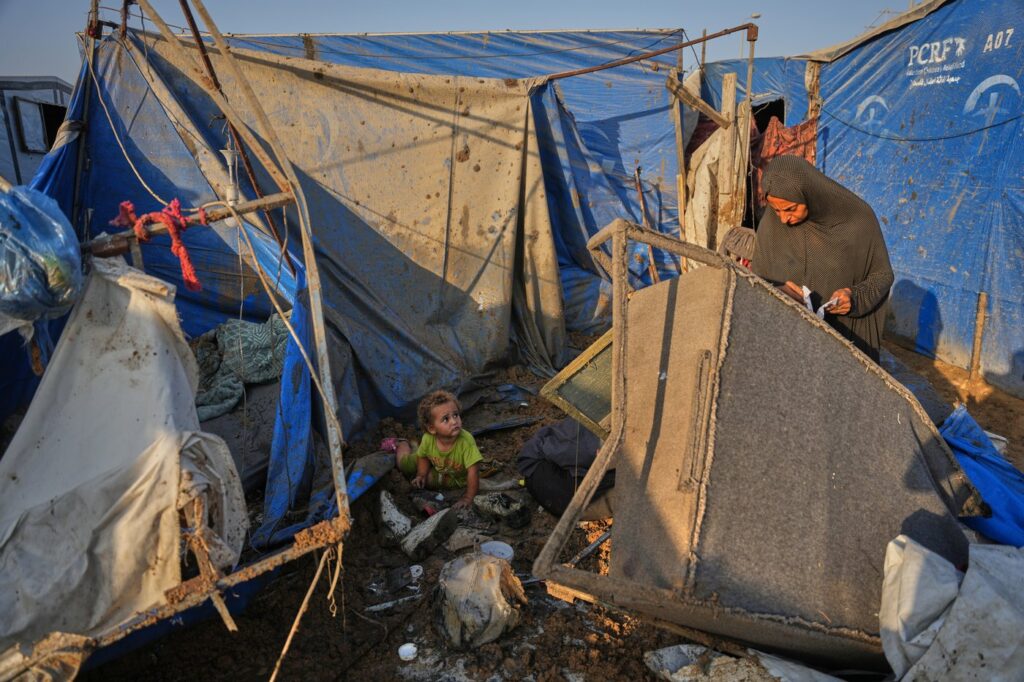
Currently, most of Gaza's 2 million Palestinians are either displaced or residing in overcrowded tent camps, where inadequate living conditions have resulted in rodent infestations and outbreaks of contagious diseases like chickenpox. Abdel Moneim Aboul-Roos, a 24-year-old tuk-tuk driver who lost his leg in an Israeli airstrike, expressed his frustrations, stating, “They can talk about withdrawal and disarmament. I don’t care about any of it as long as there is no food or medicine.”
Last year, Israel and Hamas had agreed to a U.S.-backed ceasefire plan that concluded significant hostilities, facilitated the return of Israeli hostages, and permitted a rise in humanitarian aid to the region. This agreement also outlined a gradual withdrawal of Israeli troops, the establishment of an international stabilization force, and a plan for the disarmament of Hamas' weapons. Nevertheless, as both parties accused each other of ceasefire violations, negotiations faltered, leading to Hamas retaining its arsenal and the Israeli military’s refusal to withdraw. Since October, more than 1,200 Palestinians have been killed by Israeli actions in Gaza, contrasting with five Israeli soldier deaths attributed to militant attacks.
Many Palestinians harbor distrust toward both Israel and Hamas. The newly announced road map by Trump, which Hamas has confirmed, specifies the types of weaponry that the militant group and its affiliates would be obligated to relinquish to a new technocratic administration. According to the document, Israel is not expected to participate in the decommissioning of Hamas' weapons and is required to cease all military actions in Gaza to facilitate the transition and recovery process.
While residents of Gaza regard the road map as a potentially positive development, skepticism looms regarding the commitment of Israel or Hamas to its stipulations. Ayman Ahmed, a displaced Palestinian in southern Gaza, articulated a common sentiment: “This is enough. We need improvement in our lives.” He expressed hope that Hamas would surrender its arms but was doubtful about its realization any time soon, stating, “They don’t care about the lives of Palestinians.”
The violence erupted when Hamas militants attacked southern Israel on October 7, 2023, resulting in the deaths of approximately 1,200 people and the abduction of 251 others back to Gaza. Israel's subsequent offensive has claimed more than 73,300 lives, according to the Gaza Health Ministry, which is associated with the Hamas-led government. The ministry's records, viewed as credible by U.N. agencies, do not distinguish between civilians and militants, but indicate that women and children constitute nearly half of the casualties.
Amidst this extensive death toll and continuing assaults, many Palestinians believe that Israel is unlikely to make any concessions. Ghazal Astal, a resident of southern Gaza, recounted the persistent Israeli gunfire, stating that the area has morphed into an "indescribable battlefield." Ammar Kaskeen, 30, shared his skepticism, asserting that the road map would not compel Israeli forces to withdraw. He believes that Israel aims not just to disarm Hamas, but also to expel the Palestinian population from Gaza, stating, “They will make us suffer.”
Despite Israel's entrenched position, Palestinians continue to dream of returning to their homes. Although no official comments have been made by Israel regarding the road map, unnamed Israeli officials have conveyed that the agreement does not align with the nation’s interests. They reiterated that Israel intends to maintain its position along the Yellow Line in Gaza, delineating the Israeli-controlled eastern territory from the western areas of the enclave. Recently, the military has constructed a substantial earthen barrier that coincides with this line, developing what it terms a "security zone," complete with intelligence and technological resources. Controlled demolitions and clearing operations have also occurred across much of the territory under Israeli control, leaving former residents unsure about the status of their homes.
Anas Nakla, who was displaced from Rafah in southern Gaza, expressed a desire to return home, acknowledging that his house was destroyed but emphasizing, “We can return and rebuild.” Similarly, Mohamed Hamad, who was forced to leave his northern Gaza residence, hopes the U.S.-backed road map may compel Israel to vacate some areas it currently controls. He believes that even limited returns would instill hope among others that, one day, they too may return to their homes.