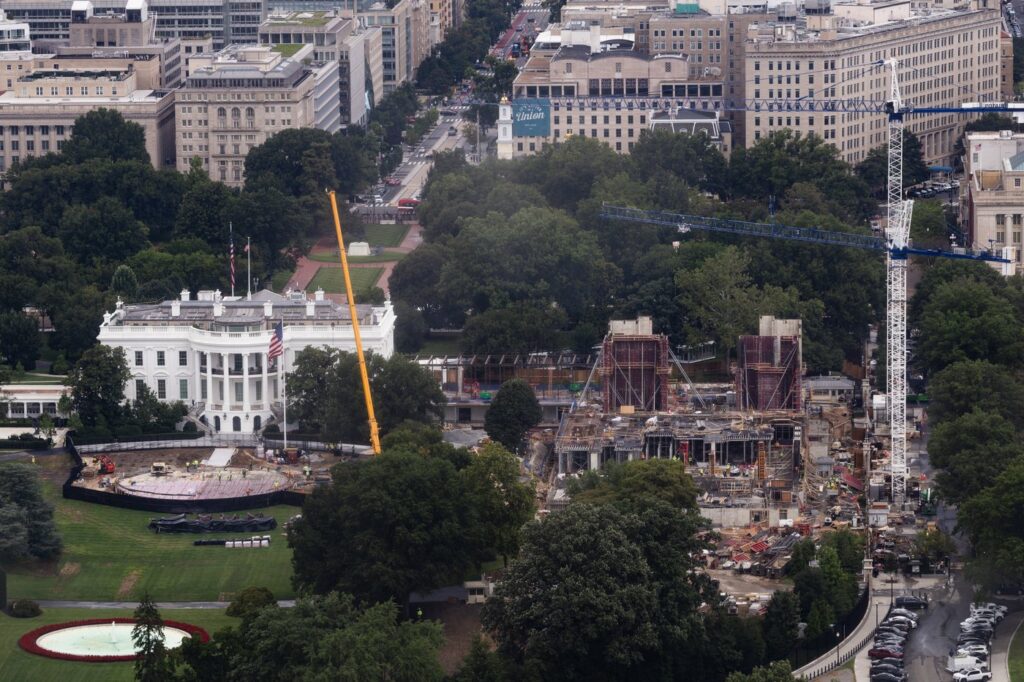
A divided federal appeals court ruled that the Trump administration must cease construction of a proposed $400 million ballroom at the White House, citing Congress's lack of approval for the project. President Donald Trump criticized the ruling as "unjust" and announced plans to appeal the decision to the U.S. Supreme Court.
According to the three-judge panel from the U.S. Court of Appeals for the District of Columbia Circuit, Trump lacks the unilateral authority to construct a 90,000-square-foot ballroom following the demolition of the East Wing last fall. The court ruled that such a significant project requires Congressional authorization.
The president expressed his discontent through social media, characterizing the ruling as politically motivated and a national security threat. Trump claimed that the ballroom is designed to include various security features, such as bomb shelters and medical facilities, emphasizing the project's importance for the safety of future presidents and the country.
Earlier in the week, the Trump administration also faced scrutiny for its construction plans for a 250-foot-tall triumphal arch, which was criticized for potentially jeopardizing the historical significance of numerous nearby sites. The appeals court's ruling regarding the ballroom was a continuation of the pushback against Trump’s ambitious construction agenda.
In a 2-1 decision, the appeals court sided with historic preservationists who filed a lawsuit against the ballroom project. The ruling confirmed a previous order from U.S. District Judge Richard Leon, who had halted aboveground construction while allowing underground work related to security features to proceed. The court has temporarily stayed its ruling for two weeks, granting the administration time to appeal.
The judges stated, "Whether or not a massive ballroom should be constructed is for Congress to decide and is not a matter for Executive self-help." They clarified that their decision was based on legal grounds rather than the desirability of the ballroom, and it established that construction could not continue without Congressional approval.
Trump has argued that he raised substantial amounts of private money for the project, including hundreds of millions of dollars from corporate donors and wealthy individuals, asserting that public funding is not being utilized. However, Congress initially rejected the administration's request for $1 billion to facilitate the development. Concerns were raised regarding possible redirection of $350 million meant for other purposes to finance the ballroom.
The National Trust for Historic Preservation, which initiated the lawsuit, expressed satisfaction with the court's ruling. Brent Leggs, the organization's president and CEO, affirmed that the law stipulates only Congress can sanction the construction of a ballroom at the White House. The preservation group maintained that the White House does not currently require a ballroom for national security reasons.
This legal battle commenced in December 2025 after the demolition of the East Wing, a site where Trump aims to build a ballroom capable of accommodating nearly 1,000 guests. The administration contended that security upgrades are paramount to safeguarding against potential threats such as drones and ballistic missiles. In contrast, preservationists successfully argued that the absence of the ballroom does not constitute a national security emergency.
Ultimately, the appeals court's decision reinforces the need for adherence to procedural requirements regarding significant modifications to federal properties. The case has highlighted the ongoing tension between ambitious projects proposed by the Trump administration and the legal framework governing construction within the nation's capital.