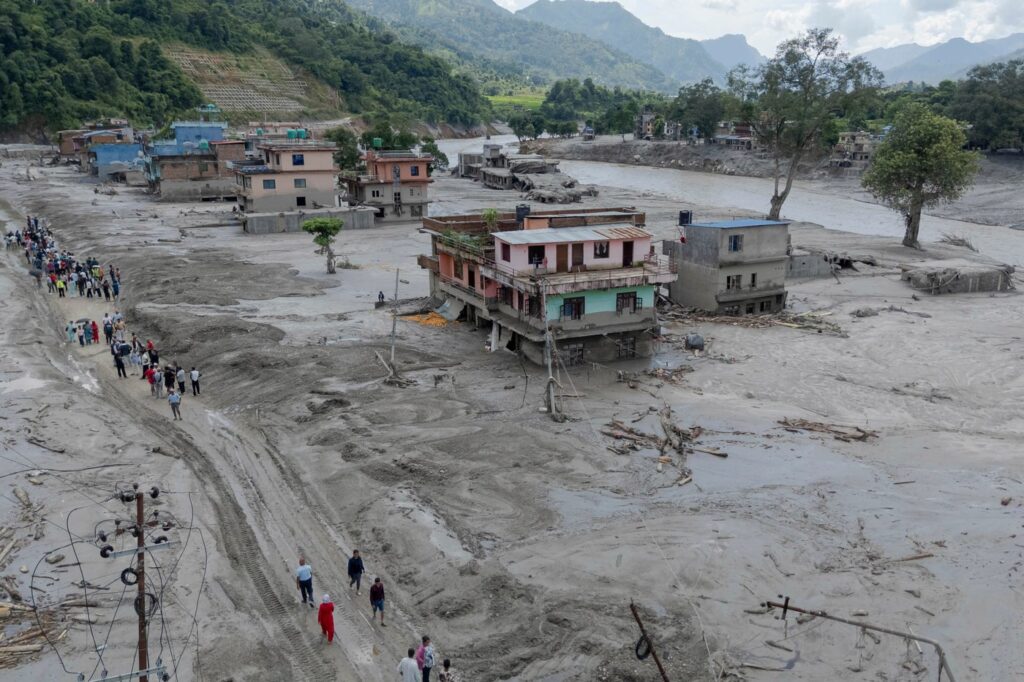
KATHMANDU, Nepal (AP) – Rescuers are urgently searching for hundreds of individuals who remain missing two days after a devastating flash flood hit the Himalayan border between Nepal and China. As of Friday, the death toll had tragically increased to 469 in Nepal, a significant rise from the previous count of 390, while China reported three deaths in Tibet. Combined, the two countries have over 1,500 individuals unaccounted for.
Authorities from both nations have issued warnings regarding a lake formed upstream following the disaster, which is at risk of overflowing. They have urged residents in potentially affected areas to evacuate to safer locations. According to China’s Ministry of Water Resources, this lake currently contains about 2 million cubic meters (70 million cubic feet) of water and is projected to receive an additional 3 million cubic meters (106 million cubic feet) in the next three days.
Reports from Chinese state broadcaster CCTV indicated that the lake's barrier, which poses a threat to Gyirong Port—the key border crossing with Nepal—was situated more than 10 kilometers (6 miles) away. This lake is at an elevation of 2,950 meters (9,680 feet), approximately 1,000 meters (3,280 feet) above Gyirong Port.
The Nepal Army has sent a team to the border region to assess the situation of the Bhotekoshi River, anticipating potential flooding. As of Friday, Nepal's National Disaster Risk Reduction and Management Authority reported that 3,253 individuals had been airlifted from the disaster-stricken area. Flood survivors, including those injured, were transported to Kathmandu and various other locations. Among the missing are foreign nationals, with many being trekkers and pilgrims.
Brig. Gen. Raja Ram Basnet, a spokesperson for the Nepal Army, revealed that a crew had been dispatched to the Upper Trishuli-1 Hydropower Project near the Nepal-China border due to concerns over trapped individuals within a tunnel. Basnet stated, “It is complicated to find the entry and exit points of the tunnel because everything has been covered by mud. Our first priority is rescuing the stranded people.”
Videos capturing the disaster depict rampant floodwaters obliterating structures, bridges, and vehicles, as people scrambled to escape the towering torrents. The aftermath left debris scattered, with broken concrete and mud engulfing buildings and streets.
Amid this chaos, families worldwide are grappling with the news of their missing loved ones. Rajan Tamang, a restaurant owner in New York City, shared his distress after learning from relatives in Kathmandu that his mother and sister were among those who perished, while many others remain unaccounted for. He recounted, “My family was just waking up, and they didn’t even get any information, and suddenly this flood came. Some of them are missing, some of them lost their life, and only a few are alive.”
In response to the calamity, U.S. President Donald Trump expressed his sorrow over the devastation, noting how “strong, well-built buildings were wiped out like they were toothpicks.” He emphasized that the United States has communicated with Nepalese leaders, offering support and assistance in whatever capacity needed.
Scientists analyzing satellite images indicated that the catastrophe may have stemmed from the collapse of bedrock beneath a glacier in the high Himalayas, which caused part of the glacier to dislodge. The resulting combination of rock and melted water led to swollen rivers and a torrent that swept away buildings, bridges, and land downstream.
Journalists from various regions contributed to the ongoing coverage of this tragic event, highlighting the extensive impact on both Nepal and China, and the urgent need for rescue and recovery efforts.