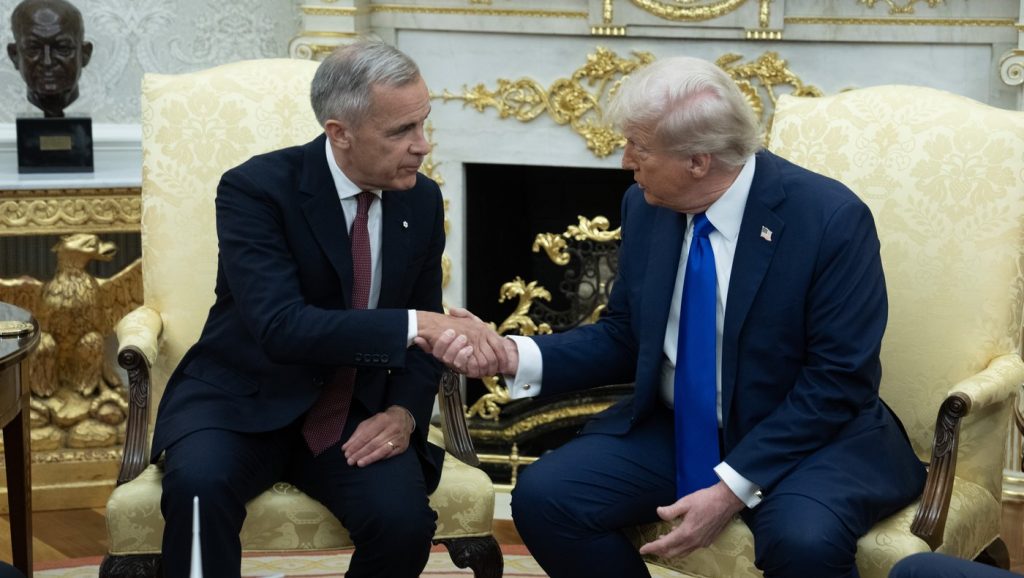
OTTAWA – Prime Minister Mark Carney addressed the federal government's ongoing evaluation of the latest tariffs and import bans imposed by the United States. Speaking to reporters in Banff, Alberta, during a two-day cabinet retreat, Carney indicated that while these measures are considerable for certain sectors, they are "relatively modest" in comparison to previous U.S. actions.
On Tuesday, U.S. President Donald Trump signed new orders banning imports of various products, including most alcohol, and raised tariffs on other goods. This decision followed Canada's recently implemented retaliatory duties after trade negotiations reached a standstill in August. Trump's administration had imposed a substantial 50 percent tariff on nearly $28 billion worth of Canadian goods, including items such as honey, sunscreen, sports equipment, and milk.
Both sides in the trade dispute have exchanged blame, with Canada accusing the U.S. of imposing last-minute demands during negotiations. Carney reiterated Canada's "red lines" in these trade discussions, emphasizing the importance of retaining the nation's sovereign right to sign trade agreements with other countries while protecting Canadian culture and the French language.
When questioned about potential Canadian retaliation against the latest U.S. trade actions, Carney provided no definitive answer but acknowledged that the new measures are significant for specific companies and sectors, suggesting "there's a response there."
In parallel, Carney met with Ukrainian President Volodymyr Zelenskyy earlier on the same day, announcing that Canada plans to collaborate with Ukraine on producing millions of drones for the Canadian military. Furthermore, he pledged additional air defense support for Ukraine and disclosed that the two nations signed joint statements focusing on energy cooperation and defense.
During a press conference alongside Zelenskyy, Carney mentioned that he had communicated with Trump multiple times in recent days amidst escalating trade tensions. "We continue to work with the United States. We can compartmentalize across this," Carney stated while addressing Canada's role in advocating for peace in Ukraine. He also noted discussions with Trump regarding the conflict in Iran and other significant global issues.
The Prime Minister’s Office confirmed the two leaders' recent conversations but did not disclose specific details regarding their timing or context relative to the latest trade disputes.
Carney emphasized, "Canada is always ready to strike a fair deal," expressing confidence in finding a mutually beneficial agreement for both Canada and the United States, and assured that he and his team are prepared for negotiations.
Canadian politicians are pushing back against Trump’s recent executive orders that restrict Canadian access to procurement contracts and introduce a new round of tariffs. The five new orders are scheduled to be effective from September 29 and will entirely prohibit imports of specific Canadian products, including motorcycles, certain dairy items, and alcoholic beverages. Additionally, some previously tariffed items such as toilet paper and cement will be exempted, while more dairy products will be added to the tariff list.
In response to the tariffs and bans, Ontario Premier Doug Ford announced that affected businesses would qualify for provincial support programs. In a speech to the Toronto Region Board of Trade, he stated that Ontario would expand eligibility for its tariff assistance programs to impacted industries to help them sustain operations.
Meanwhile, New Brunswick Premier Susan Holt has mandated the province's public sector to refrain from purchasing American products when Canadian alternatives are available, as a counteraction to the latest U.S. tariffs. Holt's government is also exploring the possibility of restricting American access to fishing and hunting licenses as well as mining claims. Additionally, starting October 1, there will be a ban on purchasing U.S. goods and services for contracts exceeding $5 million.