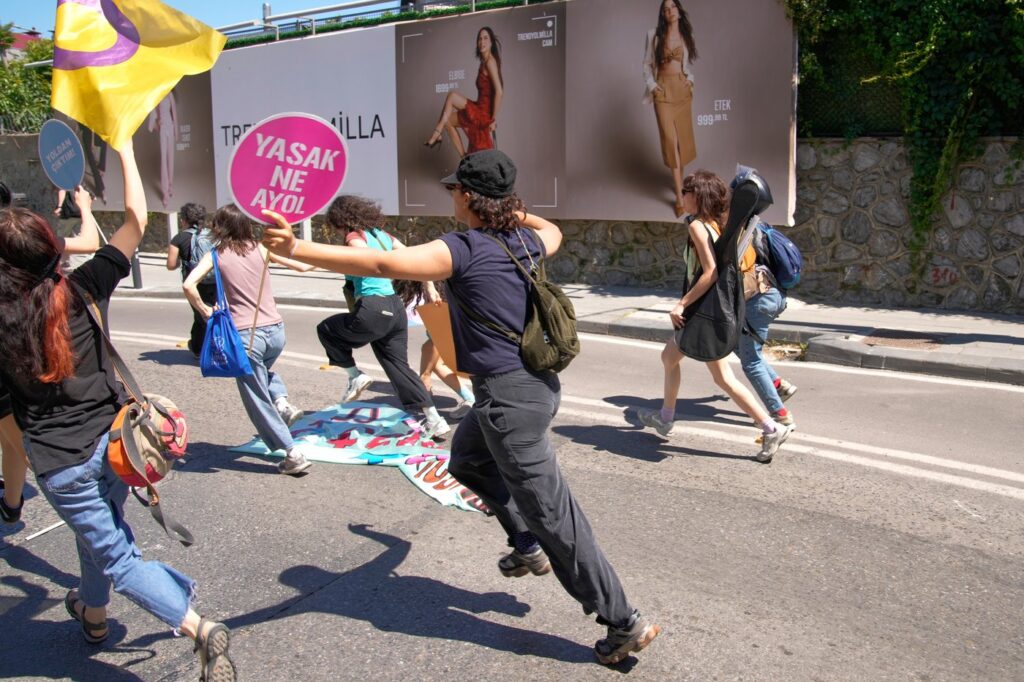
ISTANBUL (AP) — Turkish authorities intensified their crackdown on LGBTQ+ groups early Sunday morning, detaining dozens of members and conducting raids on association offices as well as popular gathering spots. This operation marks a significant escalation in the government's decade-long hostility towards LGBTQ+ rights activists, particularly as the nation approaches upcoming elections.
Police raids began at 1 a.m. on Sunday across major Turkish cities, including Istanbul, Ankara, Izmir, Aydin, and Mersin. The crackdown involved an investigation into 162 suspects, linked to nine associations and 13 businesses. Justice Minister Akin Gurlek stated on social media that these actions were necessary to "protect children, the institution of the family, and public order," and claimed they aligned with President Recep Tayyip Erdogan's decade-old executive order aimed at families and children.
Gurlek emphasized the state's constitutional duty to protect families and children, asserting that it would not tolerate any criminal organization, abuse network, or illegal activity targeting these groups. The raids were notably aimed at both current and former members of several prominent LGBTQ+ rights organizations and HIV awareness groups. Additionally, the websites of these organizations were blocked as part of the crackdown.
Amidst the ongoing raids, Gurlek pointed out that these associations received substantial funding from international sources and agencies, which has become a contentious point in the government's narrative. In response to the raids, the Human Rights Association condemned the actions, labeling them as a political maneuver rather than a legitimate judicial investigation. They accused the government of attempting to impose a monolithic family model and purge both LGBTQ+ individuals and independent civil society under the pretext of protecting families and children.
The association further criticized the inclusion of unrelated charges such as "forming a criminal organization," "drugs," "prostitution," and "obscenity," suggesting these allegations were aimed at discrediting the entire LGBTQ+ community rather than uncovering the truth.
The ruling Justice and Development Party (AKP), known for its religious conservatism, has increasingly vocalized opposition to LGBTQ+ organizations in recent years to resonate with the conservative segments of its political base. Notably, in 2015, the government banned Istanbul Pride, which had previously attracted tens of thousands of participants, and since then, authorities have resorted to violent dispersal of any gatherings related to Pride events.
Furthermore, in a recent incident this summer, an LGBTQ+ cruise ship, which has docked in Turkey multiple times before, was denied permission to anchor at Turkish ports, exemplifying the country's growing intolerance towards the LGBTQ+ community.
It's worth noting that while the Ottoman Empire, Turkey's historical predecessor, decriminalized homosexuality in 1858, significant social discrimination against LGBTQ+ individuals persists in modern Turkey. This ongoing repression reflects a broader trend of increasing hostility towards LGBTQ+ rights within the country.
Cinar Kiper, The Associated Press