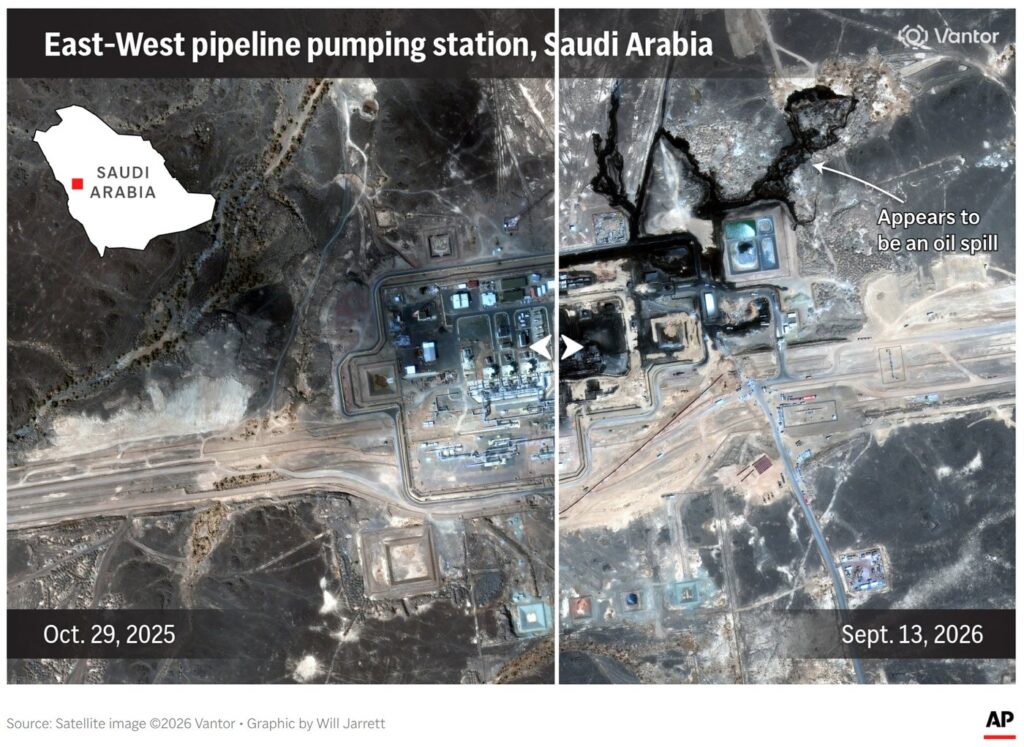
CHICAGO (AP) – The recent closure of Saudi Arabia's major oil pipeline following a drone attack has sparked concerns about impending shortages in global energy markets already strained by the ongoing war with Iran. As fears of further disruptions loom, fuel and essential commodity prices may escalate sharply.
On Friday, Saudi Arabia, the largest oil producer in the Middle East, shut down its East-West pipeline after attributing the attack to Iranian-backed militias operating from Iraq. Two regional officials indicated to the Associated Press that repairs to the damaged pipeline could take between three to five weeks.
The East-West pipeline is vital for transporting crude oil from Saudi Arabia to the Red Sea, allowing for shipments to bypass the Strait of Hormuz. This narrow waterway previously facilitated the passage of roughly 20% of the world's oil supply before the U.S. and Israel launched strikes against Iran in February. The closure threatens to significantly limit Saudi oil exports and elevate global prices.
The Houthi rebels, aligned with Iran, have captured islands along crucial Red Sea shipping routes, exacerbating the threat to Saudi exports. While some alternate shipping options remain, including a limited flow of tankers through Hormuz, experts warn that more supply disruptions could lead to higher prices affecting households worldwide. As of Monday, Brent crude oil traded above $105 per barrel.
What is the East-West Pipeline?
The East-West pipeline stretches approximately 1,200 kilometers (746 miles) across Saudi Arabia, transporting oil from a processing facility near the Persian Gulf to the Red Sea. From there, crude oil is typically loaded onto tankers bound for Europe via the Suez Canal or towards Asia through the Bab el-Mandeb Strait.
This pipeline was constructed during the 1980s due to fears that Tehran would disrupt shipping in the Strait of Hormuz amid the Iran-Iraq war. Throughout the initial six months of the current conflict, the pipeline has been instrumental in maintaining some level of oil flow from the region while tanker traffic in Hormuz was largely halted.
According to Rystad Energy, between 2.6 million to 4 million barrels of oil per day have flowed through the pipeline to the Red Sea port of Yanbu since late August, a volume now at risk of being removed from the market. This quantity represents approximately 4% of global oil supply, per the International Energy Agency (IEA). Saudi Arabia's oil production fluctuated from almost 10 million barrels per day in September 2025 to around 6 million barrels per day in August, as reported by the IEA.
Janiv Shah, Rystad Energy's vice president of oil markets, emphasized that the recent surge in Brent prices indicates a market already reacting to the potential loss of supply. Although Saudi inventories may temporarily sustain exports, this situation could change quickly.
Current Oil Flow Status in the Middle East
With consumer dependence on oil supply through the Strait of Hormuz a major concern, the situation remains precarious. Before the onset of the war, around 20 million barrels passed through Hormuz each day. Despite some tankers resuming transit in early September, the volume of traffic remains significantly low compared to previous levels.
Houthi forces have tightened control over the Bab el-Mandeb Strait, a critical passage in the southern Red Sea. Analysts from Melius Research reported that approximately 3 million barrels of oil per day were transported through Bab el-Mandeb in early September, but that figure could now be zero due to the Houthi's actions. Most Saudi shipments from Yanbu have shifted northwards, either via the Suez Canal or Egypt's SUMED pipeline, although the Houthis have begun targeting vessels in northern waters as well.
Salvatore Mercogliano, a maritime history professor at Campbell University, stated that while the conditions are concerning, the reopening of the Hormuz route, albeit not completely, offers some respite for Saudi oil exports. However, he cautioned that the situation remains precarious.
Impact of Rising Oil Prices
The current supply constraints have resulted in escalating prices globally. Analysts predict that these latest disruptions will inflict additional hardship on consumers in the upcoming weeks and months. One immediate effect is the rise in fuel and household energy costs. Countries in Asia and Africa, which heavily depend on Middle Eastern imports, have been particularly impacted by these price hikes.
For instance, in Nigeria, diesel prices surged by 92% compared to late February, while gasoline prices rose by almost 61%, according to energy tracker Global Petrol Prices. Other nations like Indonesia and Lebanon are experiencing similar spikes in fuel costs. In the United States, regular gasoline prices averaged $4.32 per gallon on Monday, an increase of nearly 45% since the start of the war, with diesel hitting a record high of $6.23 per gallon.
The escalating cost of diesel significantly affects other goods, as it is essential for long-haul trucks and agricultural equipment. Analysts from Melius Research have warned of likely inflationary ramifications, exacerbated by the war’s impact on critical commodities like fertilizer and energy sources, particularly as the U.S. nears its harvesting and heating season.
____
Anderson reported from New York. Associated Press writer Samy Magdy in Cairo contributed.
Wyatte Grantham-Philips and Mae Anderson, The Associated Press