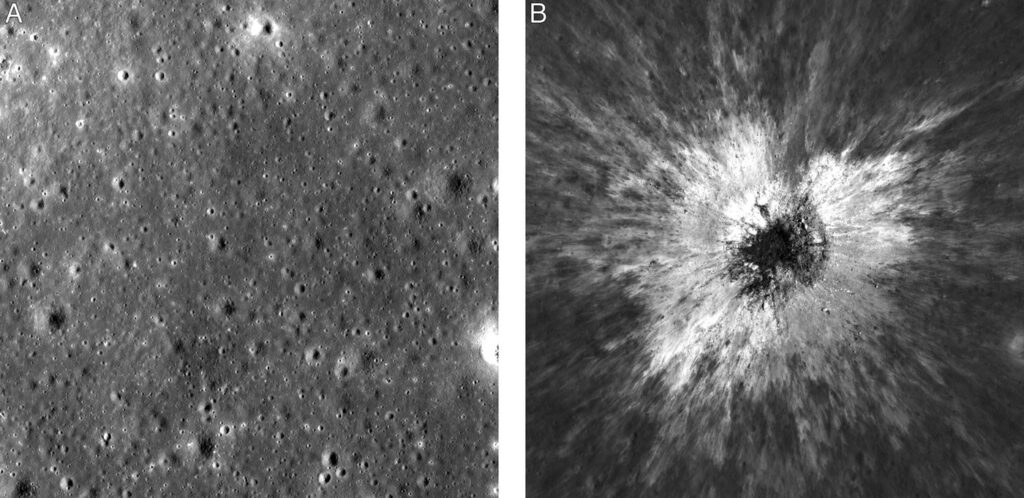
CAPE CANAVERAL, Fla. (AP) — Scientists have made a remarkable discovery on the moon, identifying a crater that is larger than the Roman Colosseum. This significant geological feature resulted from a powerful impact two years ago and initially went undetected. The crater, which measures approximately 728 feet (222 meters) across and reaches depths of up to 141 feet (43 meters), is now recognized as the largest known impact crater formed in recent history within the solar system.
The statistical rarity of such a large-scale event is approximated at once every 132 years. This discovery provides an invaluable repository of information as NASA gears up to establish a base for astronauts on the moon. The scientists noted that this occurrence represents a “statistically rare, effectively once-in-a-lifetime observation,” as detailed in two studies published in the journal Science Advances.
The crater, observed by NASA’s Lunar Reconnaissance Orbiter (LRO), was first spotted on the near side of the moon in May 2024, shortly after it was formed by an incoming fragment from an asteroid or comet. Surprisingly, the lunar impact was not detected in real-time by telescopes stationed on Earth or in space. It wasn't until August 2025 that LRO's wide-angle images were analyzed amidst the influx of data. Subsequent detailed images were gathered in the fall of the following year, leading to confirmation of the discovery early in 2026.
This newly identified crater has been named after the late Thomas McGetchin, a former director of Houston's Lunar and Planetary Institute, and it is three times larger than the previous record-holder crater discovered by the LRO a decade ago. The moon's surface, which has borne the scars of celestial impacts for eons, has some of the largest craters in the solar system, including one that spans over 1,500 miles (2,400 kilometers).
In the wake of this latest impact, the lunar surface has been churned up for more than 66 miles (100 kilometers). Researchers have observed that dust and rocky material were ejected at steeper angles than previously anticipated. Mark Robinson, chief scientist for the LRO's cameras and lead author of one of the studies, noted the significant implications of these findings.
Furthermore, a separate study has identified a 4-mile-wide (7-kilometer-wide) cold spot surrounding the newly formed crater. This cold spot aligns with the idea of loosening the moon's top soil. David Paige, co-author of the study and a professor at the University of California, Los Angeles, commented on the phenomenon, suggesting that “we’re now thinking of impacts as a way to garden the regolith — churning the sediments and bringing materials to the surface that are usually buried.”
Since its launch in 2009, the LRO has continuously uncovered new craters on the moon. These discoveries have revealed that the top inch (2 centimeters) of lunar soil is being overturned by ejected material approximately every 80,000 years, a rate that is faster than previously understood. Robinson emphasized that contrary to the common belief that the Apollo moonwalkers' footprints would last indefinitely, they will undoubtedly vanish within that timeframe.
As NASA looks forward to constructing a base on the moon, the next step will be to assess the risk posed by ejected materials from such craters. This risk assessment will be vital for engineering protective measures for the planned structures, thereby potentially mitigating concerns regarding damage from impacts.