NEW YORK (AP) - New York City Mayor Zohran Mamdani faced backlash as he marked the third anniversary of the October 7 attacks on Israel by condemning Hamas and denouncing Israel's military actions in Gaza. His comments sparked anger among some Jewish critics who view his strong opposition to Israel as antisemitism, while pro-Palestinian demonstrators disrupted a vigil for the victims of the Hamas attack, confronting the mayor and labeling him a traitor.
Mamdani, a Democrat and the city's first Muslim mayor, has consistently advocated for Palestinian human rights and is known for being a vocal critic of Israel's military responses in Gaza. His position has been scrutinized in a city with the largest Jewish population outside of Israel, and he has faced criticism from the far-left for not holding Israel accountable enough.
On Thursday, Mamdani appeared unfazed by the protests, stating to reporters, "I am the mayor of New York City and this is what I signed up for."
The controversy stemmed from Mamdani's statement commemorating the victims of the October 7 attacks, which began by acknowledging the "unthinkable loss" suffered by Israelis before pivoting to criticize Israel's military response. He stated, "The suffering did not begin nor end that day. It instead continued through the Israeli government's devastating, ongoing genocide in Gaza, in which it has killed more than 74,000 Palestinians, including more than 21,000 children."
This remark reignited accusations that Mamdani harbors antisemitic views, which he has strongly denied, and critics claimed he was unjustly blaming Israel for the initial attacks. U.S. Rep. Dan Goldman, a Jewish Democrat from New York, condemned the mayor's statement, calling it "reprehensible" and suggesting it was offensive to those mourning the victims of the October 7 attack.
Ofir Akunis, the consul general of Israel in New York, labeled Mamdani's statement a "disgrace, shame, and insult" to the memory of the victims. When asked if he would alter his statement, Mamdani emphasized the importance of mourning everyone affected by the ongoing violence, not just those who died during the attacks three years ago.
Rabbi Rick Jacobs, president of the Union for Reform Judaism, criticized Mamdani for not moderating his rhetoric concerning Israel. Jacobs expressed that there was an opportunity for Mamdani to adjust his statements without compromising his identity, warning that his passionate beliefs could endanger New Yorkers.
Since taking office in January, Mamdani has sought to mitigate concerns about his criticism of Israel being antisemitic, forming alliances with prominent Jewish political figures and introducing strategies to combat antisemitism and hate crimes in the city. Nonetheless, he has continued to use incendiary language against Israeli officials, calling Prime Minister Benjamin Netanyahu a "war criminal" and "the architect of a horrific genocide against the Palestinian people."
Netanyahu recently referred to Mamdani as the "antisemitic mayor of New York" during a speech at the United Nations General Assembly, suggesting that many Jewish residents no longer feel safe in the city.
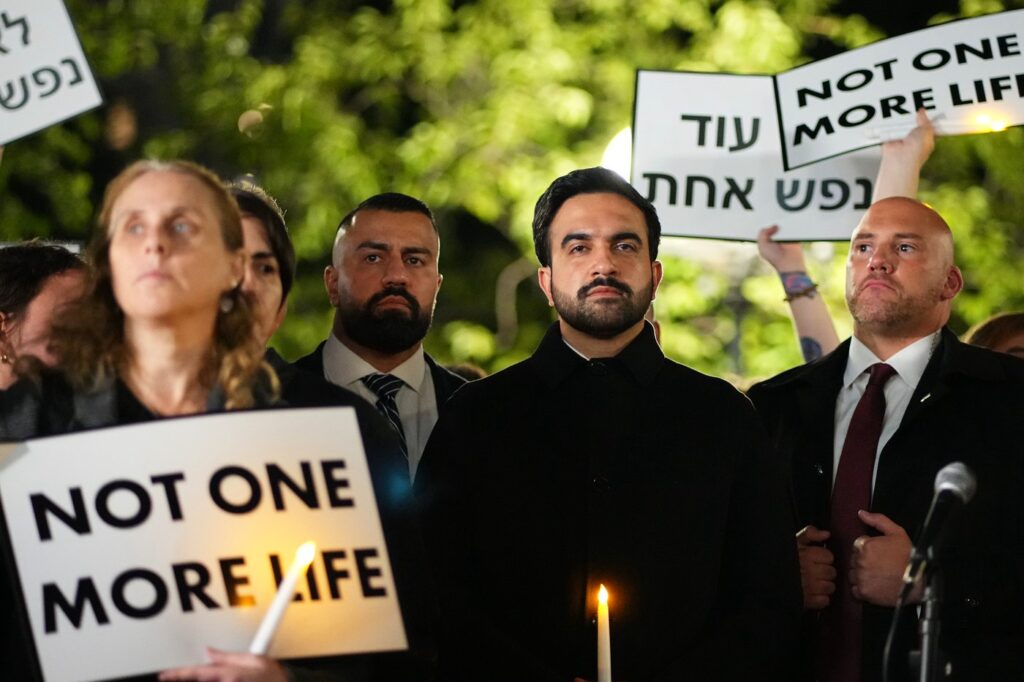
Mamdani participated in a candlelight vigil at Union Square organized by Israelis For Peace, a group of anti-occupation activists from Israel. However, the event was marred by protests from those waving Palestinian flags and chanting against the mayor. While Mamdani remained silent at the vigil, he seemed somber as protesters shouted accusations at him.
During the vigil, Brad Lander, a Jewish politician aligned with Mamdani during their mayoral campaigns, condemned violence targeting individuals regardless of nationality or religion. In response to the taunts, Lander emphasized the universal desire for the well-being of children, stating, “We refused to compromise on anyone’s humanity.” He later documented the event on social media, reinforcing the sentiment of remembrance for the victims.