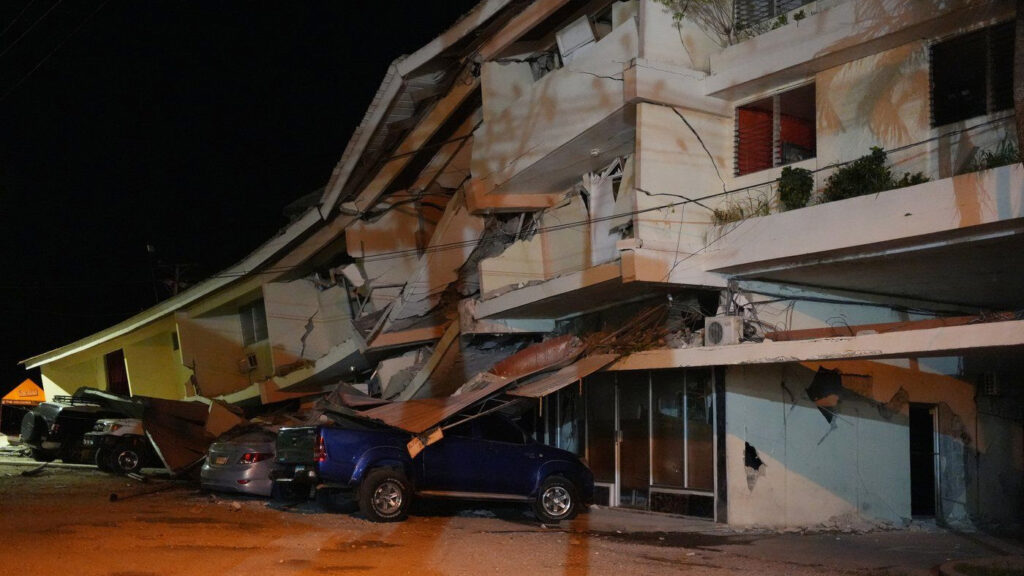
Two powerful earthquakes, measuring 7.7 and 6.6 in magnitude, struck southern Panama on Friday afternoon. The seismic events, accompanied by numerous aftershocks, caused building collapses near the epicenter and prompted nationwide evacuations.
The initial quake, which was felt as far away as neighboring Colombia, had its epicenter about 10 kilometers (6 miles) southwest of the remote community of Pitaloza Arriba in Herrera province. The U.S. Geological Survey (USGS) reported that it occurred at a depth of 10 kilometers (6 miles). Initially, the magnitude was estimated at 8.0, but it was later revised to 7.6 and finally confirmed at 7.7.
Residents of Panama City, visibly shaken, gathered outside, anxious to receive updates on the earthquake's impact. Rosendo Domínguez, a 60-year-old resident of Herrera province, reported, “We felt it very strongly. It knocked things over in the kitchen, but we’re okay, though we’re very scared. Everyone is outside, scared.”
The series of aftershocks included several significant tremors measuring 5.8, 5.5, and 5.2 in magnitude. Seismologists from the University of Panama recorded over 45 aftershocks, although many were too weak to be felt. The repeated shaking heightened fears among residents, especially given the recent history of devastating earthquakes in the region.
Calls for calm and reports of collapsed buildings
Despite the strength of the earthquakes, Panamanian President José Raúl Mulino stated that as of Friday evening, there were no confirmed fatalities. However, he cautioned that this situation might change in the coming hours or days. “Nobody was ready, and no one is ever ready for this type of disaster,” he remarked while calling for calm among the populace.
Images circulating on social media showed crumbling buildings and deep fissures in roads, reinforcing public apprehension. In June, similar back-to-back earthquakes in Venezuela’s La Guaira state killed over 6,500 people, while a 7.4 magnitude quake in Colombia in August resulted in at least 289 fatalities.
The comparatively lower toll in Panama may be attributed to stringent building codes, especially for skyscrapers in the capital, explained Carlos Valdés, head of the Seismology Department at the National Autonomous University of Mexico. Omar Smith from the National Civil Protection Service reported that the damage was mostly concentrated in the provinces of Veraguas, Herrera, and Los Santos, with no major damage reported in Panama City itself.
Several injuries were reported, including one person struck by debris from a partially collapsed structure in Penonomé, located around 150 kilometers (93 miles) from the capital. Confirmed damages included a partial collapse and cracks at the main cathedral in Penonomé, as well as structural issues at the governor’s office, and the Dos Continentes hotel. Additionally, local news outlets reported the collapse of the Church of San Atanasio, a nationally recognized historic site.
In terms of transport, Tocumen International Airport in Panama City, one of the busiest in the region, temporarily suspended operations following the initial quake but announced its reopening later in the day. The Panama Canal Authority reported that operations continued normally, focusing on employee and vessel safety while technical teams conducted inspections for potential damages.
Tsunami warnings as far as Chile’s Easter Island
The last major earthquake causing extensive damage in Panama occurred in 1991, with a 7.4 magnitude quake near Costa Rica resulting in 23 deaths and thousands left homeless. Earthquakes are relatively common in the region due to the interactions among several tectonic plates including the Cocos, Nazca, and Caribbean plates. Panama lies along the Ring of Fire, a 40,000-kilometer (25,000-mile) arc known for its volcanoes and fault lines, where the majority of the world’s earthquakes occur.
Initially, a tsunami warning was issued after the earthquakes for the coasts of Panama, Colombia, Ecuador, Nicaragua, and Guatemala, as well as for Easter Island in Chile. However, the National Weather Service later lifted these warnings. Néstor Luque from the Geosciences Institute at the University of Panama indicated that while waves between 3 to 10 feet (1 to 3 meters) were expected around Isla Caícas and the southern coast of Los Santos province, significant waves were not anticipated beyond that point.
Messages of support and offers of assistance quickly came from throughout the region. President Mulino expressed gratitude to fellow Latin American leaders for their solidarity, mentioning conversations with the presidents of Chile, Uruguay, and Guatemala. U.S. Secretary of State Marco Rubio stated he was monitoring the situation and mobilizing resources at the request of Panama’s government, pledging that “the United States stands with the people of Panama.” Colombian President Abelardo de la Espriella and other regional leaders also expressed their willingness to provide help during this challenging time.