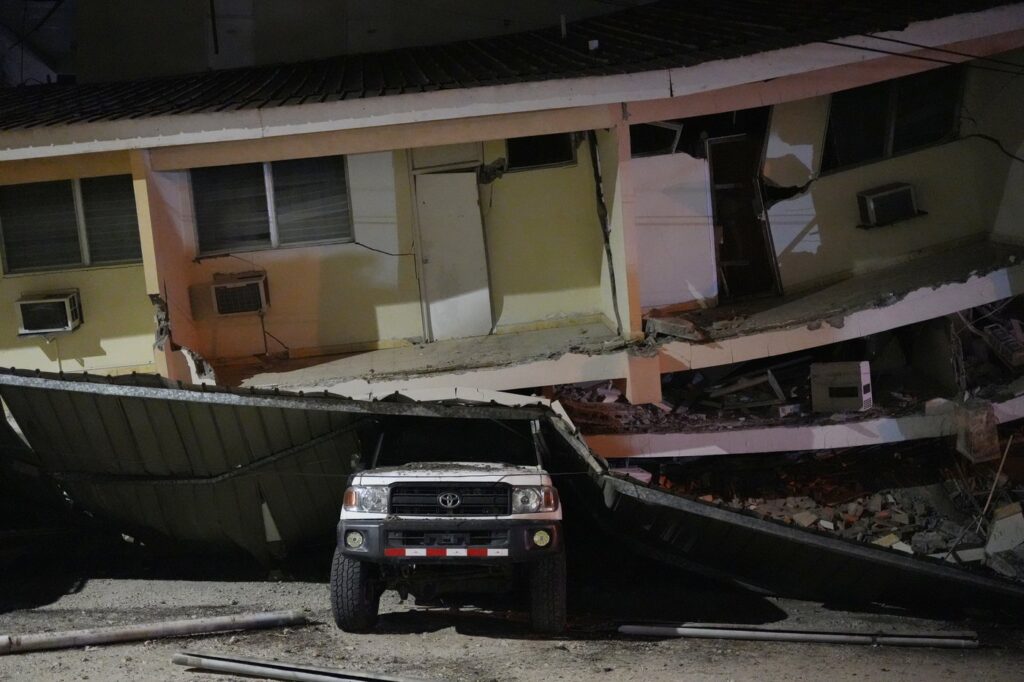
LA VILLA DE LOS SANTOS, Panama (AP) - Panama's government declared a state of emergency on Saturday in response to the aftermath of two significant earthquakes that affected communities across the nation for hours. While officials reported no fatalities connected to the tremors, damages were widespread, impacting all ten provinces and two Indigenous territories of Panama.
The earthquakes, measuring 7.7 and 6.6 on the Richter scale, occurred on Friday and led to building collapses near the epicenter, prompting evacuations nationwide. Seismologists recorded over 100 aftershocks, with some reaching magnitudes of 5.8, 5.5, and 5.2.
The initial quake, also felt in Colombia, was centered approximately 10 kilometers (6 miles) southwest of Pitaloza Arriba in the central province of Herrera and occurred at a depth of 10 kilometers (6 miles). Presidential Minister Juan Carlos Orillac announced the state of emergency during a press briefing in Panama City, detailing damage to homes, schools, healthcare facilities, roads, and hotels.
Malitzie Rivera, deputy director of the National Civil Protection System, reported injuries to 27 individuals, with varying degrees of severity. The most significant damage was noted in the central provinces of Veraguas, Herrera, Cocle, and Los Santos. The Civil Protection agency indicated that approximately 420 homes and as many public schools were damaged, alongside seven hotels, at least 13 churches, and nine bridges.
In La Villa de Los Santos, a colonial-era town situated 40 miles (64 kilometers) northeast of the epicenter, several homes and a historical Catholic church collapsed. Residents who spent the night outdoors were left waiting for government guidance on the next steps. Tony Jiménez, a 90-year-old resident whose home was partially destroyed, described the experience as utterly intense, noting he had never encountered such an event in his lifetime.
The Church of San Atanasio, which was designated a National Historic Heritage Site in 1938, is among the structures that suffered damage. Images depicting crumbling buildings and fissures in roads heightened concerns in a region that has recently experienced a series of catastrophic earthquakes. For context, two recent back-to-back earthquakes in Venezuela's La Guaira state claimed over 6,500 lives in June 2023, and a 7.4 magnitude earthquake in August 2023 in Colombia led to at least 289 deaths.
Experts suggested Panama's stricter building codes might have mitigated the earthquake's impact, especially on taller infrastructures in its capital. Although no people were reported missing, several communities remained isolated due to landslides and road damages. On Isla Cañas, off the Pacific coast of Los Santos, around 300 individuals were evacuated due to rising sea levels, while a shelter in Penonomé, approximately 93 miles (150 kilometers) from Panama City, hosted 13 people, including five children.
In Panama City, one of its water treatment plants was operating at only 20% capacity, and tent facilities with cots had been established at six hospitals. Tocumen International Airport, a key transportation hub, temporarily halted operations after the first earthquake, but resumed a few hours later; however, hundreds of travelers on airlines like Copa Airlines were left stranded due to canceled or delayed flights.
The Panama Canal Authority confirmed that operations along this critical global trade route remained uninterrupted, emphasizing employee and vessel safety while specialized teams conducted assessments for potential damage.
The last major earthquake that inflicted widespread destruction in Panama occurred in 1991, when a magnitude 7.4 earthquake, centered near Costa Rica, resulted in 23 fatalities and left thousands homeless. Earthquakes are relatively common around Panama, primarily due to its location amidst the interaction of various tectonic plates, including the Cocos, Nazca, and Caribbean plates. Furthermore, Panama is situated on the "Ring of Fire," a series of active volcanoes and fault lines surrounding the Pacific Ocean.
Following this recent seismic activity, regional nations extended their support and assistance to Panama. On Friday, President Mulino expressed gratitude for the solidarity shown by fellow Latin American leaders, including presidents from Chile, Uruguay, and Guatemala. The U.S. Department of State also mobilized a disaster response team to aid local authorities in search and rescue efforts, contributing $5 million for humanitarian aid. Additionally, U.S. Southern Command dispatched helicopters to deliver food supplies to affected communities.