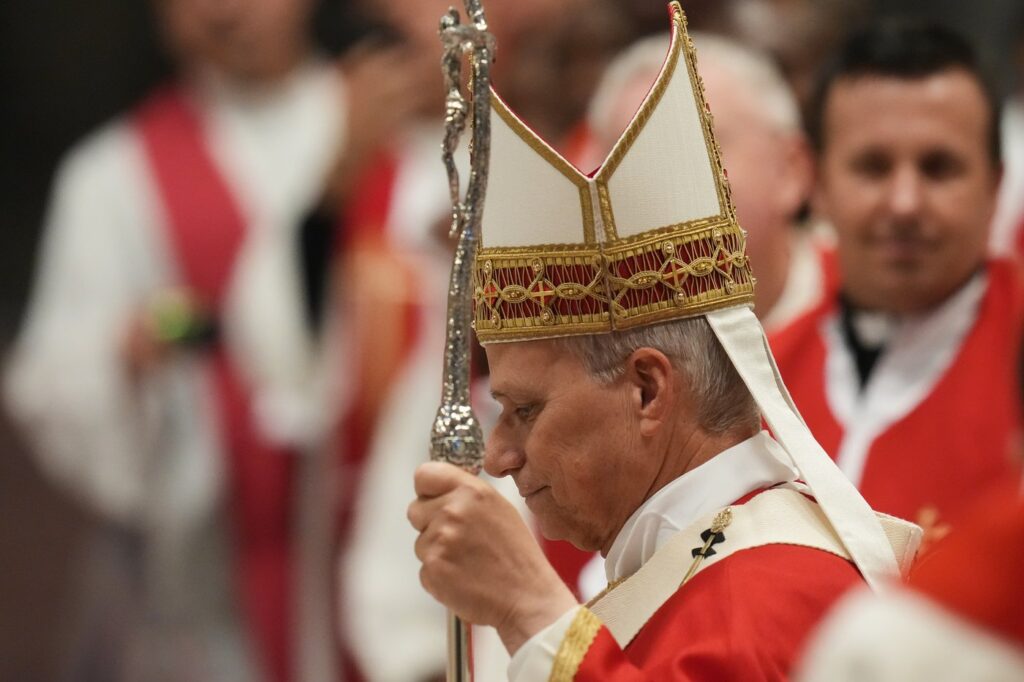
VATICAN CITY (AP) — Pope Leo XIV announced on Sunday that he will have surgery in the coming days to remove a nodule on his lung, marking the first major health issue of his 17-month pontificate. The 71-year-old pontiff mentioned that the nodule was detected at an early stage and is small and localized, with the Vatican estimating a recovery time of about a week.
In an unusual display of transparency regarding his health, the American pope revealed the news during his Sunday noon blessing. He expressed gratitude for the support from the crowd and asked for their prayers as he prepares for surgery. While the Vatican has not provided a specific date for the procedure, it is anticipated to occur early in the week.
Pope Leo XIV has one significant event scheduled: the closing Mass on Wednesday for a weeklong conference on family ministry. However, Vatican officials have indicated that he might miss this event due to his surgery. Lung nodules, which can be benign or malignant, are small abnormal growths typically measuring less than 3 centimeters (1 inch), often incidentally discovered during imaging scans conducted for other medical reasons.
Dr. Stephen Liu, a lung cancer specialist at Georgetown's Lombardi Comprehensive Cancer Center, emphasized that lung nodules are common and often benign. However, he also stated the importance of investigating any nodule when there is concern, noting that surgical removal can provide a definitive diagnosis and may lead to a favorable outcome if cancer is detected early.
Pope Leo XIV does not have a history of health issues and maintains an active lifestyle, including weekly tennis and swimming at the papal retreat in Castel Gandolfo. Additionally, he has a major trip planned from November 6-17 to Uruguay, Argentina, and Peru, although it remains uncertain how his surgery and recovery will affect this itinerary. Nonetheless, the pope conveyed his intention to proceed with the trip.
In his address, Leo mentioned that doctors had discovered a circumscribed nodule during a recent medical check-up. He affirmed that he intends to follow the medical advice provided and undergo surgery for its removal. He thanked his supporters for their continued spiritual backing and entrusted himself to their prayers.
The pope's surgery is expected to take place at Rome's Gemelli hospital, a facility that has treated both Pope Francis and previous popes. While there were no signs of admission on Sunday, the Vatican has historically been protective of the pope's health information. Unlike Pope Francis, whose health updates were often marked by inconsistent communication, Pope Leo has taken the initiative to deliver news about his condition personally.
According to Dr. Dionysis Papadatos-Pastos, an oncologist and lung cancer specialist, the presence of a lung nodule does not automatically indicate lung cancer. He noted that a well-circumscribed nodule is typically less likely to be malignant; however, investigation is crucial. Surgical examination of the nodule is a common practice, particularly for an otherwise healthy individual and if the nodule is located in a surgical area. Dr. Liu reassured that such a surgical procedure is generally safe and straightforward, allowing for rapid recovery.
Dr. Massimo Di Maio, the president of the Italian Association of Medical Oncology, emphasized the importance of determining the nature of the nodule and whether it has spread if found to be malignant. Early-stage detection is pivotal for successful curative treatment. He noted that being physically fit aids in coping with treatment and surgery.
Italian Premier Giorgia Meloni expressed support for Pope Leo XIV in his upcoming challenges, acknowledging the calmness with which he addressed his health issue as reassuring. The collaborative efforts in keeping the public informed while respecting the pope's privacy underscore a shift in the Vatican’s approach to the health communications of its leaders.