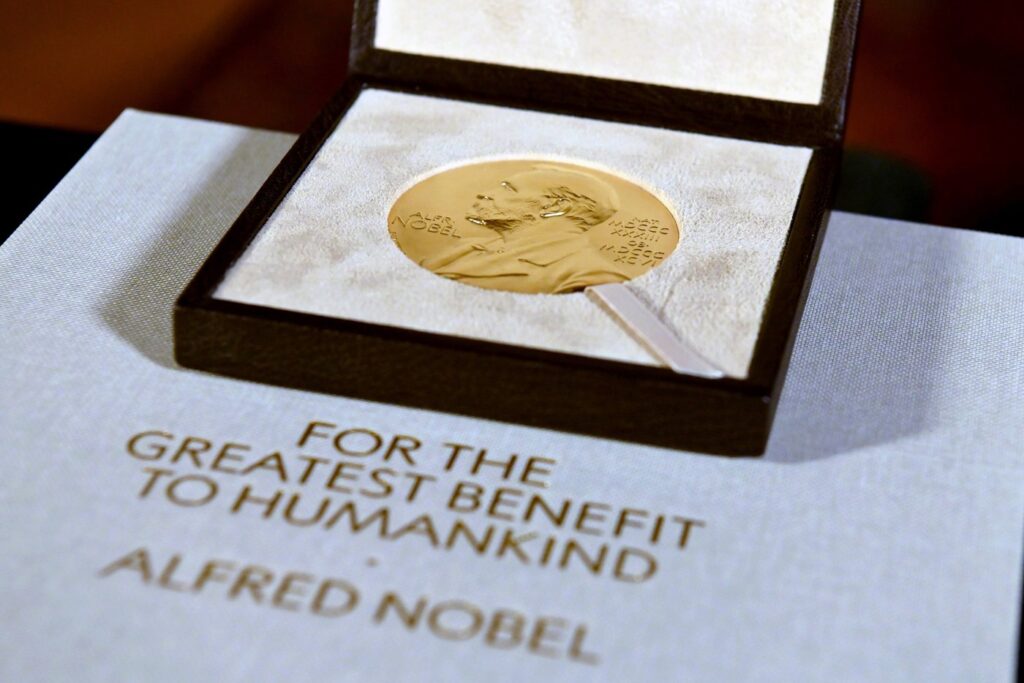
This year’s Nobel Prize awards concluded on Monday, with two economists receiving the Memorial Prize in Economic Sciences for their contributions to models that aid in managing economic shocks.
The award ceremonies are scheduled for December 10, commemorating the anniversary of Alfred Nobel's death, the founder of the prestigious awards.
The prize money for this year stands at 12 million Swedish kronor, which is approximately $1.2 million, awarded whether to an individual, a small group of laureates, or an organization.
Here are the highlights of this year’s Nobel Prize winners:
Medicine
On October 5, the Nobel Prize in Medicine was awarded to three scientists recognized for their groundbreaking research that led to the development of a tool utilizing light to decipher brain functioning. The laureates, Dr. Karl Deisseroth, Peter Hegemann, and Georg Nagel, opened a new field known as optogenetics, which combines light and genetic manipulation to control neuron activity in living brains.
Physics
On October 6, Belgian-born scientist Francis Halzen received the Nobel Prize in Physics for his pioneering work on demystifying neutrinos, a rare group of cosmic particles that provide insight into the evolution of the universe. Neutrinos are tiny particles that lack electric charge and have an extremely small mass, making them challenging to detect. Halzen ingeniously proposed using the vast Antarctic ice as a detector for collisions involving these elusive particles.
Chemistry
On October 7, the Nobel Prize in Chemistry was presented to scientists Henri B. Kagan and Kenso Soai for their work in understanding chiral molecules, an achievement that has significantly contributed to drug development and transformed modern medicine. Their discovery involves manipulating chemical reactions to favor specific molecular “handedness,” akin to the difference between left and right hands.
Literature
On October 8, the Nobel Prize in Literature was awarded to Canadian poet, essayist, and translator Anne Carson for her "bold and inventive" works that merge the classical with the modern, blurring the lines between poetry and prose. The 76-year-old Toronto-born artist often draws upon themes from classical Greek and Roman literature, as well as contemporary influences and personal experiences.
Peace
On October 9, the Nobel Peace Prize was awarded to Navi Pillay, a former U.N. human rights chief from South Africa, for her endeavors in promoting international law amidst prevailing hostilities. Her recognition is perceived as a pointed critique of U.S. President Donald Trump and Israeli Prime Minister Benjamin Netanyahu, who have dismissed the findings of the U.N. commission she led regarding the situation in Gaza. Following the announcement of her award, the Trump administration imposed new sanctions on the International Criminal Court, heightening tensions over her critical stance on U.S. policies.
Economics
The economics prize was awarded on Monday to American economists Robert E. Hall and Michael Woodford for their development of models that assist governments and central banks in managing economic fluctuations, including crises related to energy and inflation. Their foundational work helps in comprehending consumer behavior relating to saving and spending, thereby enhancing the ability of policymakers worldwide to stabilize economies in challenging times.