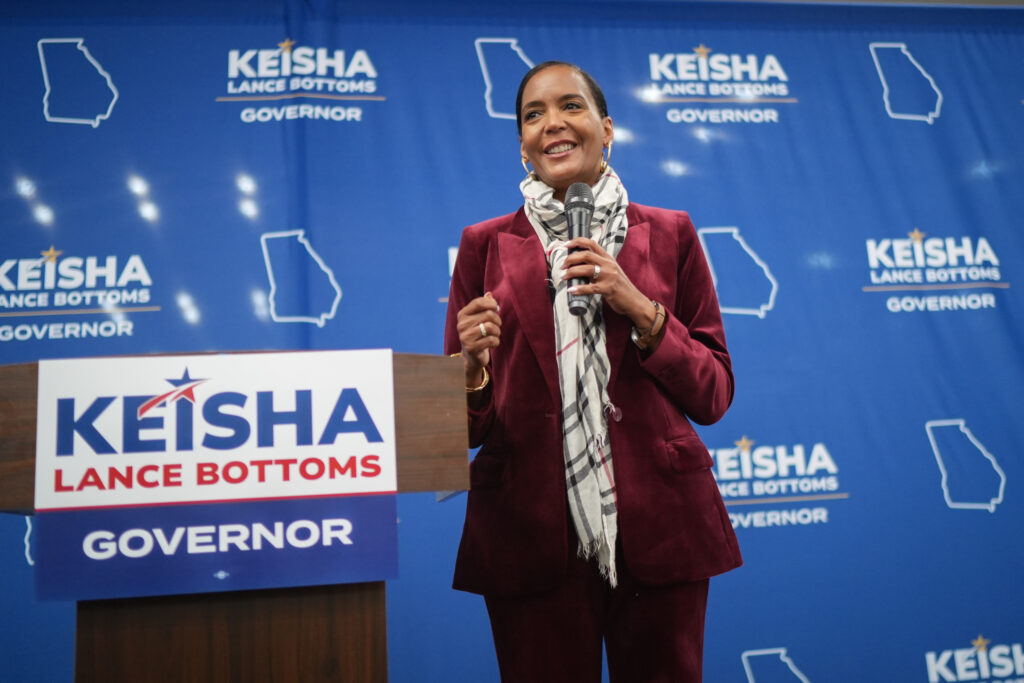
On Tuesday, Democrat Keisha Lance Bottoms made history by being elected as the governor of Georgia, becoming the first Black woman to hold a gubernatorial office in the United States. She defeated Republican businessman Rick Jackson in a highly contested race that flipped a critical swing state seat in favor of the Democrats.
A former mayor of Atlanta, Bottoms won despite facing a significant campaign spending disadvantage, with Jackson leveraging over $200 million of his own wealth. This victory marks the first time a Democrat has won the Georgia governorship since 1998.
In her pre-election remarks, Bottoms stated, “What we do in this moment will echo through history.” Rather than focusing solely on the historical significance of her candidacy, she emphasized her commitment to improving the state's economy and countering the policies of President Donald Trump.
Bottoms called for unity, saying, “Let’s choose hope over fear, progress over division, and come together to build a better Georgia for everyone.” Her victory indicates a shift in Georgia's political landscape, particularly as Atlanta continues to grow in influence. It adds to a series of milestones for the state, including the reelection of Democrat Jon Ossoff, Georgia's first Jewish senator, alongside Raphael Warnock, the state’s first Black senator.
Jackson acknowledged the outcome in a speech to his supporters, stating, “Tonight, the voters spoke… and I respect their decision.” He was unable to continue following the administration of Republican Governor Brian Kemp, who was ineligible to seek a third term. The election pointed to a continuing trend of Black women leading gubernatorial tickets in Georgia, marking the third consecutive election with this scenario after Kemp's victories against Stacey Abrams.
Policy Over History
Bottoms was one of eight Black major party nominees for governor this year, amidst a backdrop of only three Black governors ever elected in U.S. history, all of whom were Democratic men. In this election cycle, Bottoms and Republican Lisa Demuth of Minnesota both campaigned for the governorship.
She often refrained from highlighting the historical implications of her candidacy, opting instead to share her family's legacy, stating, “I am at least a fifth-generation Georgian.” She recounted how her grandfather had to enter buildings through back doors in Atlanta, a stark contrast to her present status as the city's mayor. This recognition of her ancestry shaped her perspective on the policies she seeks to implement.
Among her policy proposals, Bottoms advocates for expanding Medicaid to cover hundreds of thousands more Georgians and raising the state’s minimum wage to $15 an hour. Other key issues on her agenda include increasing salaries for teachers and public servants, repealing Georgia's restrictive abortion law, and imposing a pause on new data center developments.
In addressing the contentious abortion ban, Bottoms emphasized its life-and-death implications, mentioning tragic cases linked to miscarriage and complications women face under the current legislation. She has vocally opposed Jackson’s alignment with Trump, asserting, “I’m not running to be his favorite governor. I’m running to work on behalf of people like you.”
Throughout the campaign, she countered Jackson's narrative that he understood the struggles of average Georgians, pointing out his profitable position as the owner of Jackson Healthcare. She criticized his attempts to use his financial advantage to sway the election outcome, branding him a candidate who sought to “buy this election.”
Changing Political Dynamics in Georgia
Jackson's defeat signifies a critical shift in Georgia's political environment as it transforms into a competitive two-party battleground. Initially a political outsider with limited name recognition, Jackson used his wealth to navigate past established Republican figures to secure the nomination. Despite strong GOP control of the Georgia state government, including both chambers of the General Assembly for over two decades, Democrats are optimistic about their growing influence.
On Election Day, while Democrats aimed to gain control of the state House, Republicans appeared favored to maintain their Senate majority. The outcome of this election potentially sets the stage for new political dynamics in Georgia, showcasing a robust push towards Democratic representation in a historically Republican stronghold.