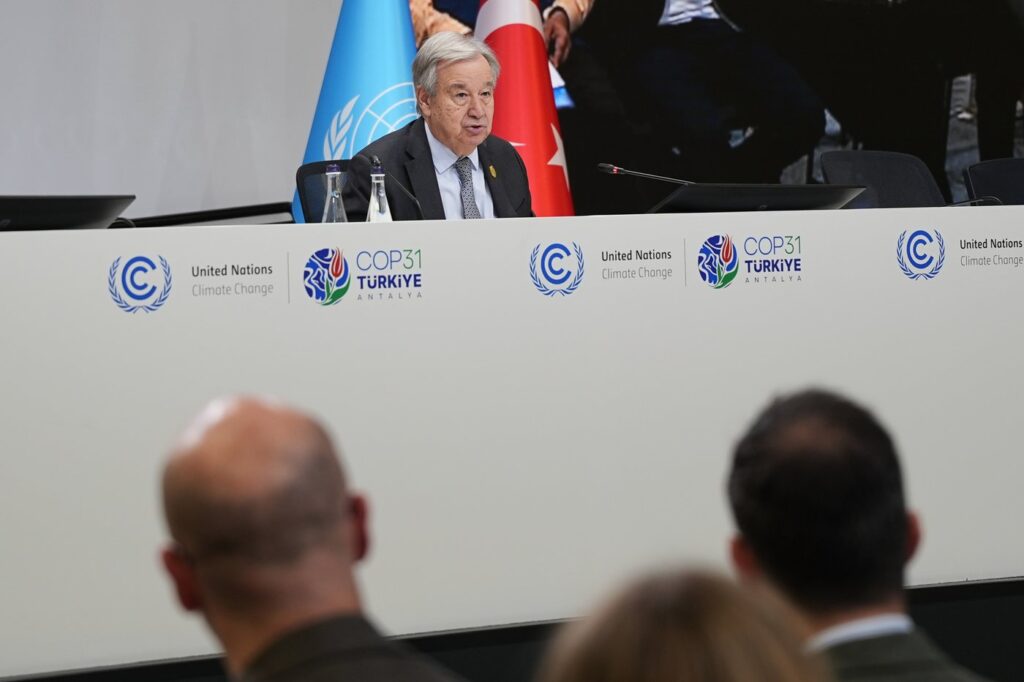
ANTALYA, Turkey (AP) At the conclusion of his final climate summit, United Nations Secretary-General António Guterres emphasized the urgent need for the world to dramatically reduce fossil fuel emissions to prevent the most catastrophic effects of climate change. Speaking in Antalya, Turkey, Guterres urged global leaders to "follow the science" and confront the hard realities of climate change.
Guterres remarked, "You cannot build peace on a burning planet," stressing that climate change is a central issue for the U.N. because it exacerbates geopolitical instability. He pointed out that climate change drives hunger and displacement, places countries under financial stress, and intensifies competition for essential resources like land and water. He added, "You cannot eradicate poverty when climate disasters keep throwing people back into it," highlighting the detrimental cycles of poverty and environmental degradation.
During the annual U.N. climate talks, world leaders are seeking a consensus on actionable measures to address climate issues, which are becoming increasingly lethal, manifesting in more frequent heat waves, droughts, floods, and other disasters. The talks particularly focus on aiding countries most at risk from these phenomena, including vulnerable island nations facing land loss due to rising sea levels.
A key topic of contention in the discussions is the goal for electrification, which proposes to increase the share of electricity in total global energy consumption from around 21% to 35% by 2035, ideally sourced from renewable energy like solar and wind. However, the aim does not mandate that electricity must come from renewable sources, allowing for the continued use of coal and other fossil fuels at least initially. Guterres highlighted that prioritizing clean energy would lead to a 14% reduction in global emissions, compared to a mere 7% if fossil fuels are allowed in the electrification equation. In contrast, International Energy Agency Executive Director Fatih Birol advocated for broader agreement among nations even without a strict clean energy requirement.
Environmental groups, however, maintain that true electrification will only yield significant outcomes if dependence on fossil fuels is eliminated. Jasmin Duregger from Greenpeace's Global Gas Campaign stated, "Electrification must end fossil fuel dependence, not be an end in itself."
Leaders from climate-affected nations, particularly poorer countries that have contributed minimally to climate issues, are increasingly vocal about their need for financial support to address climate disasters and adapt to a warming environment. Representatives from small island nations, for whom climate change is literally a matter of survival due to rising seas, have emphasized the urgency of strengthening a U.N. fund intended to compensate vulnerable nations.
Guterres asserted that wealthier nations, which have contributed disproportionately to climate change, must fulfill financial pledges made at previous summits, while also increasing their contributions. He underlined that merely tripling adaptation financing would still cover less than 30% of the actual needs, describing the financial gap as severe.
Progress on climate action is stymied by the absence of key participants, particularly the largest emitting countries. Guterres noted that effective collaboration among all nations, especially top emitters, is crucial. An independent report by Climate Action Tracker indicated that efforts to mitigate global warming have stagnated over the past five years, suggesting that the world will likely exceed the goal established under the 2015 Paris Agreement of limiting warming to 1.5 degrees Celsius (2.7 degrees Fahrenheit) above pre-industrial levels. The report implied that even if every nation fulfills its current commitments, global temperatures could rise by 2.6 degrees Celsius (4.7 degrees Fahrenheit) by century's end.
Guterres called for urgent action, emphasizing that reducing emissions by about 6% annually is essential to keep temperature increases to a minimum. He described the prospect of exceeding 1.5 degrees Celsius as "a recipe for catastrophe." Notably, some of the world's largest polluting nations, including the United States, did not participate in this year’s summit. This marks the second consecutive year the U.S., historically the largest contributor to climate issues, has been absent from these crucial discussions.
"Facts are facts," Guterres stated. "No country can protect itself from climate change alone. We share one planet, and whether we like it or not, we share one fate."