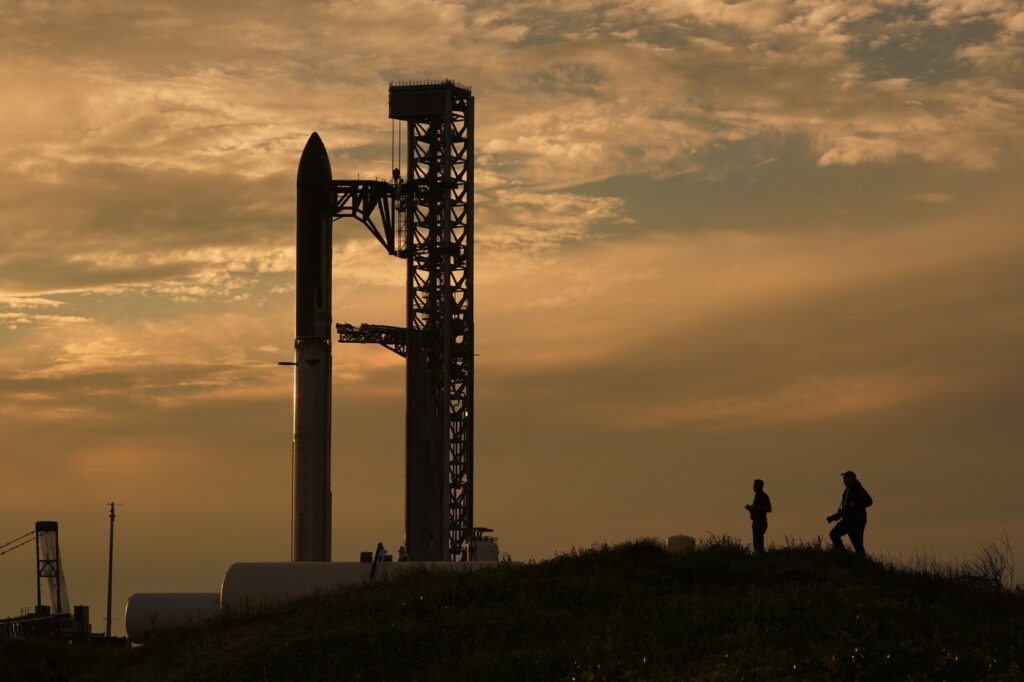
SpaceX is set to launch its Starship rocket into orbit on Friday in what is considered the company's most ambitious test to date. This 22-hour mission aims to recover the entire rocket system, a pivotal step intended to accelerate efforts for travel to the Moon and Mars. The launch is anticipated to take place in the late afternoon, subject to approval by the Federal Aviation Administration.
Upon successful launch, the massive booster is designed to return to its Texas launch pad just six minutes after liftoff. Meanwhile, the bullet-shaped Starship spacecraft aims to navigate back to Earth the following day. In an innovative approach, both components are intended to be caught mid-air by mechanical arms attached to the launch tower, marking a significant milestone in rocket recovery efforts.
Should Elon Musk and the SpaceX team successfully execute this plan, it would be the first time a rocket launched into orbit has been entirely retrieved for the purpose of recycling. Musk envisions this capability as essential for achieving rapid and consistent launch rates necessary to establish lunar bases and facilitate human missions to Mars.
"It’s hard to describe how I'm going to feel when we pull this off,” expressed Kiko Dontchev, SpaceX's vice president of launch, during a recent NASA tech summit at Florida's Kennedy Space Center. He characterized the event as exceptionally exciting and a remarkable feat of engineering.
Once in orbit, the Starship will deploy 26 advanced Starlink satellites. The spacecraft is scheduled to complete 15 orbits around the Earth at an altitude of approximately 170 miles (275 kilometers) before returning to the launch site for a dramatic conclusion on Saturday.
SpaceX has conducted three successful booster captures at the Starbase facility located near the U.S.-Mexico border. However, this launch will mark the first attempt to capture the upgraded Starship model, which stands 236 feet (72 meters) tall, as well as to catch the spacecraft itself, which measures 171 feet (52 meters). In the past, the spacecraft portion of 14 previous Starship attempts ended up in the ocean, either by design or due to malfunctions that triggered self-destruct systems.
The last test conducted in September represented the first occasion where the Starship reached orbit, although no attempts were made to recover any stages of the rocket. Going forward, SpaceX plans to initiate launches from Florida within a few months and from Louisiana in the coming years. The scaling of infrastructure, combined with the complete reusability of the rocket, is seen as a pathway to rapidly increase launch frequency.
SpaceX's smaller Falcon rockets will continue to operate out of Cape Canaveral, ferrying astronauts to the International Space Station for NASA and transporting Starlink satellites from California for the time being. Ultimately, Musk aims for the Starships to replace the Falcon rockets.
According to Dontchev, the Falcon rockets are not fully reusable since the second stage is disposed of after each flight, whereas the Starship is designed for the recovery of both the first and second stages. Significant financial backing from NASA reinforces SpaceX's commitment to transport Artemis astronauts to the Moon via Starship, with competing interests from Jeff Bezos' Blue Origin.
Nasa's decision regarding which spacecraft will deliver astronauts for the Artemis IV lunar landing—marking the first such landing in over fifty years—is expected a year prior to the mission. The Artemis III mission, scheduled for next summer, will involve astronauts practicing docking their capsule with both Blue Moon and Starship in Earth orbit, laying the groundwork for an anticipated lunar landing by 2028.