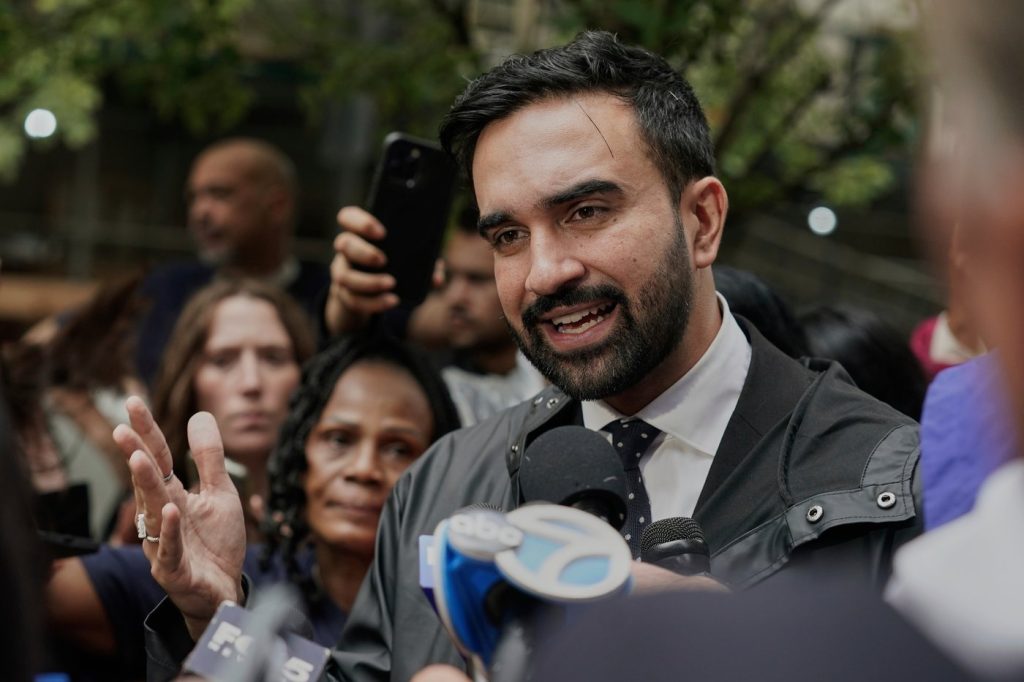
Zohran Mamdani's rapid ascent in the New York City mayoral race has made him a national figure, evoking pride among many Muslim Americans while also serving as a target for right-wing political attacks. If elected, Mamdani would make history as the city’s first Muslim mayor, but his candidacy has sparked a wave of anti-Muslim sentiment. Notable Republican figures, including Rep. Andy Ogles from Tennessee, have resorted to derogatory labels and calls for deportation, while Rep. Nancy Mace from South Carolina linked Mamdani to 9/11 in a social media post alongside a photo of him in traditional attire.
Far-right activist Laura Loomer ominously suggested that New York City could be facing another 9/11 due to Mamdani's candidacy. His campaign symbolizes both the struggle against anti-Muslim discrimination and the increasing assertiveness of Muslim Americans seeking to claim their space in political leadership. “He really does hold so much symbolism,” stated Youssef Chouhoud, a political scientist, underscoring the dual narrative of discrimination and empowerment within Mamdani's campaign.
Mamdani has faced criticism from both political parties, with conservatives notably targeting his progressive views and stance on Israel. Former President Donald Trump has singled him out, falsely questioning his U.S. citizenship—a tactic reminiscent of Trump's “birther” conspiracy against Barack Obama. At the National Conservatism Conference, speakers like Steve Bannon labeled Mamdani a “Marxist and a jihadist,” reflecting the intensity of the attacks directed at him.
This vitriol resonates with many Muslim Americans, including Amani Al-Khatahtbeh, who expressed concern that while Muslims are gaining visibility in politics, dehumanizing sentiments against them have become more prevalent. "We’re at a crossroads," she noted, highlighting the juxtaposition of Muslim representation and the persistence of hate.
The race has also underscored the rise of political violence. Following threats against Mamdani, some even labeling him a terrorist, the candidate's campaign denounced these acts, connecting them to a broader culture of hate within the city. “We will not be intimidated by racism, Islamophobia, and hate,” the campaign's statement asserted, emphasizing their commitment to standing against such attacks.
Anti-Muslim bias has remained a distressing reality in the U.S., particularly since the events of September 11, 2001. The era has seen practices like the NYPD's disbanded Muslim surveillance program, alongside numerous political machinations that have perpetuated a narrative that positions Muslims as outsiders. Eman Abdelhadi, a sociologist, articulated that the underlying message of anti-Muslim rhetoric remains consistent: portraying Muslims as a threat and perennial foreigners.
Mamdani's sudden prominence in the aftermath of the Israel-Hamas conflict has further complicated his campaign. Accusations of antisemitism have been leveraged against him, especially by fellow Democrats like former Governor Andrew Cuomo and Mayor Eric Adams, who called him “dangerous” for his views on Israel. In a controversial incident, an outside group supporting Cuomo produced a flyer that altered a photo of Mamdani to emphasize stereotypical features, a move that Mamdani condemned as blatant Islamophobia.
Optimism pervades the sentiments of many American Muslims regarding Mamdani's potential victory. Shahana Hanif, the first Muslim woman elected to the New York City Council, expressed hope that the tactics of fear surrounding Islamophobia are failing. Hanan Thabet, another supporter, articulated the emotional stakes of Mamdani's candidacy, reflecting on the collective grief within her community due to current events affecting Palestinians in Gaza. Her children's enthusiastic engagement with Mamdani's campaign represents the hope and energy he has inspired.
Overall, Zohran Mamdani's bid for mayor encapsulates a complex interplay of hope, resistance, and tension within contemporary American politics, especially concerning the representation of Muslim Americans in leadership roles. His campaign not only addresses the current sociopolitical landscape but also reflects the struggle of a nation grappling with its history of discrimination and the aspiration for genuine inclusivity.