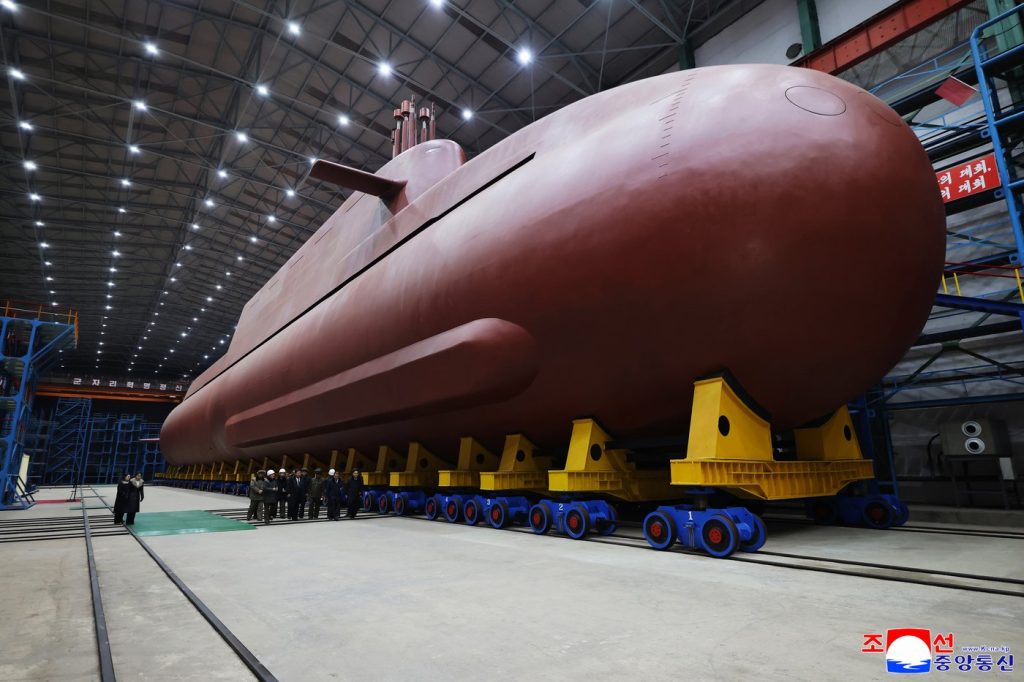
SEOUL, South Korea (AP) – On Thursday, North Korea showcased significant advancements in the construction of what it claims to be an 8,700-ton-class nuclear-powered submarine. Images released by state media depicted a nearly completed hull, as North Korean leader Kim Jong Un criticized neighboring South Korea's attempts to obtain similar technology. According to the Korean Central News Agency, Kim inspected the shipyard where this strategic guided missile submarine is being constructed, emphasizing its importance in modernizing and strengthening North Korea's naval capabilities.
During his visit, Kim expressed strong opposition to South Korea's plans, which have been supported by U.S. President Donald Trump, labeling them an "offensive act" that undermines North Korea's security and maritime sovereignty. He argued that these developments further highlight the necessity for North Korea to enhance its navy's nuclear capabilities, asserting that the completion of the submarine would represent an "epoch-making" shift in the nation’s nuclear deterrent strategy against perceived threats.
Although the exact date of Kim's shipyard visit was not disclosed, the images released featured him inspecting a massive vessel coated in anti-corrosion paint. This marks the first sighting of the submarine since March, when earlier images mainly focused on its lower sections. The current state of the submarine suggests that many essential components, such as the engine and potentially even the reactor, may have been installed, as submarines are generally assembled from the inside out, according to Moon Keun-sik, a marine specialist at Hanyang University in Seoul.
Moon posited that the unveiling of the vessel likely indicates that it could be ready for sea trials in the near future, potentially within months. The development of a nuclear-powered submarine has been one of Kim's key military objectives, forming part of a broader agenda announced in 2021 that aims to address what he perceives as escalating U.S.-led military threats. Additional weaponry on Kim's wish list includes solid-fueled intercontinental ballistic missiles, hypersonic weapons, spy satellites, and multi-warhead missiles, with North Korea conducting various tests to develop these systems.
Should North Korea succeed in building a submarine that can operate stealthily for extended periods and launch missiles from beneath the ocean, it would pose a significant risk to regional stability, as these missile firings would be challenging to preemptively detect. Concerns persist regarding North Korea's capacity to obtain the resources and technology necessary for constructing nuclear-powered submarines, especially given the country's economic sanctions and impoverished state. However, some analysts suggest that North Korea's recent alignment with Russia may have facilitated access to critical technologies in exchange for military support.
In the context of its ambitions, South Korea is simultaneously pursuing its own nuclear-powered submarine capabilities. During a summit with Trump, South Korean President Lee Jae Myung requested U.S. support for these efforts, stressing that it is vital to bolster defense spending. The feasibility of acquiring nuclear fuel and reactor technology for such submarines remains a topic of ongoing discussion.
In a separate report, the Korean Central News Agency indicated that Kim oversaw tests of new anti-air missiles launched into the sea, while South Korea's Joint Chiefs of Staff confirmed multiple missile launches detected from North Korea's eastern coastal regions, prompting an assessment by South Korean and U.S. intelligence agencies regarding the nature of the weaponry used.
The situation on the Korean Peninsula has become increasingly tense in recent years, particularly as Kim has accelerated his military nuclear program and further strengthened ties with Moscow in the wake of Russia's invasion of Ukraine. Despite repeated calls from Washington and Seoul to revive negotiations aimed at curbing North Korea's nuclear ambitions, the regime has consistently disregarded these overtures, maintaining a hardline stance on its nuclear and missile programs.