IDLIB, Syria (AP) – A bombing at the Imam Ali ibn Abi Talib Mosque in Homs during Friday prayers resulted in the deaths of at least eight individuals and left 18 others wounded. This tragic incident highlights the ongoing sectarian, ethnic, and political strife that continues to plague Syria, despite a relative decrease in large-scale fighting.
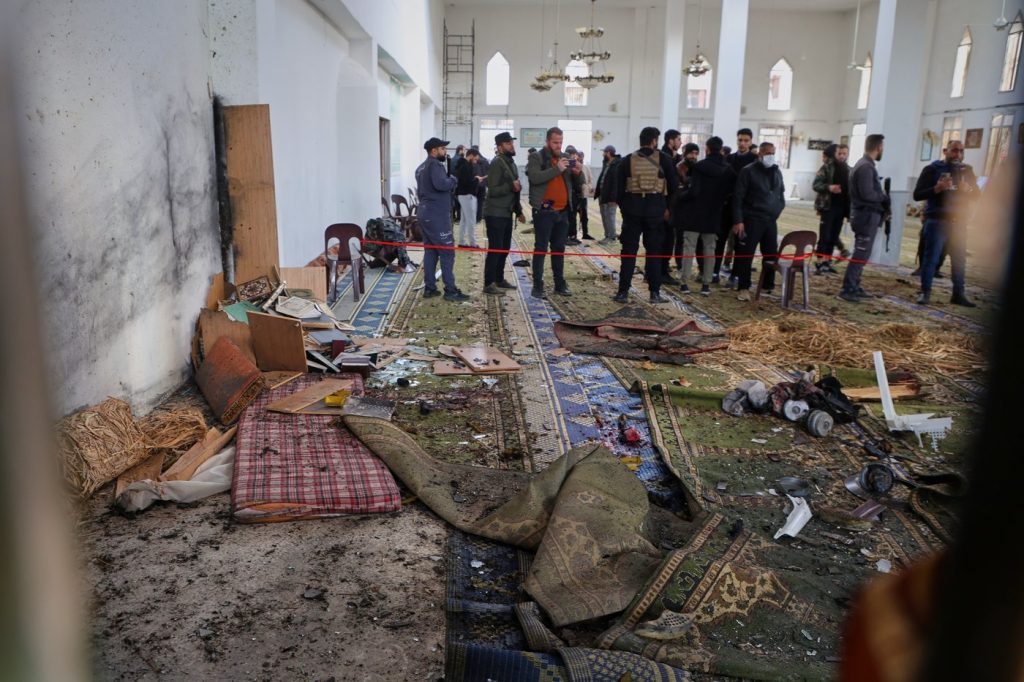
Images from Syria’s state-run Arab News Agency depicted gruesome scenes with bloodstains on mosque carpets, damage to the walls, shattered windows, and evidence of fire. The mosque is situated in Homs, Syria's third-largest city, specifically within the Wadi al-Dhahab neighborhood, which primarily houses members of the Alawite minority.
The Syrian state news agency SANA reported that initial investigations indicated that explosive devices were strategically planted within the mosque. Authorities are actively searching for the attackers, whose identities remain unknown, and have established a security perimeter around the building, as confirmed by the Syrian Interior Ministry. A little-known group named Saraya Ansar al-Sunna claimed responsibility for the attack via a statement on its Telegram channel. This group had previously identified itself following a suicide bombing in June, which targeted a Greek Orthodox church in Dweil'a, resulting in 25 fatalities.
The Syrian government has linked the church attack to a faction of the Islamic State (IS), although IS did not adopt any responsibility for that incident. This extremist group, which propagates a radical interpretation of Sunni Islam, regards Shiites—who include the Alawite sect—as infidels. Raising concerns, Syria recently became a part of the global coalition combating IS and has intensified its efforts against IS units, particularly after a recent attack on U.S. forces led to the deaths of two service members and a civilian translator.
U.N. Secretary-General Antonio Guterres unequivocally condemned the mosque bombing, emphasizing the necessity to identify and bring the culprits to justice. A spokesperson for the U.N. stated that Guterres recognized Syria’s commitment to combat terrorism and ensure accountability for the violence.
In Syria, the Alawite community, to which President Bashar Assad belongs, has faced numerous episodes of targeted violence since the civil war’s peak. Following Assad’s downfall last year, Alawites have reportedly been subjected to significant repression. In March, a vicious attack by Assad supporters on security forces ignited a wave of violence, resulting in the deaths of hundreds, predominantly from the Alawite sect.
In a statement, the Supreme Alawite Islamic Council described the mosque explosion as a continuation of organized terrorism targeting the Alawite community and other Syrian groups. The council placed full responsibility for these violent acts squarely on the Syrian government, promising that such criminal actions would not go unpunished.
Condemning the attack, local officials characterized it as part of a wider pattern of desperate attempts to destabilize the region and undermine civil harmony among the Syrian population. The Ministry of Foreign Affairs reaffirmed Syria's stance against all forms of terrorism and highlighted the convergence of former regime remnants, IS militants, and their collaborators towards a single objective: to hinder the development of a new state and disrupt stability, thereby threatening civil peace.
The mosque’s deputy imam recounted the terrifying moments during the attack, describing how worshippers were praying when a loud explosion rocked the building, knocking many to the ground and starting a fire that damaged copies of the Holy Quran. Following the explosion, security forces and the Red Crescent arrived to assist the injured.
Regional neighbors, including Saudi Arabia, Jordan, and Lebanon, condemned the attack, with Lebanese President Joseph Aoun reaffirming Lebanon’s support for Syria’s fight against terrorism. Additionally, intermittent clashes resumed on Monday between Syrian government forces and Kurdish-led fighters in Aleppo, resulting in temporary closures of schools and public facilities as civilians sought shelter. A ceasefire was subsequently announced, but tensions persisted, with allegations of violence exchanged between security forces and Kurdish fighters continuing into Friday.