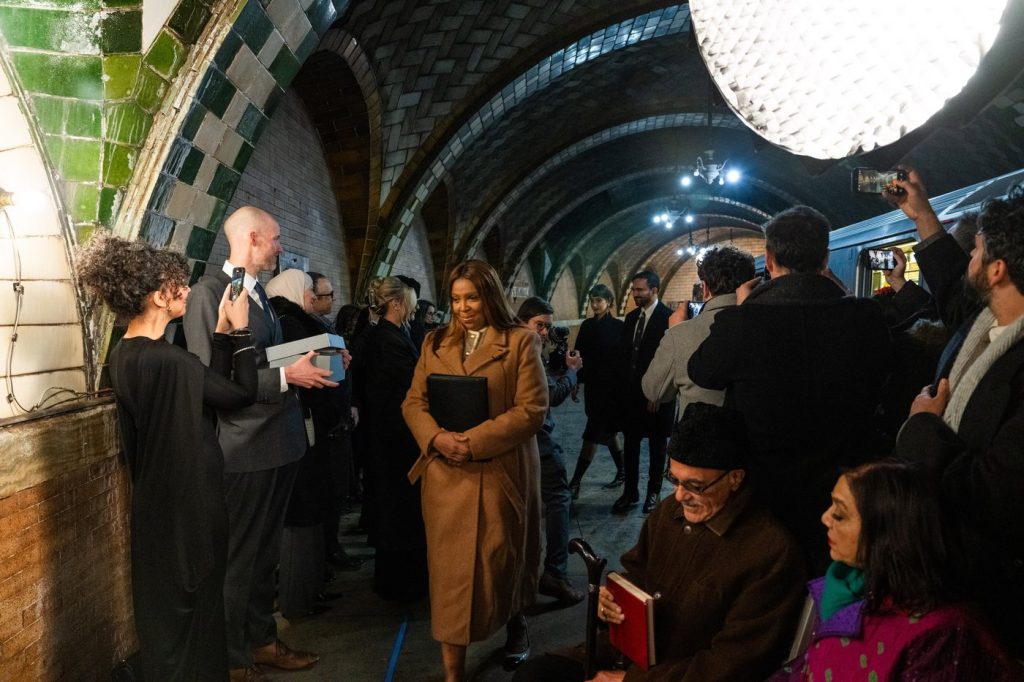
NEW YORK (AP) – Zohran Mamdani was sworn in as the 110th mayor of New York City using a Quran, marking a historic moment for the city as it is the first time a mayor has utilized Islam's holy text for the oath. The event took place in a long-closed subway station beneath City Hall, emphasizing that Mamdani is not only the first Muslim but also the first South Asian and the first African-born individual to assume the mayoral position in New York. At 34 years old, Mamdani's swearing-in reflects a series of historic milestones, symbolizing the vibrant Muslim community in the city, as noted by scholars assisting his family.
Traditionally, New York City mayors have taken their oaths on the Bible, but there is no requirement to use a religious text during the process. Mamdani openly embraced his Muslim faith throughout his campaign, making significant appearances at mosques across the five boroughs. This outreach garnered him considerable support, particularly among first-time South Asian and Muslim voters.
During the subway ceremony, two Qurans were used: one belonged to his grandfather, and the other is a pocket-sized Quran dating back to the late 18th or early 19th century, part of the New York Public Library's collection at the Schomburg Center for Research in Black Culture. Hiba Abid, the library’s curator for Middle Eastern and Islamic Studies, highlighted the Quran's significance as a symbol of the diversity and historical connection of the city’s Muslims.
For a subsequent swearing-in ceremony at City Hall on January 1, Mamdani plans to use both his grandfather's and grandmother's Qurans, although further details on these heirlooms have yet to be provided.
The historic Quran, part of Arturo Schomburg's collection—known for documenting the contributions of people of African descent—has a modest design characterized by a deep red binding and simple floral medallion. Its plain script suggests it was intended for everyday readers, emphasizing accessibility rather than luxury. Scholars estimate it was produced during the late Ottoman period, reflecting the historical relationship between Islam and Black cultures in America and Africa.
Mamdani's identity reflects a complex background; he is South Asian, born in Uganda, and married to Rama Duwaji, an American of Syrian descent. His rise as a Muslim democratic socialist has also triggered a surge of Islamophobic sentiments, which peaked during his campaign. In an emotional speech before the election, Mamdani expressed that the hostility has made him more determined to be open about his faith, stating, "I will not change who I am, how I eat, or the faith that I’m proud to call my own."
The decision to swear in on a Quran has attracted criticism from some conservative figures. U.S. Senator Tommy Tuberville voiced his discontent, leading organizations such as the Council on American-Islamic Relations to label him as an anti-Muslim extremist. This backlash against political figures choosing to showcase their faith is not unprecedented; similar sentiments were expressed towards Keith Ellison when he became the first Muslim elected to Congress in 2006.
Following Mamdani's inauguration, the Quran is set to be displayed publicly at the New York Public Library. Abid hopes the attention surrounding this event will encourage individuals to explore the library's collections chronicling Islamic life in New York, including early 20th-century recordings of Armenian and Arabic music as well as personal narratives detailing experiences of Islamophobia post-9/11. She remarked on the Quran's accessibility, stating, "This manuscript was meant to be used by ordinary readers when it was produced. Today it lives in a public library where anyone can encounter it."