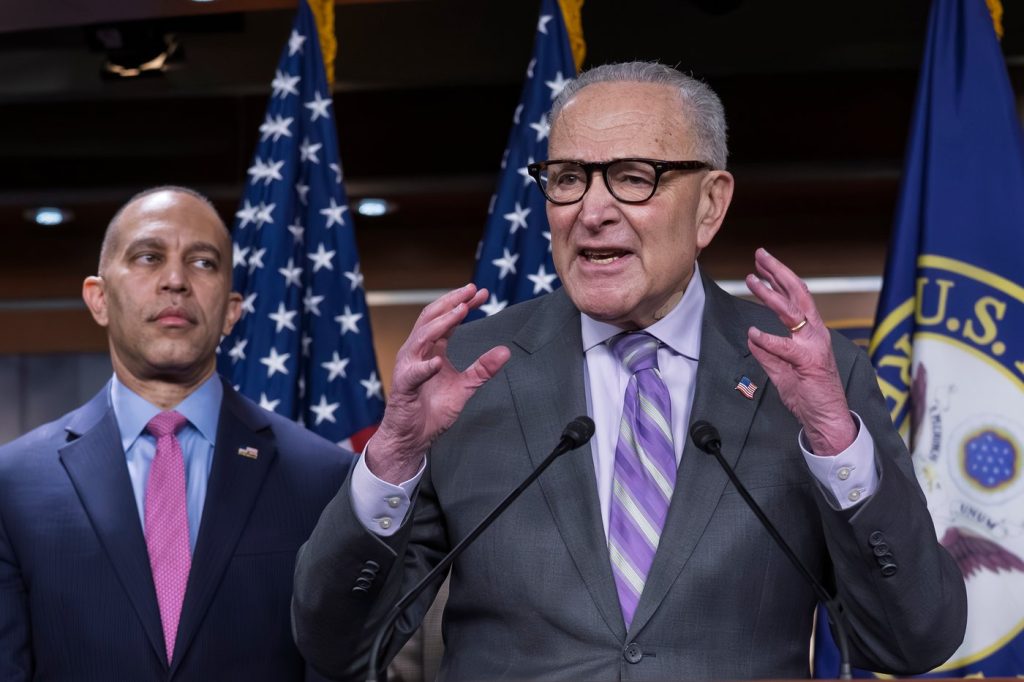
WASHINGTON (AP) – As the expiration date for funding the Department of Homeland Security (DHS) approaches in two weeks, Democratic leaders are threatening to block any renewal unless significant reforms are implemented regarding U.S. Immigration and Customs Enforcement (ICE) and other law enforcement agencies. They specifically point to the controversial federal immigration enforcement operations led by President Donald Trump, particularly in Minnesota.
Following the shooting of two protesters by ICE officers in Minneapolis in January, Congress is engaging in discussions aimed at establishing new guidelines for ICE and U.S. Customs and Border Protection (CBP). Senate Democratic leader Chuck Schumer emphasized the need for Congress to "rein in ICE in very serious ways" and to "end the violence." Schumer and House Democratic leader Hakeem Jeffries asserted their party's stance, indicating they are "drawing a line in the sand," especially since Republicans need Democratic votes to continue funding.
The negotiations emerge amid a growing bipartisan sentiment that Congress should intervene to alleviate the tension stemming from aggressive immigration enforcement activities impacting Minnesota and other states. However, Senate Majority Leader John Thune, R-S.D., remarked that achieving consensus on such nuanced matters in a constrained timeframe may be an "impossibility."
Last week, President Trump acquiesced to a Democratic request to separate DHS funding from a broader spending bill, extending the current funding levels for two more weeks. House Speaker Mike Johnson, R-La., noted that he was present during a conversation at the White House where Trump and Schumer expressed optimism about reaching an agreement.
Uncertainty looms regarding whether Trump and sufficient congressional Republicans will concede to any of the Democrats' extensive demands, which include requiring ICE officers to unmask themselves, obtain judicial warrants in specific situations, and collaborate more effectively with local authorities. Republicans have already expressed resistance to these proposals.
Moreover, House Republicans are pushing for the inclusion of their own priorities in the DHS spending bill. These include requiring proof of citizenship for voter registration and imposing restrictions on so-called sanctuary cities, which they claim inadequately enforce immigration laws. Although the specifics of what constitutes a sanctuary jurisdiction remain ambiguous, it typically refers to state and local governments that limit cooperation with federal immigration authorities.
While Democrats are passionate about addressing what they view as excessive immigration enforcement under Trump’s administration, it remains uncertain if they will compromise on their demands. Schumer reiterated the need for serious negotiations, while he and Jeffries forwarded a list of "common sense solutions" aimed at safeguarding constitutional rights and ensuring accountable law enforcement practices.
A key point of contention is the implementation of body cameras for immigration enforcement officers. Republicans have shown openness to this requirement, with Homeland Security Secretary Kristi Noem declaring on Monday that each DHS officer in Minneapolis, including ICE agents, would receive body-worn cameras, with a plan for expansion nation-wide depending on funding availability. Notably, the proposal already allocates $20 million towards outfitting immigration enforcement agents with these devices.
Conversely, the issue of agents wearing masks has escalated into a significant disagreement. Democrats contend that removing masks will enhance accountability, while Republicans assert it could render agents vulnerable to harassment. Concerns continue to mount over the use of administrative warrants for immigration arrests versus the stricter judicial warrants sought by Democrats, particularly in cases involving home entries.
Furthermore, Democrats advocate for a uniform code of conduct comparable to that of state and local law enforcement agencies for all ICE and federal agents. A severe point of contention arose when federal officials barred state investigators from accessing evidence after the fatal shooting of protester Renee Good by an ICE agent, provoking calls for transparent investigations that include state participation.
Despite the push from Democratic lawmakers, it appears any compromise reached on the DHS funding will likely leave some factions within the party dissatisfied. Statements from progressive representatives, such as Ayanna Pressley of Massachusetts, reaffirm their staunch opposition to any resolution lacking a mandate for unmasking ICE agents. Overall, the complexities of the negotiations and the differing priorities underscore the challenging path ahead in reconciling positions as the funding deadline looms closer.