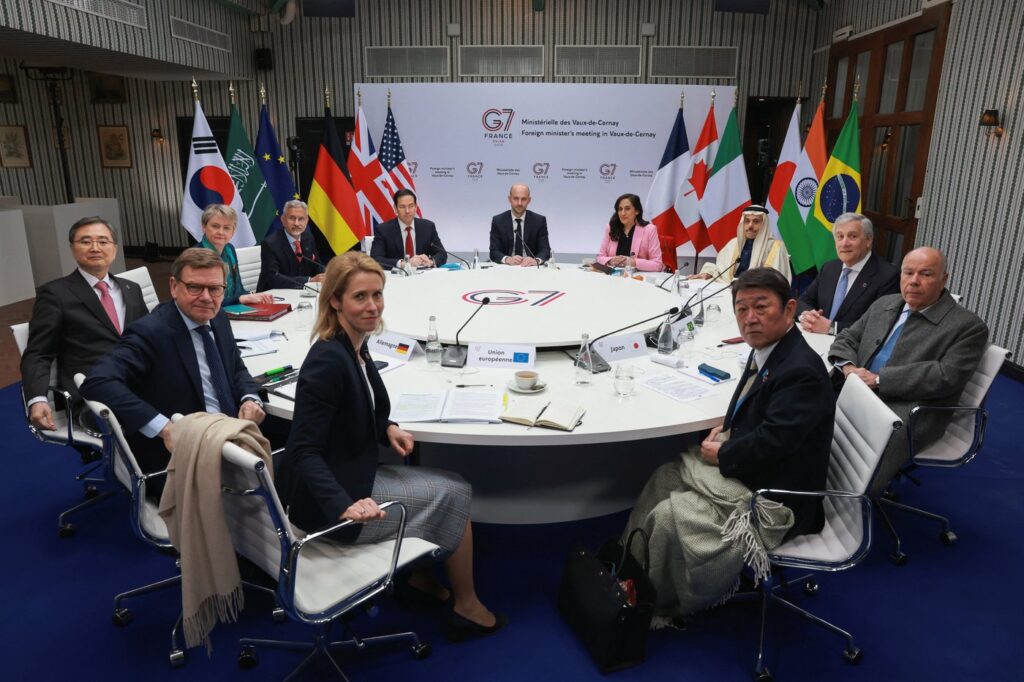
In Vaux-de-Cernay, France, the top diplomats from the Group of Seven (G7) countries exhibited noticeable divisions regarding the ongoing Iran war during their meeting on Friday. Nonetheless, they reached a consensus on the urgent need to call for an immediate halt to attacks targeting civilian populations and infrastructure. U.S. Secretary of State Marco Rubio joined representatives from other G7 nations just one day after President Donald Trump publicly criticized NATO allies, which complicated Rubio's efforts to advocate for U.S. strategies concerning the Iran conflict among its close partners.
Trump has expressed frustration that many of America’s closest allies have shown skepticism toward the Iran war. This skepticism was evident during the G7 meeting, held at a historic 12th-century abbey near Paris. With the war having entered its fourth week—initiated by U.S. and Israeli forces—there exists mounting concern over instability within oil markets and uncertainty about potential negotiations to resolve the escalating crisis. Several European Union countries have openly stated that they were not consulted prior to the commencement of U.S. military operations in Iran.
French Minister of the Armed Forces, Catherine Vautrin, reinforced this sentiment, asserting on Friday that the Iran war is not France's conflict and emphasizing a strictly defensive stance. Vautrin articulated that the path to peace lies only in a diplomatic approach. British Foreign Secretary Yvette Cooper shared similar sentiments, acknowledging the divergence between the United Kingdom's and the United States' positions. She stated that while they support defensive actions, the U.K. has taken a different stance concerning the offensive military actions involved in the current conflict.
German Foreign Minister Johann Wadephul articulated Germany's willingness to assist in securing shipping routes in the Strait of Hormuz post-conflict. He expressed a desire to expand the common ground among the G7 regarding the Middle East conflict. French Foreign Minister Jean-Noel Barrot announced that the G7 had adopted a declaration calling for an “immediate cessation” of attacks on civilians during the Iran war, stating that nothing justifies the deliberate targeting of civilians in armed conflicts. The declaration also underlined the necessity of ensuring free and secure navigation in the Strait of Hormuz.
Barrot pointed out the escalating issue caused by a lack of ship traffic from the Persian Gulf to the global market, emphasizing that a return to normalcy in shipping is vital once U.S. military objectives are met. He supported the notion that escort missions could help ensure that maritime traffic can resume safely. Rubio acknowledged the same viewpoint in discussions with other G7 diplomats, pushing for maritime security and freedom of navigation in international waters.
Moreover, Trump’s ongoing criticism of NATO has added another layer of complexity to the situation. In a Cabinet meeting the preceding Thursday, he expressed disappointment over NATO’s lack of action concerning Iran, emphasizing that they failed to step up to support U.S. efforts. The G7 nations include British, Canadian, French, German, and Italian members of the trans-Atlantic military alliance, while Japan stands out as the sole non-member.
Additionally, the ongoing war in Ukraine was a significant discussion point at the G7 meeting. U.S.-brokered negotiations are still underway, albeit without tangible results, raising concerns among allies that the renewed conflict in the Middle East could divert U.S. attention from its commitment to Ukraine. Wadephul reiterated Germany's commitment not to compromise Ukraine's defense capabilities during the meeting.
Following the discussions, Rubio claimed that Trump was committed to securing a ceasefire and a negotiated settlement with regards to the ongoing Russia-Ukraine war. However, Rubio faces challenges in reconciling relations with European allies, who have previously endured criticism from the Trump administration.
French skepticism towards the Iran war was underscored by various comments from officials, including criticism of the U.S. for failing to alert allies about the initiation of military operations in the region. Despite these tensions, 35 nations participated in military discussions organized by France to strategize on reopening the Strait of Hormuz once hostilities decrease. Following the outbreak of the conflict, France has bolstered its military presence in the Middle East, deploying an aircraft carrier and other warships to the region.