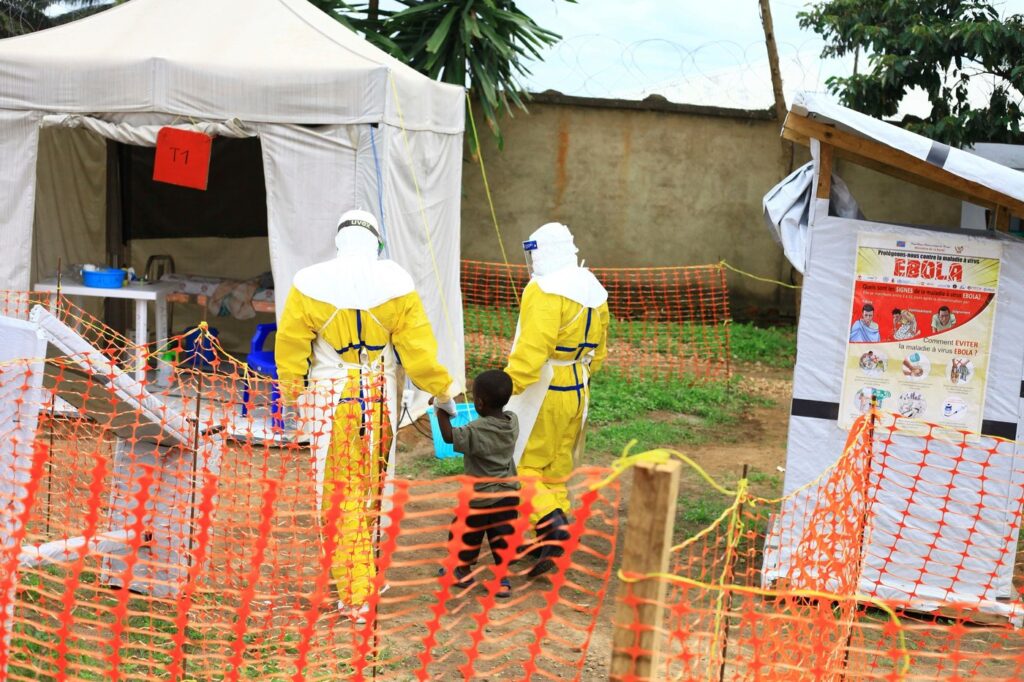
KINSHASA, Congo (AP) — Africa's leading public health agency confirmed a new Ebola outbreak in the remote Ituri province of Congo on Friday. Currently, there are 246 suspected cases and 65 deaths attributed to the outbreak, as reported by the Africa Centres for Disease Control and Prevention.
In neighboring Uganda, health officials confirmed one death from an Ebola case that was imported from Congo. The deaths and suspected cases are primarily concentrated in the Mongwalu and Rwampara health zones. While the agency states that 65 deaths are linked to the outbreak, only four have been confirmed through laboratory testing.
Ebola, highly contagious and often fatal, can be transmitted through bodily fluids such as vomit, blood, and semen. Scientists are working to ascertain the specific strain responsible for the current outbreak, as initial results indicate a variant other than the Ebola Zaire strain, which has been prominent in Congo's previous outbreaks. The World Health Organization identifies three virus groups that cause major outbreaks: the Ebola virus, Sudan virus, and Bundibugyo virus.
On Friday, Uganda reported an Ebola case involving a Congolese man who was admitted to a hospital in Kampala three days before his death. The Uganda Health Ministry indicated that the case was imported from Congo and confirmed that there are no local infections yet. The deceased individual was tested after death, revealing an infection with the Bundibugyo virus, which is endemic to Uganda. All contacts linked to the man have been quarantined, and his body has been returned to Congo.
The WHO indicated that Congo possesses a stockpile of treatments and around 2,000 doses of the Ervebo Ebola vaccine. However, this vaccine is effective only against the Ebola Zaire strain, not against the Sudan or Bundibugyo viruses, as per health authorities.
Dr. Tedros Adhanom Ghebreyesus, director-general of the World Health Organization, announced that a team was dispatched to assist Congo in investigating the outbreak and collecting samples. Although initial tests did not confirm the presence of Ebola, further analysis conducted a day prior did confirm it. He expressed confidence in Congo’s robust history of responding to Ebola outbreaks, announcing a release of $500,000 to support Congo’s efforts.
The outbreak arises approximately five months after Congo's last Ebola outbreak, which left 43 dead, was declared over. Ituri province is located in eastern Congo, a region characterized by difficult road conditions, over 1,000 kilometers (620 miles) from the capital, Kinshasa.
The Africa CDC voiced concerns about the potential for the outbreak to spread further due to the high levels of population movement, mobility related to mining in Mongwalu, insecurity in affected areas, and gaps in contact tracing and control measures. Its proximity to Uganda and South Sudan compounds these worries.
An urgent coordination meeting was convened on Friday involving health officials from Congo, Uganda, and South Sudan, alongside UN agencies and other nations. Jay Bhattacharya, the acting head of the U.S. Centers for Disease Control and Prevention, also stated that U.S. health officials are in communication with their counterparts in Congo and Uganda, pledging to provide the necessary support and resources.
This latest incident marks the 17th Ebola outbreak in Congo since the disease emerged in the country in 1976. Notably, a previous outbreak from 2018 to 2020 claimed over 1,000 lives, characterized by the dominant Ebola Zaire strain. An earlier outbreak that affected West Africa from 2014 to 2016 resulted in more than 11,000 fatalities.
The new outbreak adds to the ongoing challenges faced by Congo, a country that has been grappling with various armed groups in its eastern regions. As the continent's second-largest nation by land area, logistical difficulties also hinder effective outbreak response. During the previous year’s outbreak, the WHO encountered considerable obstacles in vaccine delivery due to access limitations.
According to Dr. Gabriel Nsakala, a professor of public health involved in earlier Ebola responses, the experience and infrastructure available to health workers in Congo could aid in managing this outbreak effectively. He emphasized the importance of rapidly delivering expertise and equipment to those on the ground.