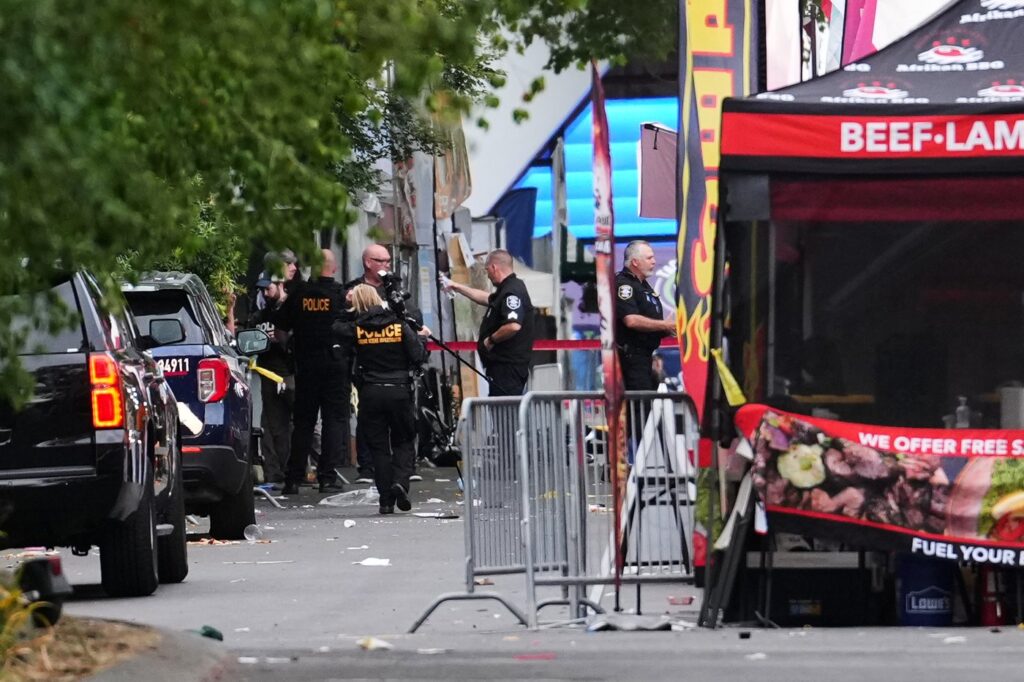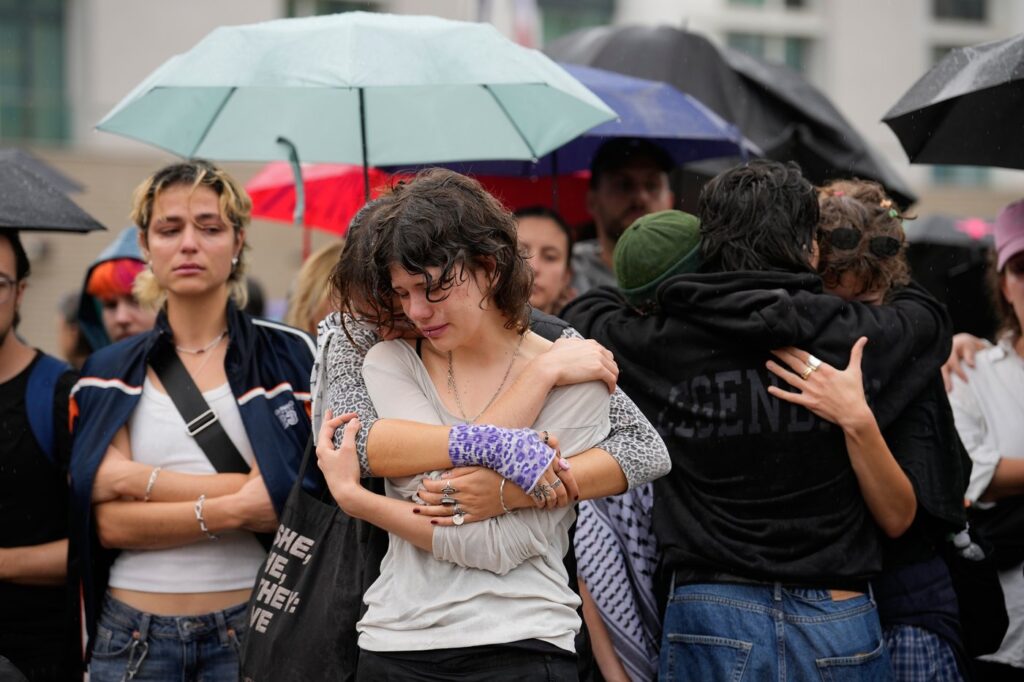
BERLIN (AP) – Berliners expressed their grief on Monday following a tragic attack that unfolded near the city's Pride festival. The attack led to the death of one woman and left 29 others injured, raising significant concerns over how the suspect, Abdul Ballout, a 21-year-old German national with ties to the Islamic State (IS), was able to roam freely despite his criminal background.
Ballout was killed after a 24-hour search that began after the van attack on Saturday night, during which he allegedly targeted a crowd with a van before resorting to a machete. The attack has been classified by authorities as an extremist terror incident, prompting questions about public safety and the handling of known offenders.
According to reports, the victim was a Polish citizen who was visiting Berlin with her daughter. Following the incident, Chancellor Friedrich Merz demanded to know how such an event could have been prevented, highlighting that Ballout had previously sought to align himself with IS.
Details concerning Ballout's past reveal a troubling record. Born in Germany to Lebanese parents, he attempted to travel to Syria in 2025 to join IS and was arrested in Lebanon, where he received a three-month military court sentence for inciting religious conflict. Upon his return to Germany, he faced additional legal troubles. In May of this year, a juvenile court convicted him of preparing a serious act of violence and disseminating Islamic State propaganda on social media. He was sentenced to a year and 10 months in a youth custody facility.
Officials have since clarified that while Ballout was released, it was due to the completion of pretrial detention and his not being deemed a flight risk. This decision has come under scrutiny, with several German officials questioning the effectiveness of the juvenile justice system and calling for reform after the attack.
Berlin's Interior Minister Alexander Dobrindt stated, "You can assume that it certainly would have made sense to put this person in custody," expressing disbelief that someone with Ballout's record was allowed to remain at large. Berlin Mayor Kai Wegner expressed a similar sentiment, noting a lack of understanding regarding the court's decision in this specific situation.
As part of his sentence, Ballout was required to attend a deradicalization program for high-risk offenders. However, experts evaluating him concluded that he was not a suitable participant since he attempted to present himself as a non-extremist, thereby hindering any productive deradicalization process. According to Cornelia Lotthammer, director of public relations for the Violence Prevention Network, "They could see that he is a problem… But still, if he does not work together with our colleagues, then we can’t do anything." She noted that law enforcement would have been alerted had there been any signs of planning an attack.
The attack comes at a politically sensitive time, with major elections scheduled in three German states, including Berlin, in September. There are concerns that the tragedy could fuel anti-migrant sentiment and bolster far-right parties like the Alternative for Germany (AfD), which has criticized the government over immigration policies. AfD's local leader in Berlin, Kristin Brinker, questioned how an individual with clear connections to IS was permitted to remain free, calling for accountability within the city government.
The devastating ramifications of this incident continue to resonate as officials and community members seek answers and reflect on the processes that allowed such a tragedy to occur.