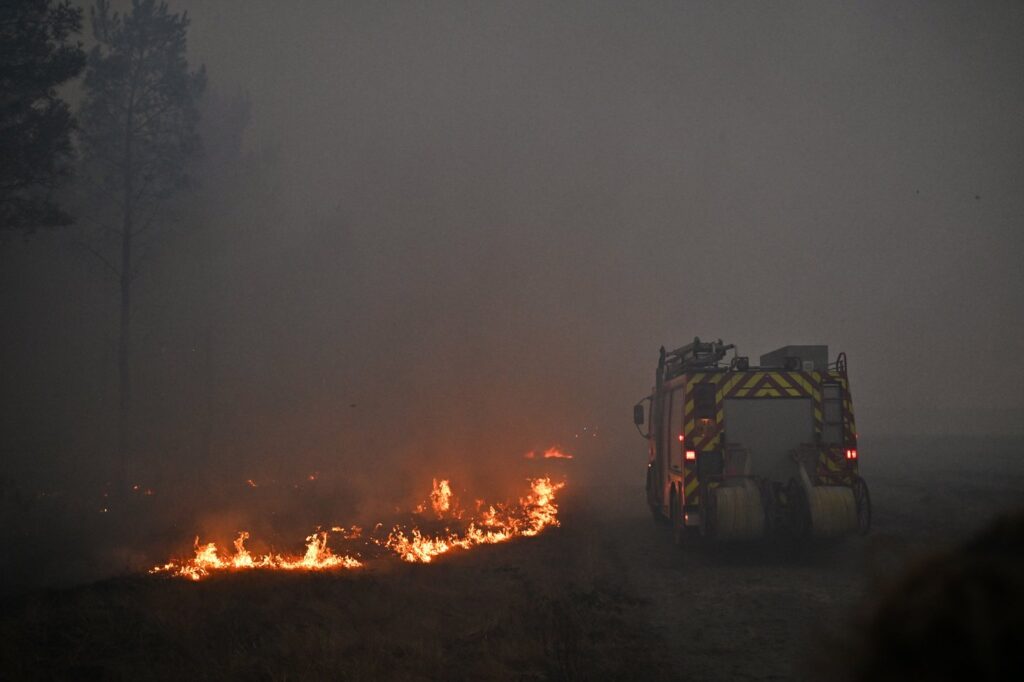
In Leyde-Cap Ferret, France, President Emmanuel Macron expressed solidarity and encouragement to fire crews battling a massive wildfire, as he acknowledged the challenges ahead. During a visit to a coordination center for firefighting efforts in southwest France, Macron described the blaze, which has persisted since last week, as highly unpredictable. It transformed into a self-feeding firestorm, destroying an area four times the size of Paris and displacing 220,000 residents.
Macron labeled the current situation as France's worst fire crisis since World War II, commending the bravery of firefighting teams who managed to slow the fire’s progression near Bordeaux. However, officials warned that the battle is far from over, with numerous woodlands still smoldering and a forecasted heat wave threatening to exacerbate conditions.
Forecasts predict temperatures could soar to 35°C (95°F) and above starting Tuesday, putting immense pressure on thousands of firefighters and aerial support teams engaged in the ongoing fight against the flames. Authorities are also emphasizing the need for relief efforts for evacuees, particularly for the staggering number of 250,000 people displaced across the southwest due to two separate fires.
Macron addressed the trauma faced by those who have lost everything in the fires, as he stressed the weeks ahead would be difficult and called for perseverance. With the arrival of the peak tourist season in August, the Gironde region around Bordeaux has implemented measures to deter visitors, including a ban on holiday camps for children and individuals with disabilities, along with multiple advisories against travel to the fire-affected areas.
Firefighting crews have been actively creating defensible space by clearing strips of forest and scrubland to halt the flames, which at one point came within 15 kilometers (10 miles) of Bordeaux. Efforts are also being supported by farmers, who have been supplying water to fire crews. The fire chief for the Gironde region informed Macron that the blaze posed unique challenges, often shifting unexpectedly and creating electrical storms that resulted in additional flare-ups.
Meanwhile, Spain is also grappling with unprecedented wildfires, with over 330,000 people forced to flee from blazes in both France and Spain. Wildfires in Spain have particularly gained intensity around Madrid and in the Valencia region, where authorities have evacuated 79,000 individuals while another 30,000 remain confined to their homes.
Calls for stronger action against climate change are becoming more pronounced, with both the French and Spanish governments linking the exceptional nature of the current wildfires to the climate emergency. Spanish Prime Minister Pedro Sánchez stated that the ongoing phenomenon is not isolated but rather a direct result of climate change, which has intensified fire activity and heat waves.
A specific fire near Ávila, west of Madrid, has now become Spain’s largest wildfire on record, covering an area of 500 square kilometers (193 square miles), which is five times the size of Barcelona. Many residents, like David Gonzalez, a gardener, expressed feelings of anger and helplessness as they witness the destruction of their communities.
So far this year, wildfires in Spain have scorched 1,530 square kilometers (590 square miles) — six times the area affected by fires in the first half of 2022. With forecasts of yet another heat wave set to hit Spain, potentially raising temperatures above 40°C (104°F), the fire danger remains alarmingly high.
Additionally, Italy is facing similar challenges, with a recent wildfire breaking out in the Puglia region, particularly near Peschici. The blaze prompted evacuations of about 300 tourists from beaches and campgrounds, as authorities deployed water-dropping planes and ground crews to combat the spreading fire, reminiscent of the devastating wildfires that struck the same area in 2007.