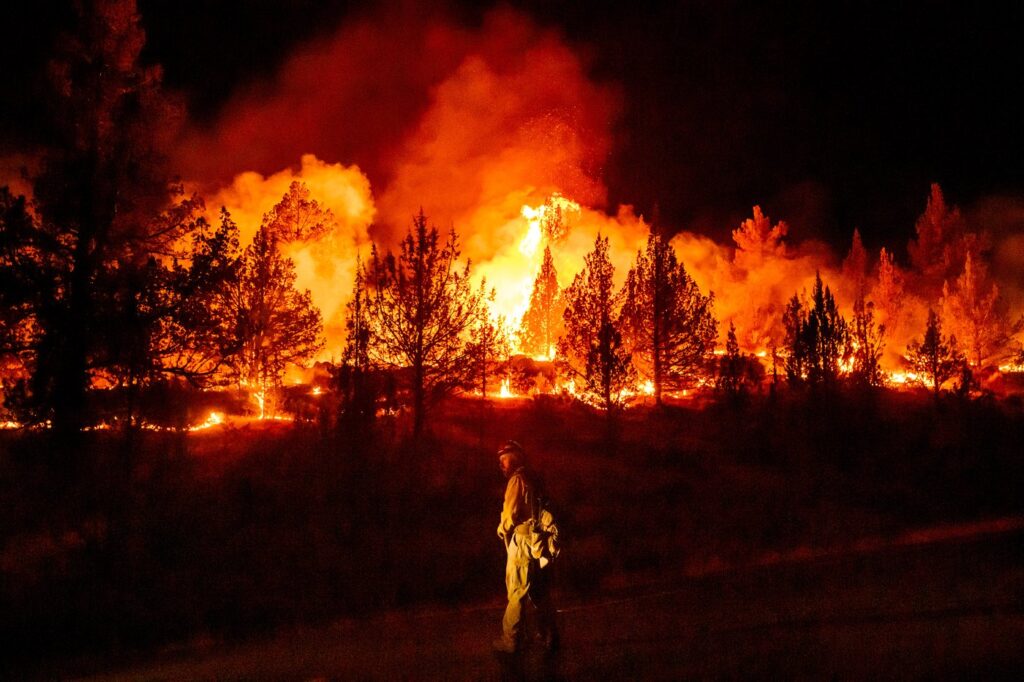
This summer, the world has been experiencing a surge in wildfires, particularly in Europe and North America, where incidents have become increasingly extreme. However, despite these alarming events, crucial global statistics indicate a record low in burning emissions, primarily attributed to improved fire management practices in Africa and Asia.
Mike Flannigan, a fire scientist at Thompson Rivers University in Canada, highlighted the paradoxical nature of these observations, stating that while extreme fires are becoming more frequent, global burning numbers continue to decline. Spain is experiencing its largest wildfire on record, which has consumed over 193 square miles (500 square kilometers). In fact, wildfires in Europe have ignited just under the all-time high recorded in 2025. Both Canada and the United States reported at least a 25% increase in the land burned by wildfires this summer compared to the 10-year average, with the area affected more than doubling since decades past.
Jennifer Balch, a fire scientist at the University of Colorado, warned that extreme wildfires are on the rise worldwide, particularly concerning for regions like the U.S., Canada, and Europe. Data from the European climate center, Copernicus, revealed that global emissions from burning fires have hit record lows, significantly influenced by decreased fire activity in Africa and Asia. Mark Parrington, a senior scientist at Copernicus, noted that this year’s carbon emissions from burning are the lowest recorded since satellite measurements began nearly 25 years ago—roughly half of what they were in the early 2000s.
Park Williams, a water and fire scientist at UCLA, explained that Africa dominates global fire activity. Over the last 25 years, fire activity in sub-Saharan Africa has decreased considerably. The statistics indicate that over three-quarters of global emissions from burning plant material originate from Africa and Asia, while North America and Europe contribute less than one-eighth. This decline in fire activity is largely due to shifts in agricultural practices and land use, as urbanization and farming continue to expand in these regions.
In contrast, the rise of extreme fires in North America and Europe can be closely linked to climate change. John Abatzaglou, a fire scientist at the University of California Merced, emphasized that climate change caused by fossil fuel consumption has increased temperatures and reduced moisture, creating ideal conditions for wildfires. The hotter atmosphere exacerbates fire conditions, and with climate change extending the burning season, regions previously resistant to fire are now facing heightened risks.
Furthermore, Abatzaglou pointed out that while North America has historically managed fire suppression effectively, increasing intensity and frequency due to climate change is diminishing that capability. As the conditions for wildfires become more favorable, the impact is exacerbated by the proximity of these fires to densely populated areas, leading to the destruction of valuable property.
Looking ahead, fire activity is expected to intensify due to the emergence of a strong El Niño weather pattern, which typically results in more dangerous fires in the tropics. While it generally brings more rainfall—which could help curb forest fires in the U.S. West—the increased moisture can lead to heightened grass growth in deserts, ultimately resulting in grass fires. This pattern has been observed in devastating gras fires in places like Los Angeles and Hawaii.
As scientists assess the potential impact of El Niño, it becomes clear that regions in North America and Europe must enhance their fire management strategies. Experts advocate for better planning and adaptation methods, including prescribed burns to manage excess vegetation, as wildfires become an inevitable part of the landscape. The prevailing question remains not if these landscapes will burn, but rather when.