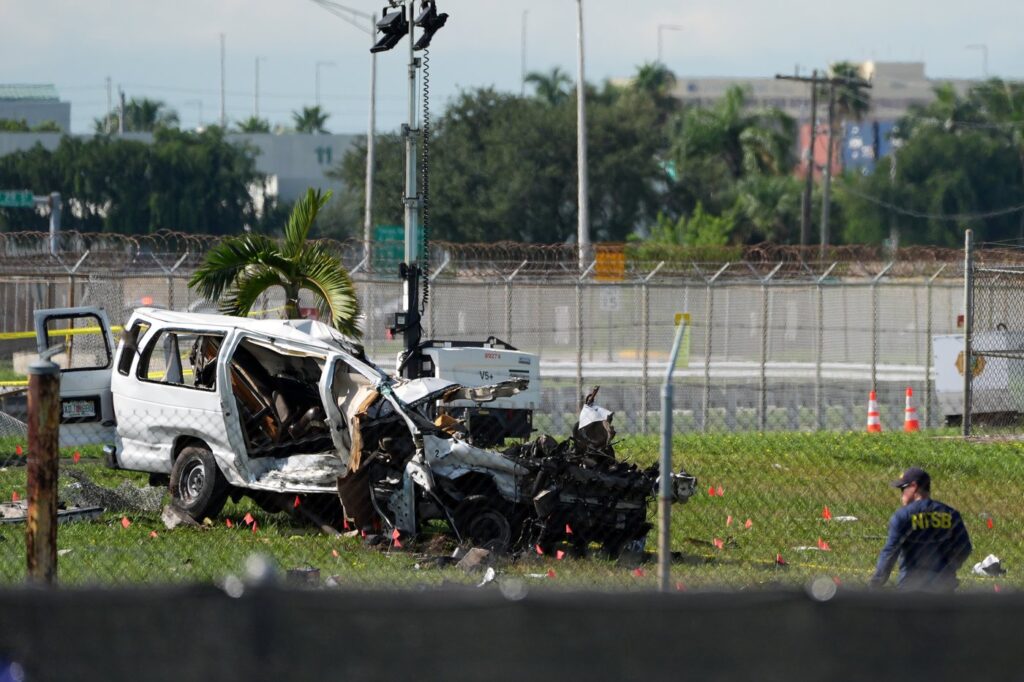
MIAMI (AP) — Flight data has indicated that an Amazon cargo plane attempted to abort an unstable landing at Miami International Airport before tragically colliding with a van, resulting in the deaths of five individuals inside, as revealed by investigators on Tuesday.
National Transportation Safety Board (NTSB) officials announced they would be interviewing the pilot and co-pilot on Wednesday to understand the circumstances surrounding the jet's decision to overrun the runway on Sunday. NTSB Chairwoman Jennifer Homendy stated during a news conference that they are meticulously reviewing flight data and cockpit recordings to analyze what transpired in the moments leading up to the aircraft crashing into the van on airport premises, subsequently careening through a fence and colliding with an SUV on a city street.
Homendy emphasized the importance of interviewing the pilots prior to making any conclusions regarding the cockpit voice recorder. The preliminary data suggested that the thrust reversers, typically employed to aid in stopping the plane upon landing, were not utilized. All five victims were reportedly in a van employed to transport crews responsible for cleaning aircraft.
As a result of the incident, which occurred after the Amazon jet was returning from a two-hour flight originating in Puerto Rico amidst inclement weather conditions, five other individuals sustained injuries. The pilot and co-pilot have since been released from the hospital, while two individuals remain in critical condition, and a third is listed as stable.
The crash site displayed the severely damaged van, whose front end was completely crushed, alongside an SUV that had been so extensively wrecked that it was nearly unidentifiable. The cargo jet came to rest nose-down, marked by a significant soot stain near the word “Prime Air.”
According to former FAA official Mike O'Donnell, the manner in which the plane landed on its nose and right landing gear indicates an unstable landing, possibly signaling that the pilot was attempting a go-around maneuver. O'Donnell remarked that the decision to abort the landing should have come sooner, suggesting pilot hesitation may have played a critical role in the crash. By the time the crew attempted to execute a go-around, it could have been too late due to insufficient runway length remaining for safe landing.
Aviation attorney Mary Schiavo, who previously served as the Transportation Department’s Inspector General, speculated that a disagreement between the pilots regarding the correct response may have contributed to the situation. Furthermore, adverse weather conditions, including a strong tailwind, likely exacerbated the circumstances, leading to the plane landing far beyond its intended target. Investigators are keen to ascertain what information was relayed to the pilots concerning weather conditions and how air traffic controllers managed the approach to the runway.
In response to the incident, Amazon released a statement expressing their cooperation with investigators, extending condolences to the victims' families. The deceased individuals were confirmed to be Rolando Aleman Leon, 55; Yoel Rodriguez Naranjo, 53; Julio C. Pineda, 75; Carlos Acosta Fajardo, 53; and Javierkys Reyes Quevedo, 47. The cleaning service van was owned by Professional Ocean Service Corp., a company that provides aircraft cleaning services.
Homendy highlighted the safety implications this crash poses, especially for airport workers, noting the tragedy of people losing their lives while performing their jobs. She pointed out that Miami Airport currently lacks specialized systems for halting runaway aircraft, which could have been a contributing factor in this incident. However, experts have indicated that Miami's airport complies with FAA standards by maintaining a cleared buffer zone of at least 1,000 feet beyond the runway's end. Unlike over 120 other U.S. airports, Miami does not utilize crushable materials that the FAA asserts have saved numerous lives in similar scenarios.
As the investigation continues, the NTSB aims to provide a comprehensive report that will detail the causes of the crash and offer recommendations to prevent future occurrences, although such a report may take more than a year to complete. The Boeing 767 involved, a cargo plane operated by 21 Air based in North Carolina, has a long history as it was initially built for passenger service, operating for various airlines globally before its conversion in 2015.
Following the incident, Miami airport was able to resume operations on a third runway after the NTSB released it from investigative duties, which previously resulted in the cancellation of over 225 flights and numerous delays. Investigators are still documenting evidence at the crash site as they work to uncover more details regarding this tragic event.